
Does She Like Me LGBT Quiz
How the Scales are Structured
Who Usually Takes This Test?
See How You Compare
Below is a preview of how scores are typically distributed across each scale.
Example Questions From the Test
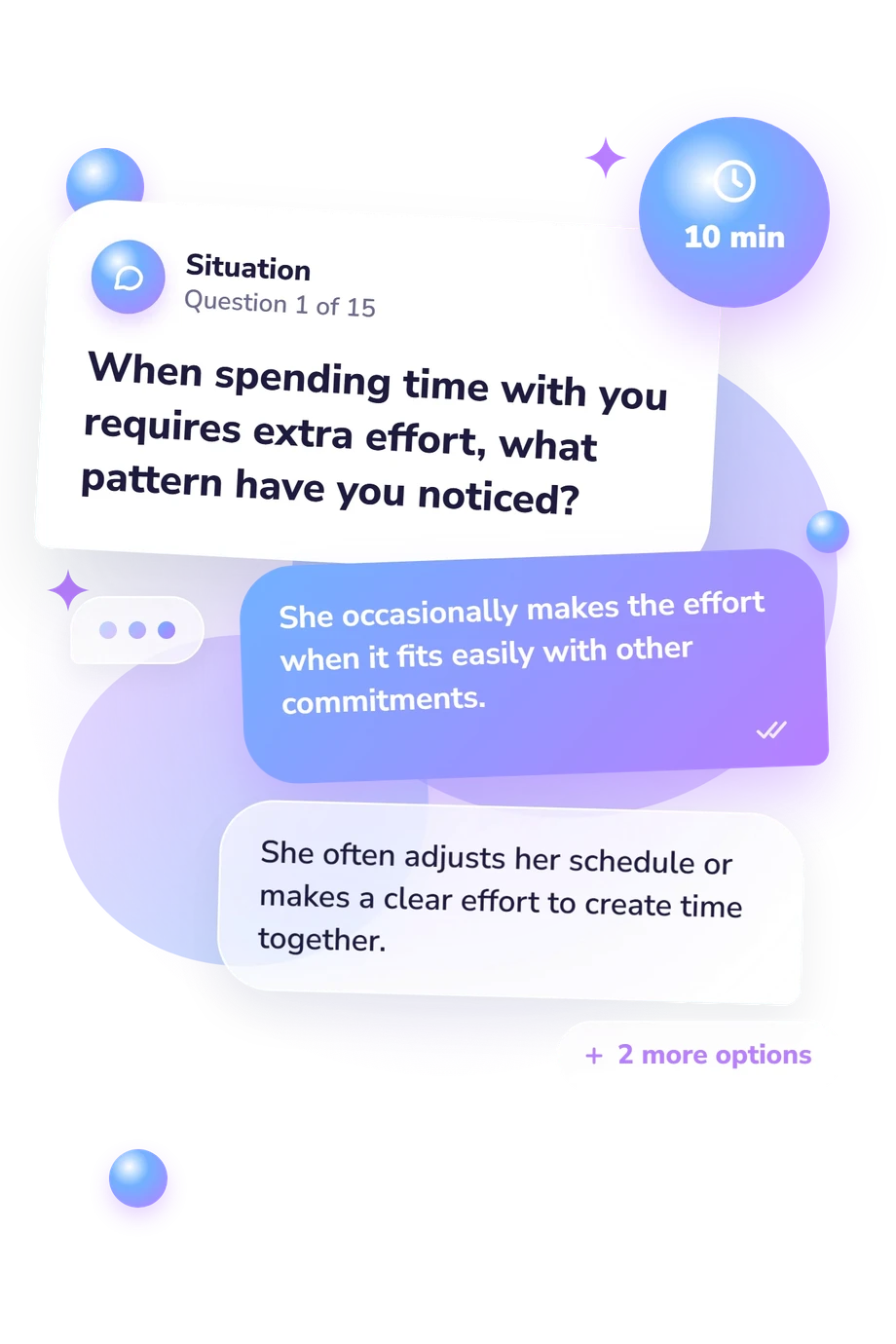
- She occasionally makes the effort when it fits easily with other commitments.
- She often adjusts her schedule or makes a clear effort to create time together.
- She consistently prioritizes time together and proposes workable alternatives when busy.
- Time together usually happens only when convenience or an existing obligation brings you together.
- A shared task, group situation, or ordinary friendship topic.
- Whether I might enjoy getting to know her better.
- Moments of chemistry and the possibility that I am attracted to her.
- A strong wish for romantic closeness or a date with her.
- I would prefer to keep the relationship non-romantic.
- I would feel uncertain, but curious enough to think about it.
- I would feel excited and would probably want to say yes.
- I would strongly want to accept and would feel relieved that the interest might be mutual.
Does She Like Me LGBT Quiz - Description and methodology of the test
For LGBTQ+ readers understanding whether a connection is mutual, this questionnaire organizes perceptions of her behavior alongside your feelings. The Does She Like Me LGBT Quiz helps organize the question Does She Like Me Quiz LGBT?, interpreting ambiguous cues and attraction without establishing her feelings or orientation. It suits readers exploring a does she like me lesbian quiz about whether a girl is interested, while keeping consent in view.
What This Assessment Explores
It examines perceptions of her behavior and feelings. Items cover effort, contact, proximity, teasing, compliments, dating talk, closeness, and next steps. It interprets a connection, not identity.
Its profile links perceived behavior with what you want if interest is mutual. The result describes your openness, not her orientation or feelings, when a does my crush like me quiz lgbt is involved.
The dimensions are:
- Flirtation and Personal Closeness (0-15) summarizes personal or flirtatious cues: Mostly ambiguous cues (0-5), Some personal cues (6-10), or Strong personal-cue pattern (11-15).
- Initiative and Investment (0-15) reflects her consistency in initiating contact, making time, and following through: Limited initiative (0-5), Mixed investment (6-10), or Consistent initiative (11-15).
- Your Attraction and Openness (0-15) reflects current attraction and willingness to explore it, not identity: Little current pull (0-5), Exploring interest (6-10), or Clear current attraction (11-15).
Methodology and Evidence Base
Each item presents a situation or reaction with four descriptions. The options do not follow one order; depending on the question, they describe different kinds or levels of experience. This self-report method combines perceptions of her conduct with items about your attraction and preferred next step.
Results are reported across three dimensions and displayed bands. They organize the pattern described by your answers but do not establish mutual attraction. Reading several situations together is more useful than treating one cue as decisive, especially when an LGBT crush quiz is involved.
The content is conceptually consistent with Muehlenhard’s dating-interest cue studies. Hall’s work on flirting, Wade and Feldman’s work on context, and Riggio’s research on self-reported attraction provide related conceptual context, not validation of this questionnaire. This online self-report tool has no stated norms or validation data and is not a standardized adaptation of those instruments.
Interpret the result as structured reflection: hopes, anxiety, cultural expectations, incomplete information, and limited self-awareness can shape responses. Direct communication is needed to learn her feelings, and any next step should respect consent, privacy, and a genuine no.
- Muehlenhard, C. L., Koralewski, M. A., Andrews, S. L., & Burdick, C. A. (1986). Verbal and nonverbal cues that convey interest in dating: Two studies. Behavior Therapy, 17(4), 404-419. 10.1016/S0005-7894(86)80071-5
- Hall, Jeffrey A., Xing, Chong, & Brooks, Seth. (2015). Accurately Detecting Flirting: Error Management Theory, the Traditional Sexual Script, and Flirting Base Rate. Communication Research, 42(7), 939-958. 10.1177/0093650214534972
- Wade, T. Joel, & Feldman, Andrea. (2016). Sex and the Perceived Effectiveness of Flirtation Techniques. Human Ethology Bulletin, 31(2), 30-44. 10.22330/heb/312/030-044
- Riggio, H. R., Lui, P. P., Garcia, A. L., Matthies, B. K., Culbert, G., & Bailey, J. (2015). Initial validation of a self-report measure of perceptions of interpersonal attraction. Personality and Individual Differences, 74, 292-296. 10.1016/j.paid.2014.10.030
Updated: