
Do I Like Her Quiz
How the Scales are Structured
Who Usually Takes This Test?
See How You Compare
Below is a preview of how scores are typically distributed across each scale.
Example Questions From the Test
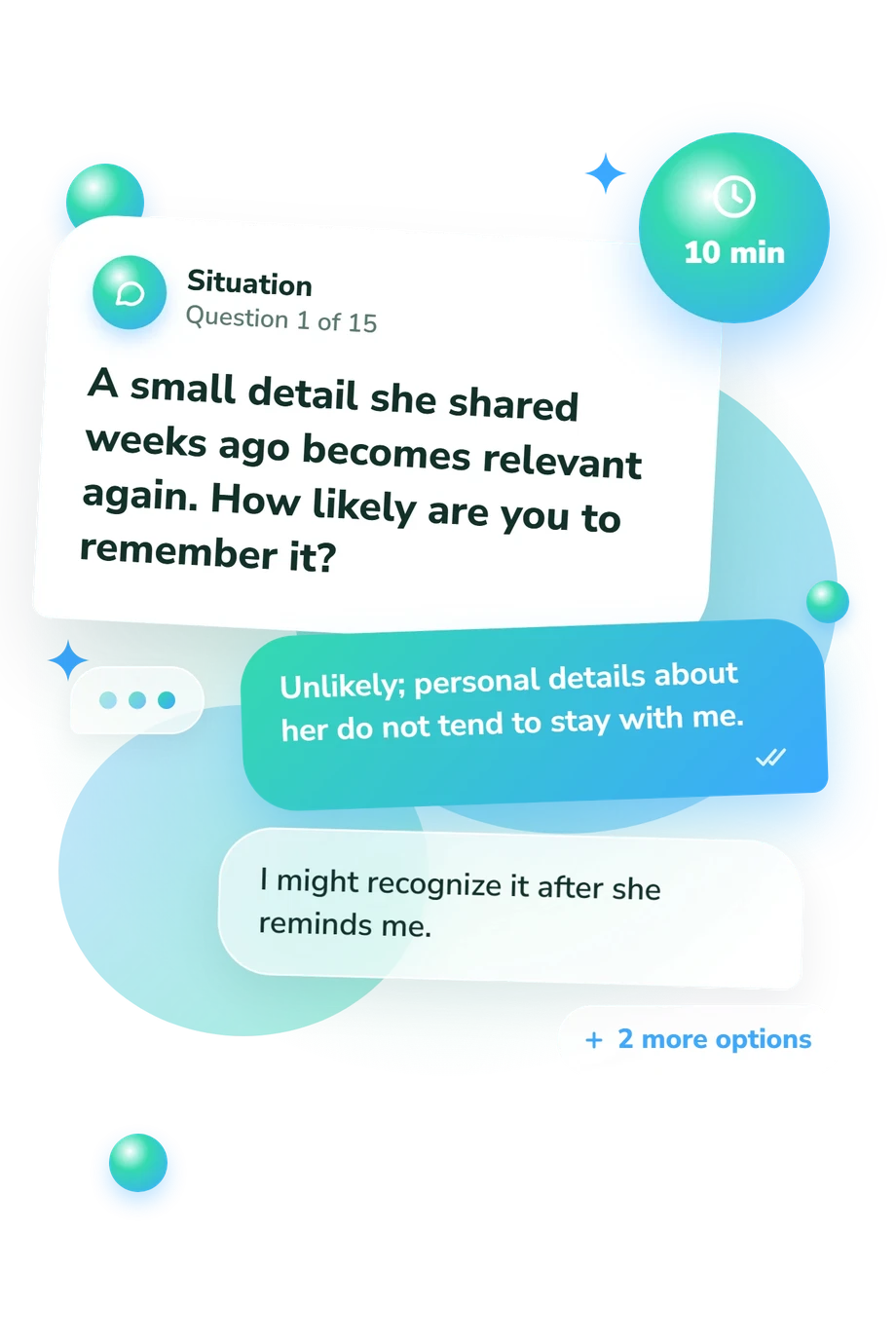
- Unlikely; personal details about her do not tend to stay with me.
- I might recognize it after she reminds me.
- I often remember meaningful details she has shared.
- I naturally retain many details because what matters to her holds my attention.
- I would want to clarify that I see the connection as platonic.
- I would need time because I am not sure I want the relationship to change.
- I would be open to a date and curious about how it might feel.
- I would feel excited and want to explore a romantic relationship with her.
- I would naturally prefer the usual amount of personal space.
- I would be comfortable, but closeness would not feel especially meaningful.
- I would enjoy the closeness and feel more aware of her.
- I would feel noticeably drawn to her and hope the closeness continued.
Do I Like Her Quiz - Description and methodology of the test
People unsure whether their attention is friendly, attracted, or oriented toward romance can use the Do I Like Her Quiz to organize those reactions. It suits a reader who wants clarity from a do i actually like her quiz when curiosity, attraction, and intention do not point in the same direction. The result shows which signals are stronger now without forcing a yes-or-no verdict.
What This Assessment Explores
Questions focus on attention to her experiences, reactions to her presence, and willingness to create one-to-one contact. They cover remembering details, responding to vulnerability, anticipating shared time, and imagining the connection developing. For a do i really like her quiz question, the profile shows whether interest, intention, and attraction align or diverge.
The three displayed dimensions and bands are:
- Person-Centered Interest (0-15) shows attention to her individuality: Limited personal focus (0-5), Growing curiosity (6-10), or Strong personal interest (11-15).
- Relationship Intention (0-15) shows willingness to make time and explore romance, not mutuality or compatibility: Little wish to pursue (0-5), Open but undecided (6-10), or Clear desire to explore (11-15).
- Romantic Pull (0-15) reflects current attraction and anticipation, not proof of love or compatibility: Mostly neutral (0-5), Emerging pull (6-10), or Strong pull (11-15).
Methodology and Scientific Basis
Each item presents a familiar interpersonal situation with four ordered response choices, moving from less personal involvement toward stronger interest, intention, or attraction. Results are reported on three separate scale scores, so a do you like her quiz result can show strength in one area alongside uncertainty in another.
Instead of answering only whether you like her, the profile separates personal interest, relationship intention, and romantic pull. The situations cover remembering her details, making time together, noticing attraction, and imagining whether to explore dating.
Conceptually, its attraction-related content overlaps with the Passionate Love Scale (Hatfield & Sprecher, 1986) and Rubin’s distinction between romantic love and liking. These are conceptual parallels, not evidence that this questionnaire’s three scores are validated or that it adapts either instrument. Eastwick and colleagues’ 2023 work supports treating present reactions as poor predictions of future interest.
Because it is an online self-report questionnaire, the profile reflects current context and self-awareness; use it to describe present reactions, not to infer love, compatibility, mutual interest, or what will happen next.
- Hatfield, Elaine, and Susan Sprecher. 1986. Measuring passionate love in intimate relationships. Journal of Adolescence, 9(4), 383-410. 10.1016/S0140-1971(86)80043-4
- Rubin, Zick. 1970. Measurement of romantic love. Journal of Personality and Social Psychology, 16(2), 265-273. 10.1037/h0029841
- Eastwick, Paul W., Samantha Joel, Kathleen L. Carswell, Daniel C. Molden, Eli J. Finkel, and Shelley A. Blozis. 2023. Predicting romantic interest during early relationship development: A preregistered investigation using machine learning. European Journal of Personality, 37(3), 276-312. 10.1177/08902070221085877
Updated: