
Do I Have Hyperemesis Gravidarum Quiz
How the Scales are Structured
Who Usually Takes This Test?
See How You Compare
Below is a preview of how scores are typically distributed across each scale.
Example Questions From the Test
- My usual meals or a reasonably varied amount
- Smaller meals or bland foods, but enough to eat several times
- Only a few bites or a very limited selection
- Virtually no food, with repeated vomiting whenever I try to eat
- I can drink normally
- I need to drink slowly, but the fluid generally stays down
- I can manage only tiny sips and sometimes vomit them
- I repeatedly vomit the first sips and cannot restart hydration
- I have not vomited
- Once or twice
- Three to five times
- Six or more times, or so often that I stopped counting
Do I Have Hyperemesis Gravidarum Quiz - Description and methodology of the test
Pregnant people who are worried that nausea and vomiting may be becoming unsafe can use the Do I Have Hyperemesis Gravidarum Quiz to organize current symptoms and decide how promptly to contact prenatal care. It is relevant when eating, drinking, urination, alertness, mobility, medicines, or basic self-care have changed. Hyperemesis gravidarum symptoms are considered through their effects on daily function as well as through vomiting itself.
What This Assessment Explores
Items examine intake, urination, weight, thirst, vomiting, alertness, mobility, pain, fever, medicines, and self-care. These domains cover functional disruption, hydration, and vomiting. This hyperemesis gravidarum quiz organizes situations into domains to give results more context.
These displayed scales cover the following domains:
- Complications and Functional Disruption (0-15) covers altered alertness, breathing difficulty, pain, fever, unsafe mobility, or inability to manage basic needs; bands are No indicator endorsed (0), Indicator present (1-2), and Prompt assessment advised (3-15).
- Hydration and Nutrition Indicators (0-15) reflects food, fluids, urine, thirst, weakness, and weight concerns; bands are No indicator endorsed (0-0), Indicator present (1-2), and Prompt assessment advised (3-15).
- Vomiting and Fluid Tolerance (0-15) reflects vomiting and keeping drinks down; bands are No indicator endorsed (0-0), Indicator present (1-2), and Prompt assessment advised (3-15).
Methodology and Scientific Basis
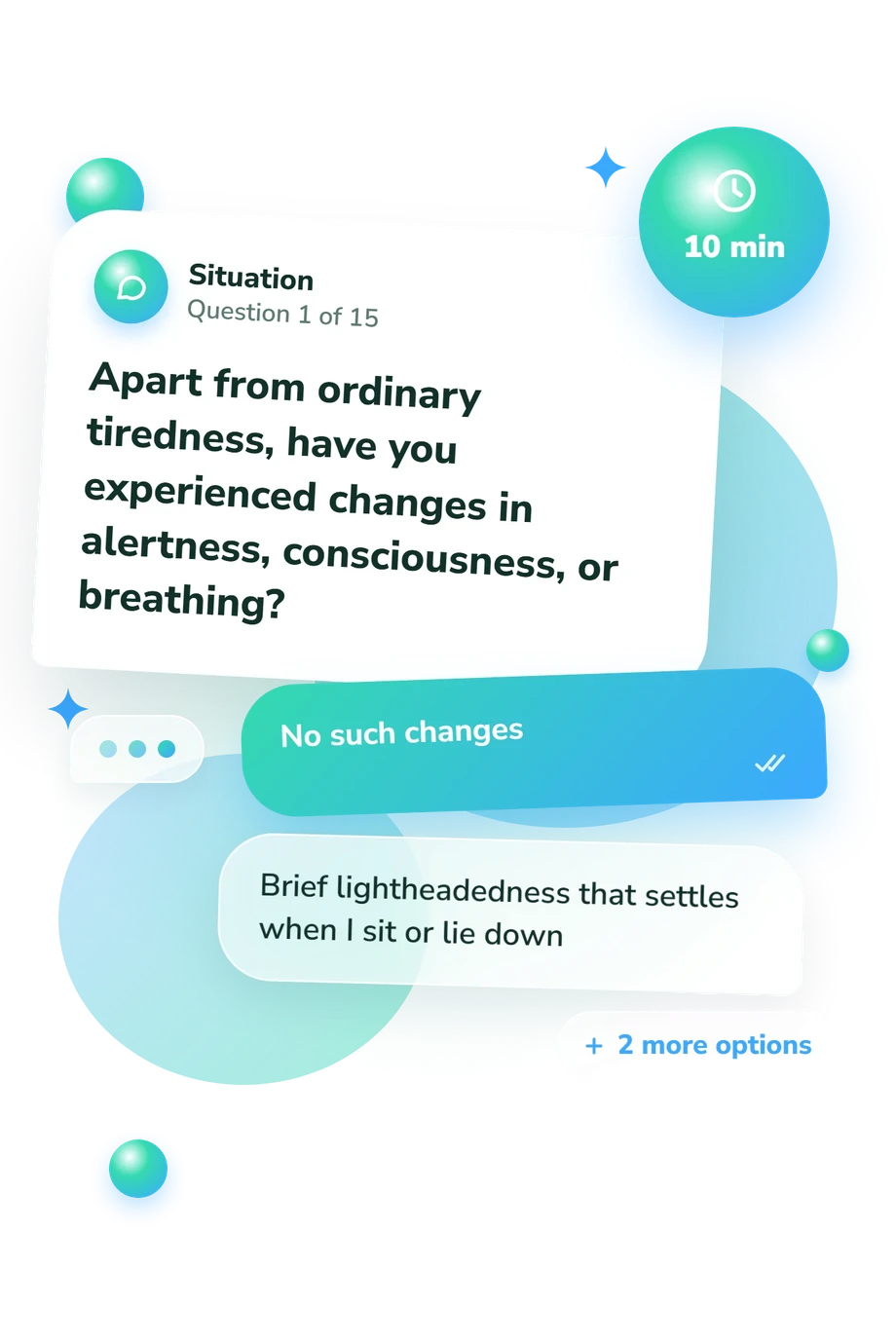
Each item offers four ordered choices, moving from no difficulty to increasingly disruptive states. Questions use periods such as the past day, the previous three days, or a typical day, and describe food or fluid retention, urine, weight, vomiting, physical steadiness, and essential activities. Respondents choose the description closest to current experience without needing medical terminology.
Responses are grouped into three domains rather than one total diagnosis. The questionnaire does not specify how individual choices contribute to each displayed scale score, so the totals are unvalidated reflective summaries. A red-flag response overrides the displayed score, especially fainting, confusion, breathing trouble, severe pain, fever, major bleeding, inability to keep fluids down, or inability to manage basic needs.
Conceptually, this hyperemesis gravidarum self-assessment is consistent with the HELP Score (MacGibbon et al., 2021), the symptom-impact instrument described by Power et al. (2010), and Motherisk-PUQE (Koren et al., 2002). It is not an adaptation of those instruments. The 2024 RCOG guideline places HELP and PUQE within clinical assessment, while these scales remain unvalidated summaries rather than severity cutoffs. Self-report is influenced by recall, current treatment, distress, and symptom description.
- MacGibbon, Kimber W., Sarah Kim, Patrick M. Mullin, and Marlena S. Fejzo. "HyperEmesis Level Prediction (HELP Score) Identifies Patients with Indicators of Severe Disease: a Validation Study." Geburtshilfe und Frauenheilkunde 81, no. 1 (2021): 90-98. DOI 10.1055/a-1309-1997
- Power, Zoe, Malcolm Campbell, Pamela Kilcoyne, Henry Kitchener, and Heather Waterman. "The Hyperemesis Impact of Symptoms Questionnaire: development and validation of a clinical tool." International Journal of Nursing Studies 47, no. 1 (2010): 67-77. DOI 10.1016/j.ijnurstu.2009.06.012
- Koren, Gideon, Radinka Boskovic, Marjie Hard, Caroline Maltepe, Yvette Navioz, and Adrienne Einarson. "Motherisk-PUQE (pregnancy-unique quantification of emesis and nausea) scoring system for nausea and vomiting of pregnancy." American Journal of Obstetrics and Gynecology 186, no. 5 Suppl Understanding (2002): S228-S231. DOI 10.1067/mob.2002.123054
- Nelson-Piercy, Catherine, Caitlin Dean, Manjeet Shehmar, Roger Gadsby, Margaret O'Hara, Kenneth Hodson, Melanie Nana, and the Royal College of Obstetricians and Gynaecologists. "The Management of Nausea and Vomiting in Pregnancy and Hyperemesis Gravidarum (Green-top Guideline No. 69)." BJOG: An International Journal of Obstetrics & Gynaecology 131, no. 7 (2024): e1-e30. DOI 10.1111/1471-0528.17739
Updated: