
Dial Caliper Quiz
How the Scales are Structured
Who Usually Takes This Test?
See How You Compare
Below is a preview of how scores are typically distributed across each scale.
Example Questions From the Test
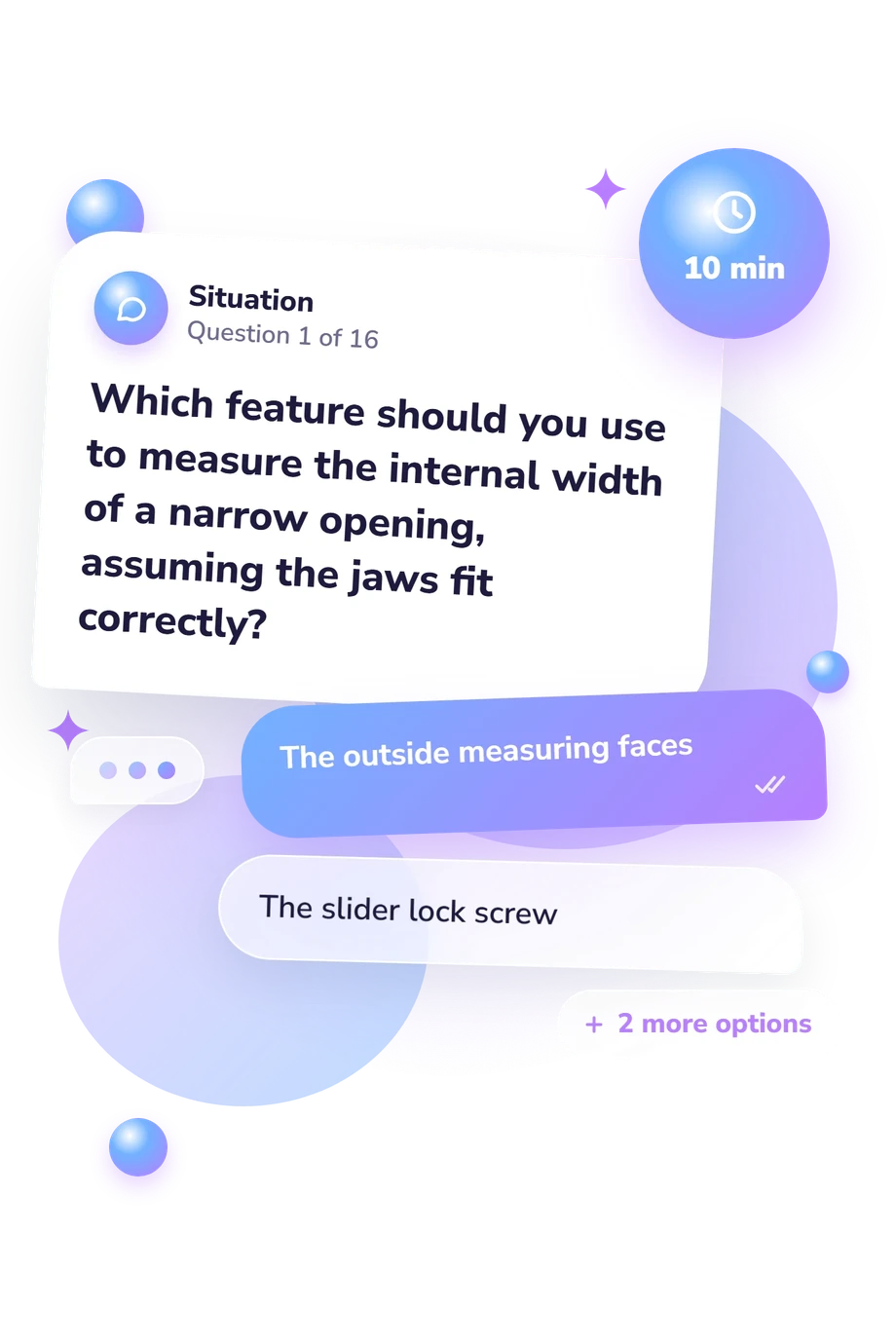
- The outside measuring faces
- The slider lock screw
- The depth rod
- The small inside jaws
- The depth rod extending from the end of the caliper
- The inside jaws
- The rack along the beam
- The dial bezel
- 203 in
- 863 in
- 630 in
- 263 in
Dial Caliper Quiz - Description and methodology of the test
For machinists, technicians, students, and careful DIY users, this dial caliper knowledge test offers a focused way to check what they understand before applying inch-caliper knowledge in workshop work. The Dial Caliper Quiz identifies areas for further study, helping readers choose where review is most useful for future practical work.
What This Assessment Explores
The questionnaire examines knowledge that supports trustworthy inch measurements rather than terminology alone. It suits readers learning workshop measurement or checking their understanding. Items link features with openings, shafts, recesses, tolerances, repeatability, clean contact, and viewing position.
The result reflects three areas:
- Choosing jaws or the depth rod shows whether you understand how to match a feature to its measurement.
- Combining beam and dial readings shows whether you understand graduations, zero correction, and calculations.
- Understanding alignment, pressure, cleanliness, viewing angle, and specifications helps you interpret stability and tolerance.
For learners reviewing caliper quiz answers, explanations matter more than memorizing a letter. The Dial Caliper Knowledge scale runs from 0-16, with one point per correct answer. Foundations to build covers 0-6, Developing knowledge 7-12, and Strong knowledge 13-16. These bands identify study priorities; model markings and instructions remain the final reference.
Methodology and Evidence Base
Each item presents four answer choices with one best response for the situation. In scoring terms, this caliper measurement quiz is criterion-based: every correct response contributes one point, so the total represents performance on the tested procedures rather than a comparison with other respondents. It is an applied knowledge check, not a speed task.
The technical frame is conceptually consistent with the Starrett dial caliper manual and the workshop guidance of Hoerner and Bear. Together with the NIST treatment of measurement uncertainty, these sources support attention to feature selection, beam-and-dial reading, zero error, repeatability, alignment, and appropriate precision. The questionnaire is not presented as an adaptation of any one published instrument.
No normative sample, reliability estimate, or psychometric standardization is specified for this assessment. Results should therefore be read as practical study guidance, not population percentiles. A strong result indicates knowledge of common inch-caliper conventions, but it cannot establish hands-on proficiency. Actual readings can vary with calibration, model markings, workpiece geometry, and handling, so the relevant manual and repeated practice remain important.
- The L.S. Starrett Company. 3201 and 3202 Dial Caliper User Manual. PKG08786-UM3201/3202, 2016.
- Hoerner, Thomas A., and Forrest W. Bear. Micrometers, Calipers and Gages. Hobar Publications, 1969. ISBN 9780913163030.
- Taylor, Barry N., and Chris E. Kuyatt. Guidelines for Evaluating and Expressing the Uncertainty of NIST Measurement Results. NIST Technical Note 1297, 1994. 10.6028/NIST.tn.1297
Updated: