
Daily Quiz
How the Scales are Structured
Who Usually Takes This Test?
See How You Compare
Below is a preview of how scores are typically distributed across each scale.
Example Questions From the Test
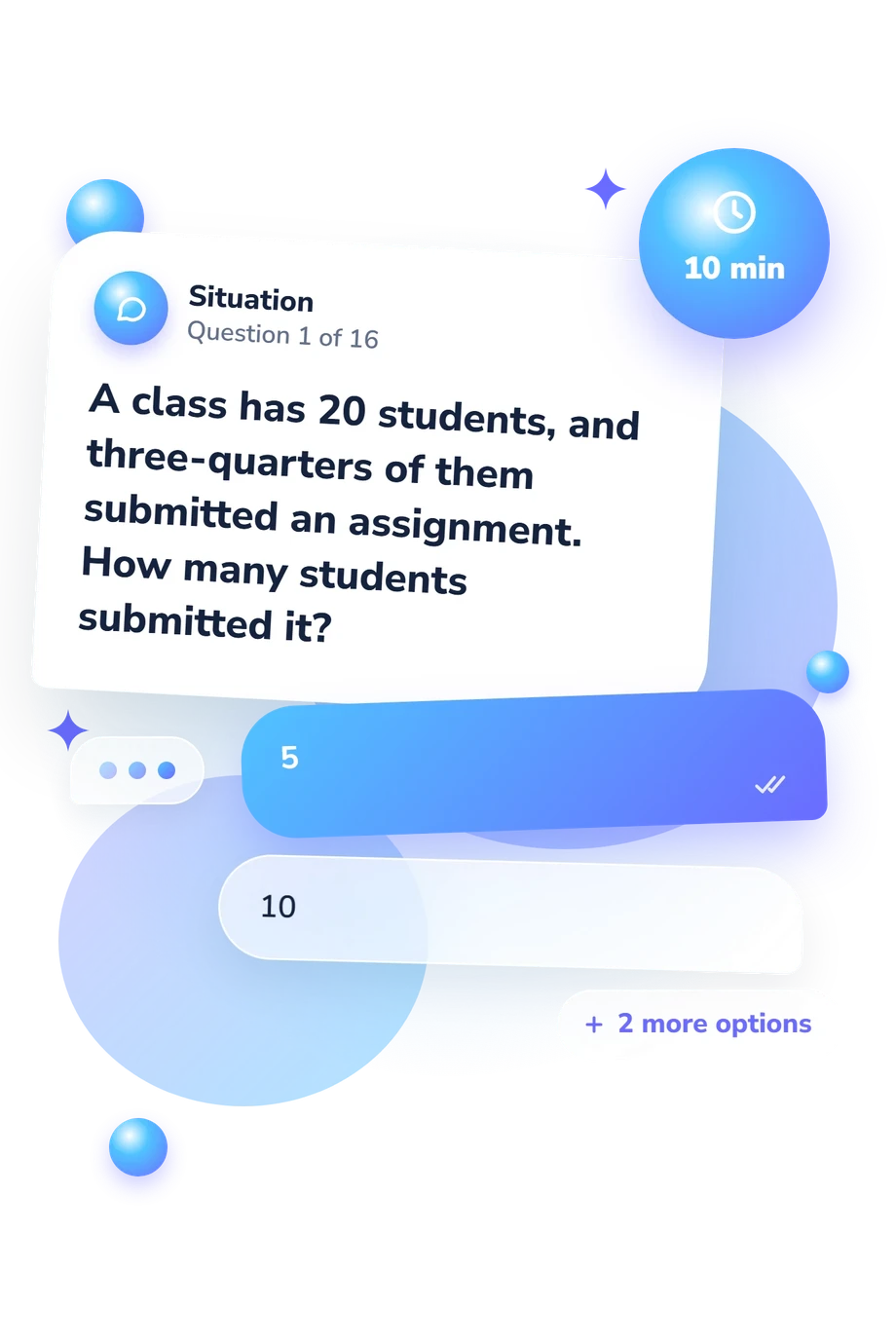
- 5
- 10
- 12
- 15
- Brief
- Detailed
- Indirect
- Repetitive
- It remains blue.
- It turns red.
- It turns green.
- It becomes colorless.
Daily Quiz - Description and methodology of the test
Designed for readers who want a quick way to check broad everyday knowledge, the daily quiz turns familiar school subjects and practical facts into a focused self-check. It suits anyone taking the quiz today while testing recall, comprehension, and simple application. The result offers a snapshot across varied domains, helping you decide which topics deserve another look.
What the Questionnaire Measures
This questionnaire samples knowledge used in learning and everyday decisions rather than one school subject. This assessment is a daily trivia quiz testing recall and familiar-rule application, suitable for broad self-reflection.
Items span calculations, language, science, geography, history, civics, literature, health, and practical reasoning. Some ask for recall; others require inference or calculation. Daily Trivia Knowledge (0-16) reflects performance on this set, not every area of knowledge. Building Foundations (0-6) marks unfamiliar facts or applications; Developing Range (7-12) shows knowledge across subjects with some gaps; Strong Daily Showing (13-16) indicates accurate, flexible performance.
The themes are:
- Quantitative reasoning shows how you handle fractions, percentages, probability, and applications.
- Language and usage indicates how you recognize meaning, grammar, and expression.
- Natural science covers biological, chemical, physical, and weather processes.
- Civics, geography, and culture cover places, institutions, history, literature, and shared facts.
Methodology and Scientific Basis
Each item uses four-option multiple choice with one best response. Performance is reported on the displayed 0-16 scale and assigned to its stated descriptive band. The result therefore describes this selected set of questions rather than every area of knowledge. Each question is part of an objective multiple-choice activity covering factual recall and elementary application, not traits or experiences.
The content is conceptually consistent with General Knowledge Database (Buades-Sitjar et al., 2021), which organizes broad knowledge across subjects. This is a conceptual comparison, not evidence that the online questionnaire is an adaptation of that database.
The content ranges from calculations and vocabulary to scientific processes, geography, civics, literature, and health. A result can therefore reflect topic familiarity as well as general knowledge.
When taking this questionnaire as part of a quiz day, interpret the result as performance on this selection of questions. Guessing, prior exposure, language familiarity, and current attention can affect performance; the General Knowledge Database study does not establish population norms or reliability for this online questionnaire.
- Buades-Sitjar, Francisco, Roger Boada, Marc Guasch, Pilar Ferré, José Antonio Hinojosa, Marc Brysbaert, and Jon Andoni Duñabeitia. “The Thousand-Question Spanish General Knowledge Database.” PSICOLOGICA, 42(1), 109-119, 2021. 10.2478/psicolj-2021-0006.
- Buades-Sitjar, Francisco, Roger Boada, Marc Guasch, Pilar Ferré, José Antonio Hinojosa, and Jon Andoni Duñabeitia. “The Predictors of General Knowledge: Data from a Spanish Megastudy.” Behavior Research Methods, 54(2), 898-909, 2022. 10.3758/s13428-021-01669-4.
- Cattell, Raymond B. “Theory of Fluid and Crystallized Intelligence: A Critical Experiment.” Journal of Educational Psychology, 54(1), 1-22, 1963. 10.1037/h0046743.
Updated: