
Creepypasta Quiz
How the Scales are Structured
Who Usually Takes This Test?
See How You Compare
Below is a preview of how scores are typically distributed across each scale.
Example Questions From the Test
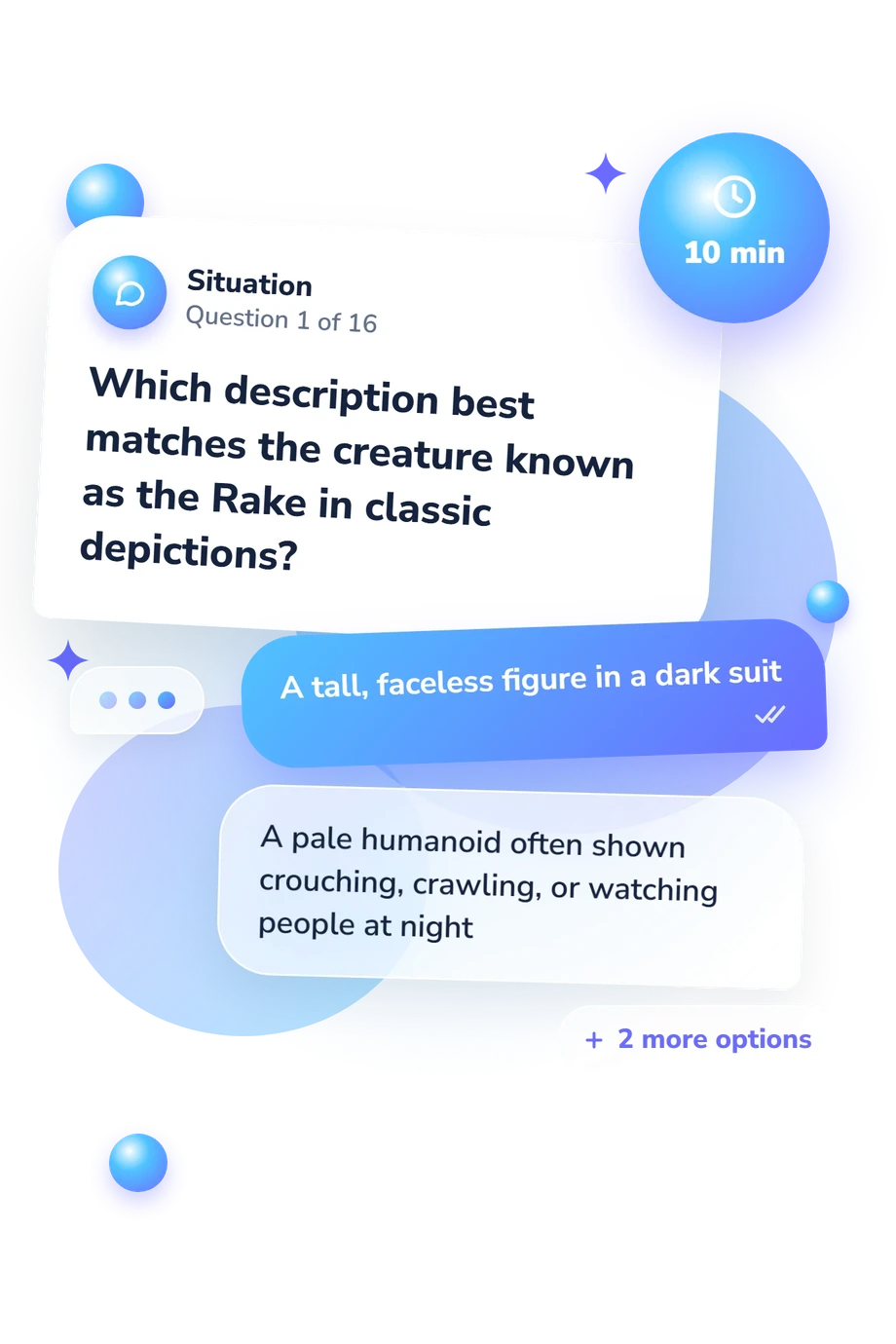
- A tall, faceless figure in a dark suit
- A pale humanoid often shown crouching, crawling, or watching people at night
- A masked organ thief wearing a dark hoodie
- A grinning dog seen through a cursed image file
- A paranormal discussion thread on 4chan
- A Photoshop contest thread on the Something Awful forums
- An early article on the SCP Foundation wiki
- A promotional website for an independent horror film
- “You shouldn’t have done that.”
- “Spread the word.”
- “Return the slab.”
- “Go to sleep.”
Creepypasta Quiz - Description and methodology of the test
For fans of internet horror and readers who want to check their recall, the creepypasta quiz offers a focused knowledge profile rather than a personality label. As a creepypasta knowledge test, it measures recall of selected lore, sources, figures, formats, and story details. The result describes overall familiarity with the tested archive, helping readers decide what to revisit or explore next.
What This Assessment Measures
Items ask you to identify a title, figure, origin, phrase, premise, or format from a short description. The result measures recognition of internet folklore, not symptoms or personal experience, so it suits readers seeking a clearer recall profile.
The result covers these themes:
- Creepypasta Knowledge (0-16) places performance in Curious Newcomer (0-6), Lore Explorer (7-12), or Deep Archive Recall (13-16), showing recall of the tested lore.
- Origins and platforms show recognition of forum threads, copied text, websites, and collaborative archives.
- Characters and creatures show how readily names connect with descriptions, behaviors, and narrative roles.
- Plot and format matching links distinctive events, quotations, game premises, and presentation styles.
A high result reflects familiarity with selected material rather than a stable personality trait; it is a lore-based creepypasta trivia test, not a personality measure.
Methodology and Evidence Base
Sixteen multiple-choice prompts offer four answer choices and ask for the best match among names, origins, quotations, creatures, game narratives, and formats. This recognition-based method tests knowledge, not self-rated traits or distress.
The score summarizes performance across the items. Since no item-weighting rule is stated, interpret it within this quiz: stronger performance means more intended associations were recognized, not mastery of every adaptation. The fan-made score uses descriptive bands for these 16 questions and is not norm-referenced; prior exposure can influence recall, while guessing can raise or lower the result.
Conceptually, this questionnaire is consistent with Balanzategui's research on creepypasta as digital folklore and the digital gothic and with Chess and Newsom's research on internet mythology. It is not an adaptation of those sources or the PKS-40 instrument, and it does not inherit that instrument's norms or validation.
Interpretation remains tied to the selected prompts: ambiguous wording and memory can affect performance, and the result cannot represent every story, adaptation, or version in the wider tradition. It is most useful for gauging familiarity with the internet horror lore represented by these questions.
- Balanzategui, Jessica. “Creepypasta, ‘Candle Cove’, and the Digital Gothic.” Journal of Visual Culture, 18(2), 2019, 187-208. 10.1177/1470412919841018
- Imaizumi, Toshiaki. “Development of 40-item Paranormal Folklore Knowledge Scale (PKS-40).” Japanese Journal of Parapsychology, 2(1), 1997, 21-34. 10.20810/jsppj.2.1_21
- Chess, Shira, and Eric Newsom. Folklore, Horror Stories, and the Slender Man: The Development of an Internet Mythology. New York: Palgrave Macmillan, 2015. 10.1057/9781137491138
Updated: