
Crayfish Anatomy Quiz
How the Scales are Structured
Who Usually Takes This Test?
See How You Compare
Below is a preview of how scores are typically distributed across each scale.
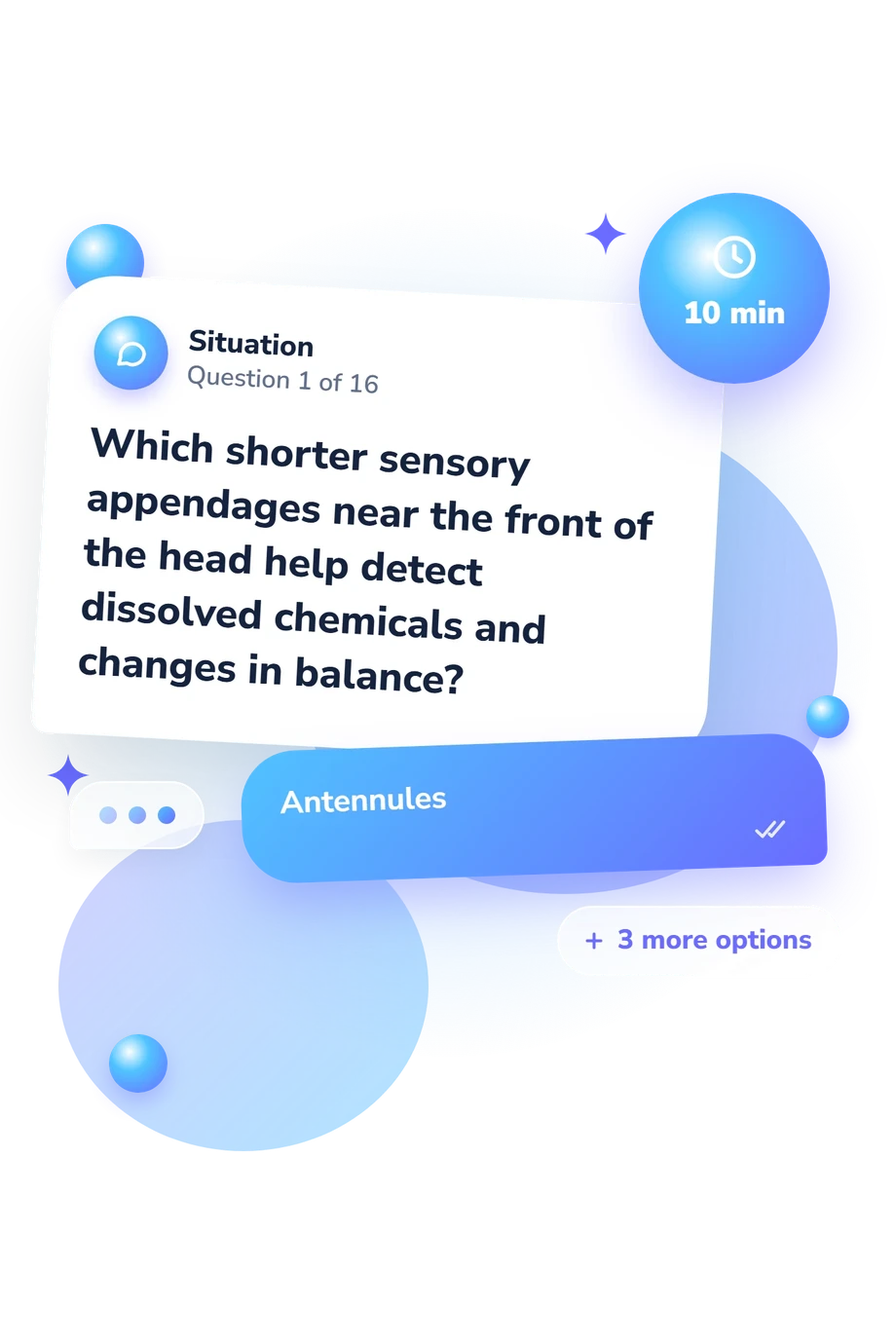
Example Questions From the Test
- Antennules
- Chelipeds
- Swimmerets
- Uropods
- Chelipeds
- Uropods
- Swimmerets
- Maxillipeds
- Tail fan, abdomen, cephalothorax, rostrum
- Rostrum, abdomen, cephalothorax, tail fan
- Rostrum, cephalothorax, abdomen, tail fan
- Cephalothorax, rostrum, tail fan, abdomen
Crayfish Anatomy Quiz - Description and methodology of the test
Students reviewing specimen terminology, instructors checking classroom readiness, and curious readers who want a clearer map of crayfish structure can use the Crayfish Anatomy Quiz as a focused knowledge check. It connects names with locations and functions, while its questions cover the external anatomy students need to review. As an anatomy study quiz, it supports more deliberate preparation before practical work.
What This Assessment Explores
Rather than estimating general biology, the assessment concentrates on visible structures and relationships among their positions, names, and functions. It suits learners studying a specimen, revising laboratory vocabulary, or checking whether they can identify anatomy without relying on a labelled diagram. As an external anatomy quiz, it moves between regional organization and individual appendages.
The question themes cover these areas:
- Body regions and landmarks identify the cephalothorax, abdomen, rostrum, carapace, telson, and tail fan by position.
- Appendages distinguish antennae, antennules, mouthparts, walking legs, swimmerets, chelipeds, and uropods.
- Functions connect structures with sensing, feeding, crawling, swimming, defense, and carrying eggs.
- Anatomical terminology tests whether nearby or paired parts can be named accurately in context.
A stronger result suggests broader command of external structures and associated functions; a lower result points to topics worth revisiting, not a fixed ability label.
Methodology and Evidence Base
Each item presents an identification or application prompt with four answer choices. Respondents connect a structure with its location, appearance, movement, or role in feeding, sensing, support, or defense. Recognition in context is emphasized over isolated recall, while distractors represent nearby or functionally related parts.
The result is reported on one Crayfish Anatomy Knowledge scale ranging from 0 to 16. The catalogue defines it as knowledge of external anatomy and reports Foundations to Review (0-6), Developing Knowledge (7-12), and Strong Knowledge (13-16). These bands describe the command indicated by the responses, not a clinical category or permanent skill level.
The questionnaire is conceptually consistent with Holdich and Reeve (1988), whose chapter links form with function, and Vogt (2002), which offers a broader account of functional anatomy; it is not presented as an adaptation of either work. Delekta and Kolmann (2024) add context on burrowing and body-form diversity, but their study does not validate this questionnaire. In practical terms, this crayfish quiz is an online self-check: the score is not normed, and honest responding, current study exposure, and terminology knowledge can affect it.
- Holdich, David M., and I. D. Reeve. “Functional Morphology and Anatomy.” In Freshwater Crayfish: Biology, Management and Exploitation, edited by David M. Holdich and R. S. Lowery, 11-51. Croom Helm, 1988.
- Vogt, G. “Functional Anatomy.” In Biology of Freshwater Crayfish, edited by David M. Holdich, 53-151. Blackwell Science, 2002.
- Delekta, Emmy M., and Matthew A. Kolmann. “Burrowing Constrains the Phenotypic Diversity of Fossorial Crayfish.” Integrative and Comparative Biology 64, no. 5 (2024): 1454-1466. 10.1093/icb/icae067
Updated: