
Cereal Quiz
How the Scales are Structured
Who Usually Takes This Test?
See How You Compare
Below is a preview of how scores are typically distributed across each scale.
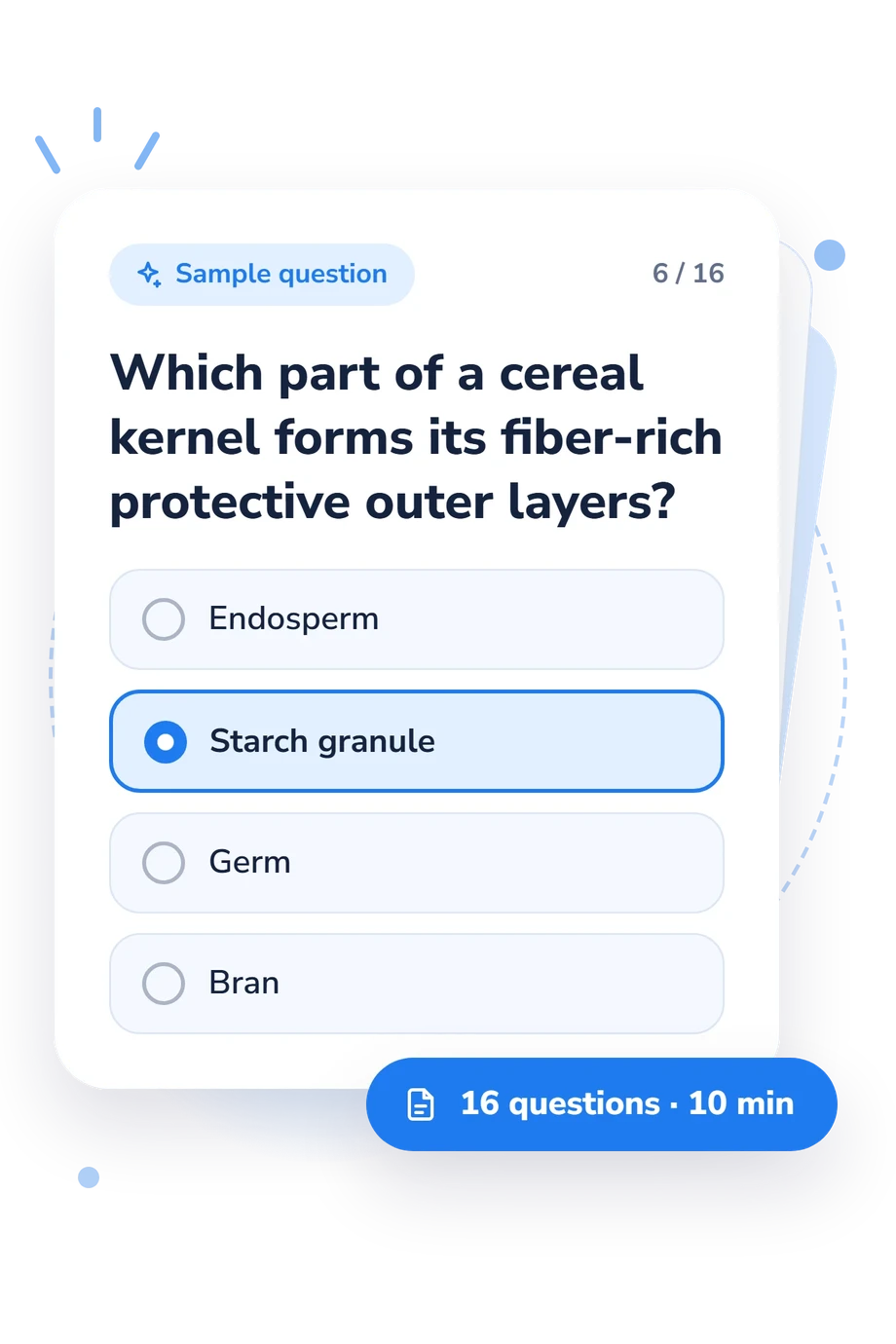
Example Questions From the Test
- Bran only
- Endosperm and germ, but not bran
- Any components that give the flour a brown color
- Bran, germ, and endosperm
- Germ
- Bran
- Endosperm
- Hull
- Wheat
- Rice
- Barley
- Rye
Cereal Quiz - Description and methodology of the test
People who want a practical check of everyday grain knowledge can use this cereal quiz to see how well they understand kernel structure, processing steps, storage choices, and label information. As a quiz about breakfast cereal, it suits curious learners, cooks, shoppers, and students seeking a focused way to review familiar cereal concepts. It measures knowledge rather than taste preferences.
What This Assessment Measures
It examines practical cereal science rather than preferences. Questions link kernel parts, grain types, malting, enrichment, nixtamalization, puffing, storage, oat preparation, sugar labels, plant adaptations, and proportion comparisons. The focus is on applying everyday concepts accurately.
For cooks, shoppers, and learners, the result summarizes overall performance across the tested content. As a cereal knowledge test, it is a focused snapshot of this subject area, not a measure of intelligence or general nutrition expertise.
The Cereal Knowledge scale runs from 0-16. Its result bands mean:
- Emerging (0-6) means you recognize some cereal basics but may confuse grain parts, processes, or label details.
- Developing (7-12) shows understanding of many core ideas and their everyday applications, with less familiar areas to strengthen.
- Strong (13-16) reflects a well-rounded command of cereal grains, processing, storage, and comparison skills.
Methodology and Evidence Base
Each item uses a multiple-choice format with several answer options and asks you to identify the best answer rather than give a personal rating. The groups move between terminology, structure, processing, storage, nutrition labeling, and simple quantitative reasoning, combining recall with practical application.
Scoring summarizes performance across the knowledge items and presents the outcome on the displayed scale. The questionnaire does not state a separate weighting rule or norm group, so the result should be read as performance across grain structure, processing, storage, labels, and comparisons rather than as a standardized estimate.
The content is conceptually consistent with the cereal-science coverage in Fast and Caldwell (2000). Delcour and Hoseney, together with Serna-Saldivar, provide complementary treatment of grain structure, processing, nutrition, and product quality. These books are reference works rather than validation studies for this exact online questionnaire, so they support the subject matter without establishing its reliability or norms. The questionnaire is best interpreted alongside the cereal test questions you found easy or difficult.
Because it is self-administered, the result can reflect prior exposure, attention, guessing, and current recall; it does not by itself establish broad cereal expertise.
- Fast, Robert B., and Elwood F. Caldwell, eds. Breakfast Cereals and How They Are Made. 2nd ed. St. Paul, MN: American Association of Cereal Chemists, 2000. ISBN 1-891127-15-2. 10.1094/1891127152.
- Delcour, Jan A., and R. Carl Hoseney. Principles of Cereal Science and Technology. 3rd ed. St. Paul, MN: AACC International, 2010. ISBN 978-1-891127-63-2.
- Serna-Saldivar, Sergio O. Cereal Grains: Properties, Processing, and Nutritional Attributes. Boca Raton, FL: CRC Press, 2016. ISBN 978-1-4398-8209-2.
Updated: