
Bible Literacy Quiz
How the Scales are Structured
Who Usually Takes This Test?
See How You Compare
Below is a preview of how scores are typically distributed across each scale.
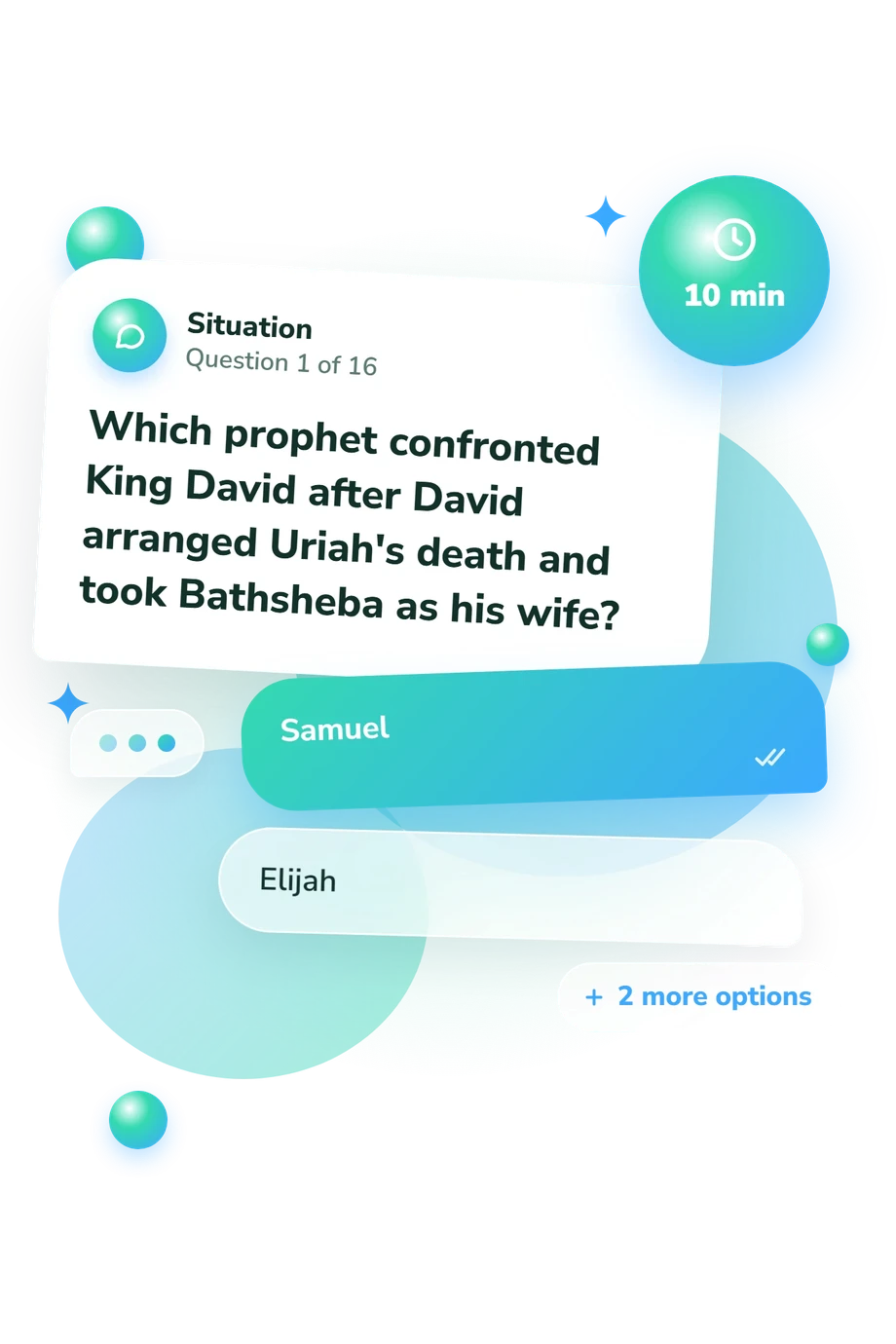
Example Questions From the Test
- Samuel
- Elijah
- Nathan
- Isaiah
- Israel crossing the Jordan into Canaan
- The return to Jerusalem after the Babylonian exile
- The giving of manna in the wilderness
- Israel's deliverance from slavery in Egypt
- Who is greatest in the kingdom of heaven?
- Who is my neighbor?
- Is it lawful to pay taxes to Caesar?
- How many times should I forgive someone?
Bible Literacy Quiz - Description and methodology of the test
Readers who want a focused way to review their familiarity with Scripture can use this bible literacy quiz as a structured check of recall and understanding. For learners, the format works as a biblical literacy quiz suited to study-group participants and anyone returning to biblical reading. The result points to areas of confidence and topics that may deserve closer study, rather than reducing literacy to memorized names or isolated facts.
What This Assessment Explores
Questions cover four connected dimensions rather than one book or doctrine. The displayed scale is Bible Knowledge (0-16), interpreted as Foundations to Build (0-6), Developing Literacy (7-12), or Strong Literacy (13-16). In practical terms, the questionnaire functions as a Bible knowledge test for checking breadth across these areas:
- Biblical narratives show whether you can connect people, events, and turning points.
- Biblical genres indicate whether you recognize how poetry, wisdom, prophecy, letters, and apocalyptic writing guide interpretation.
- Historical context measures your grasp of kingdoms, exile, and early church settings.
- Biblical teachings assess recognition of central claims, practices, images, and ethical ideas.
The result describes breadth and consistency of knowledge. It can highlight useful reading priorities, but it does not measure personal faith or interpretive maturity.
Methodology and Evidence Base
Each item presents a short prompt and four answer choices. The questions ask for factual identification, contextual connections, literary recognition, and understanding of major teachings. Selecting the best-supported option makes this a knowledge check, not a written interpretation exercise.
Results appear as one overall score with no separate subscores. The catalogue supplies the bands but does not specify a point-award rule beyond the displayed total, so the result should be read through those bands rather than through an assumed weighting system. This is a practical biblical knowledge assessment, not a normed clinical measure.
The closest named framework is the Bible Knowledge Scale (Krull & McCloy, 2022). The questionnaire is conceptually consistent with that work’s broad treatment of biblical knowledge, but it is not identified as an adaptation of the published scale. Dennery (2012) and Gourlay (2013) offer relevant research on biblical literacy and Bible knowledge; their samples and methods do not validate this online format.
Prior exposure, denominational background, translation familiarity, and current concentration can affect performance. The result is best used to choose review topics, not to represent the full depth of a reader’s interpretation or practice.
- Krull, Douglas S., and Rodney A. McCloy. (2022). Add to Your Faith Virtue and to Virtue Knowledge: A Bible Knowledge Scale. Journal of Psychology and Christianity, 41(2), 106-117.
- Dennery, Cecilia Arona Baptiste. (2012). A Correlational Study of Biblical Literacy and the Level of Leadership, Discipleship, and Demographics in an African American Church in Delaware. Doctoral dissertation, Wilmington University.
- Gourlay, Kenneth H. (2013). An Assessment of Bible Knowledge among Adult Southern Baptist Sunday School Participants. Christian Education Journal: Research on Educational Ministry, 10(1), 7-29. 10.1177/073989131301000102
Updated: