
Author Quiz
How the Scales are Structured
Who Usually Takes This Test?
See How You Compare
Below is a preview of how scores are typically distributed across each scale.
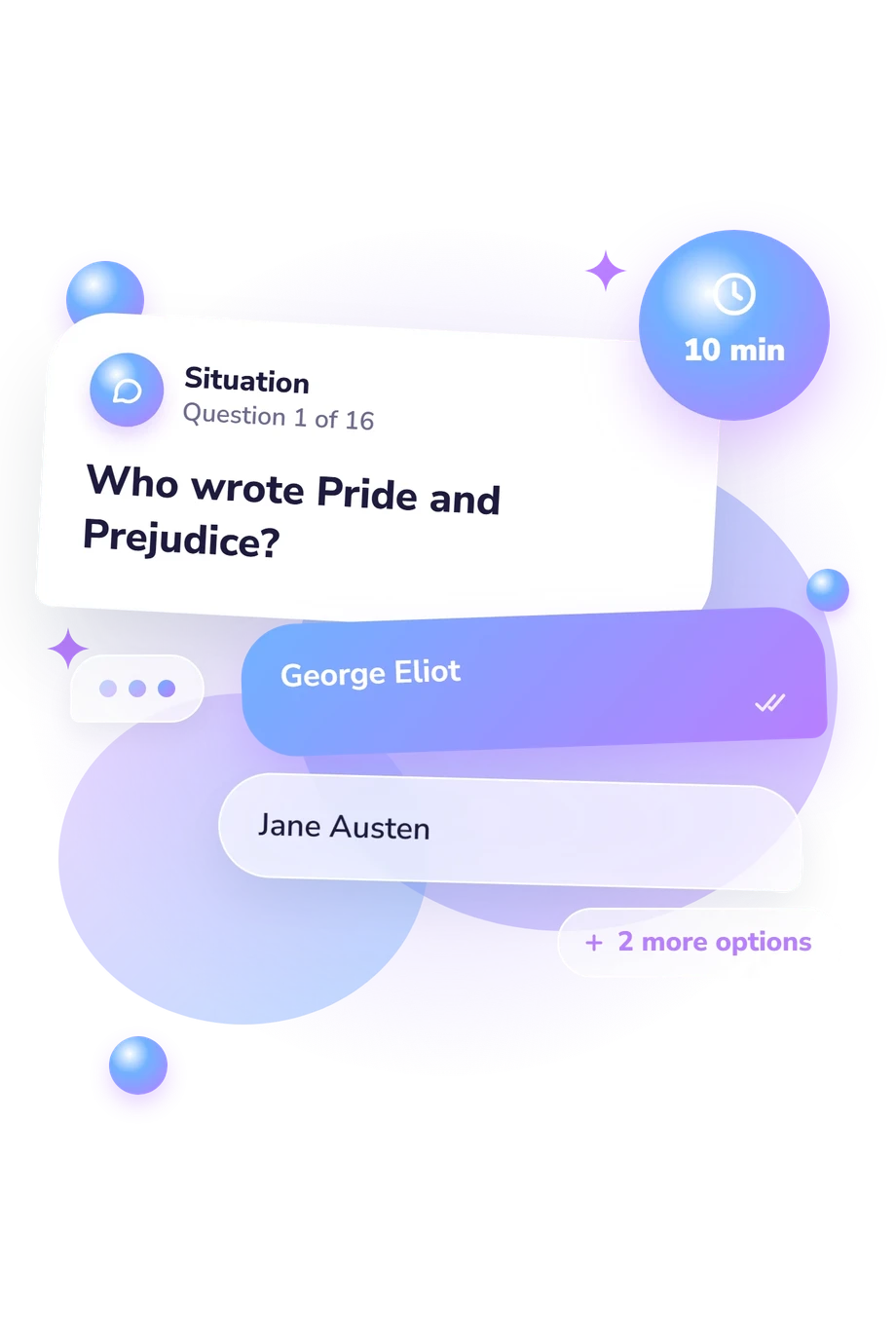
Example Questions From the Test
- George Eliot
- Jane Austen
- Elizabeth Gaskell
- Mary Wollstonecraft
- John Steinbeck
- Harper Lee
- Truman Capote
- William Faulkner
- William Shakespeare
- Oscar Wilde
- Christopher Marlowe
- Henrik Ibsen
Author Quiz - Description and methodology of the test
Readers who enjoy literature can use an author quiz to check how securely they link writers with landmark novels, characters, and literary movements. It is suited to anyone curious about their reading knowledge, whether preparing for discussion, choosing a reading challenge, or simply testing recall. A quiz on famous books and authors turns familiar titles into a focused snapshot of literary recognition.
What This Assessment Explores
This assessment focuses on recognition: matching writers to novels, plays, poems, characters, and literary traditions. The items range across classics, modern fiction, and works associated with varied periods and cultures. As an author knowledge test, it suits readers, students, and anyone curious about literary recall.
The result is a knowledge profile rather than literary taste. A correct answer shows that an author-work connection is available to you; a lower score may point to unfamiliar periods, genres, or traditions, not weak comprehension. The displayed Author Knowledge scale runs from 0-16 and uses these bands:
- Foundation (0-6) indicates recognition of some names, with room to build connections among authors, signature works, and characters.
- Developing (7-12) indicates solid knowledge across several traditions while less familiar periods or genres may need reinforcement.
- Strong (13-16) indicates accurate connections across a broad selection of studied literature.
Methodology and Evidence Base
Each item presents a clue or direct question with four answer choices. Some ask for an author from a title; others identify a work or character from its creator. The format tests retrieval rather than literary interpretation.
With four answer choices per item, this author knowledge quiz counts correct answers and places the total within the displayed bands. No weighting, guessing penalty, or response-time adjustment is stated, so those features should not be assumed.
Its evidence base is conceptually consistent with León Chica et al. (2010), whose work organizes literature proficiency around recognized works and authors; this questionnaire is not presented as an adaptation of that instrument. Stanovich and West (1989), together with Moore and Gordon (2015), link author recognition with print exposure and reading ability, so familiarity may vary with opportunity and background.
Results should be read alongside reading history, language experience, education, and cultural access to the works represented. The questionnaire has no published norms or diagnostic status, and item familiarity may affect performance independently of broader literary understanding. It can suggest further reading, but it cannot establish overall reading ability.
- León Chica, César Julio, Catalina D’Costa Martínez, and Gisela Franco Jácome. (2010). Designing Proficiency Tests to Accredit Previous Knowledge in American and British Literature in a Bilingual Education Program. Profile: Issues in Teachers’ Professional Development, 12(1), 159-179.
- Stanovich, Keith E., and Richard F. West. (1989). Exposure to Print and Orthographic Processing. Reading Research Quarterly, 24(4), 402-433. 10.2307/747605
- Moore, Mariah, and Peter C. Gordon. (2015). Reading Ability and Print Exposure: Item Response Theory Analysis of the Author Recognition Test. Behavior Research Methods, 47(4), 1095-1109. 10.3758/s13428-014-0534-3
Updated: