
Animal Cell Quiz
How the Scales are Structured
Who Usually Takes This Test?
See How You Compare
Below is a preview of how scores are typically distributed across each scale.
Example Questions From the Test
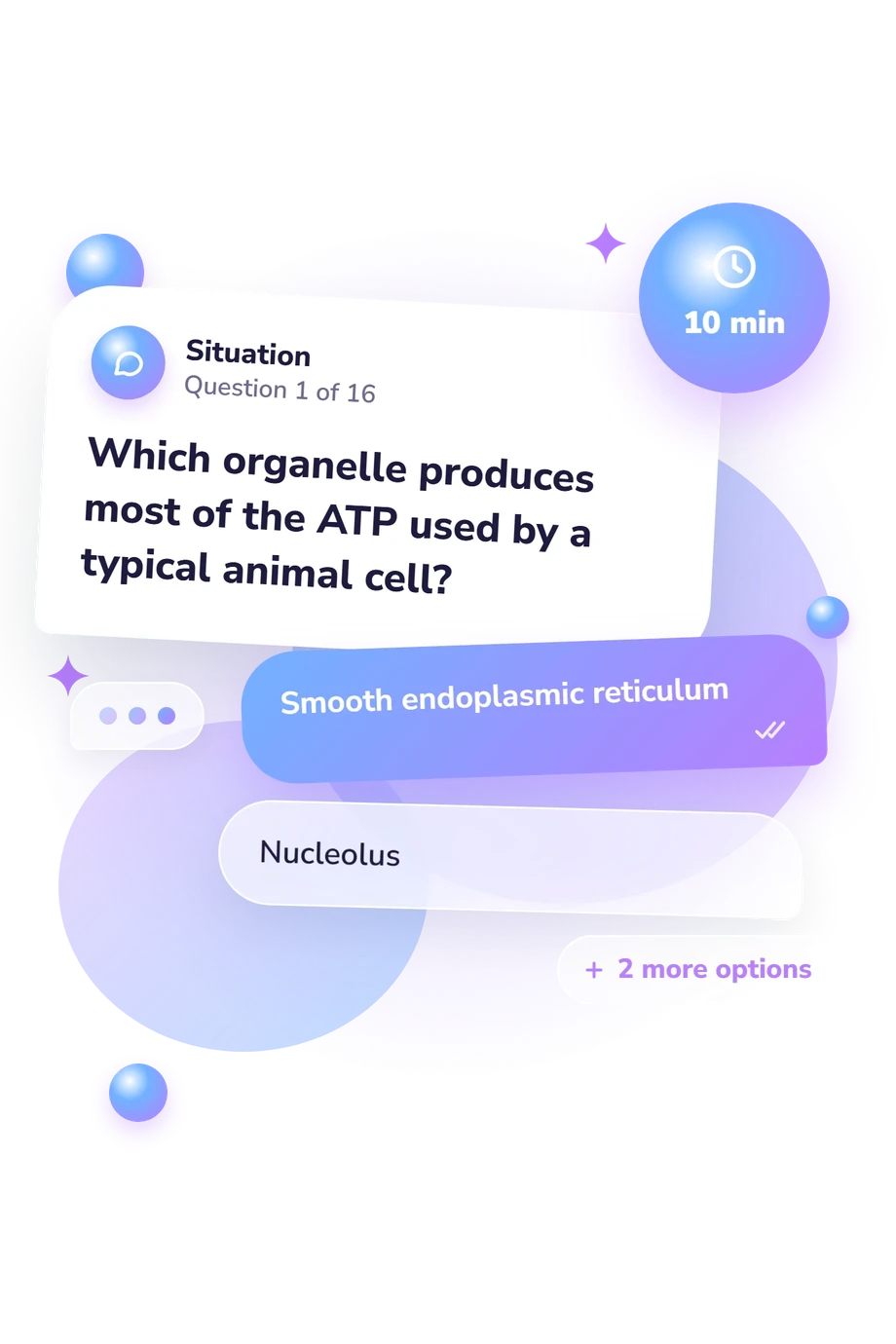
- Smooth endoplasmic reticulum
- Nucleolus
- Golgi apparatus
- Mitochondrion
- Rough endoplasmic reticulum
- Peroxisome
- Centrosome
- Nucleolus
- Nucleolus
- Centrosome
- Golgi apparatus
- Lysosome
Animal Cell Quiz - Description and methodology of the test
Students, independent learners, and instructors seeking a biology check can use this animal cell quiz to examine how well they connect structures with functions and processes. It can be used for review, study planning, or self-testing. As a quiz about the parts of an animal cell, this multiple-choice format can help a learner decide which topics deserve another pass, rather than treating a score as a complete picture.
What This Assessment Explores
The questions examine how animal-cell structures support energy production, protein handling, secretion, recycling, membrane transport, DNA storage, ribosome production, protein synthesis, and cell division. Some items ask you to infer a consequence from malfunction, not merely name an organelle. For learners reviewing biology, this animal cell organelles quiz helps distinguish structures with related jobs.
The thematic groups below describe what you are asked to connect:
- Energy and metabolism show how you relate mitochondria and peroxisomes to chemical activity.
- Organization and information show how you distinguish DNA storage, ribosome production, protein synthesis, and cell division.
- Membranes, transport, and recycling show how you link diffusion, vesicles, secretion, and digestion.
Results appear on Animal Cell Knowledge (0-16): Foundations to strengthen (0-6) signals review needs; Developing knowledge (7-12) reflects broader but incomplete understanding; Strong knowledge (13-16) reflects accurate, connected understanding of animal-cell organization and function.
Methodology and Scientific Basis
Each item presents a biological question with four answer choices. The format combines recognition with application: you may identify an organelle, trace a protein route, distinguish plant and animal cell features, or predict a consequence of malfunction. The set links named organelles to their functions.
Scoring summarizes responses on the single knowledge scale described above; its bands indicate current animal-cell knowledge, not fixed ability. The result can direct review of membranes, organelle cooperation, energy production, or intracellular trafficking.
The questionnaire is conceptually consistent with the Introductory Molecular and Cell Biology Assessment (IMCA) described by Shi and colleagues in 2010, but it is not that published instrument. The concepts tested are consistent with the cell-biology framework described by Alberts and colleagues in 2022.
For learners taking this animal cell function quiz, the result is a study snapshot shaped by prior teaching, guessing, concentration, and textbook familiarity. Standardized norms and independent validation are not reported for this online questionnaire, so interpret the result as focused feedback for study planning.
- Shi, Jia; Wood, William B.; Martin, Jennifer M.; Guild, Nancy A.; Vicens, Quentin; Knight, Jennifer K. A diagnostic assessment for introductory molecular and cell biology. CBE-Life Sciences Education, 9(4), 453-461, 2010. 10.1187/cbe.10-04-0055.
- Alberts, Bruce; Heald, Rebecca; Johnson, Alexander; Morgan, David Owen; Raff, Martin C.; Roberts, Keith; Walter, Peter. Molecular Biology of the Cell. 7th ed. New York: W. W. Norton & Company, 2022. ISBN: 9780393884821.
Updated: