
Anatomical Terms Quiz
How the Scales are Structured
Who Usually Takes This Test?
See How You Compare
Below is a preview of how scores are typically distributed across each scale.
Example Questions From the Test
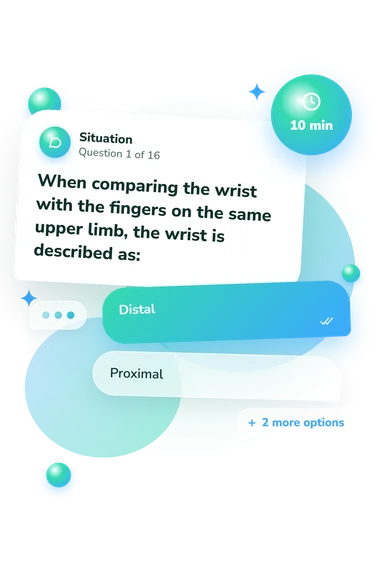
- Distal
- Proximal
- Lateral
- Deep
- Inferior
- Superficial
- Lateral
- Medial
- Adduction
- Flexion
- Abduction
- Medial rotation
Anatomical Terms Quiz - Description and methodology of the test
Designed for learners, trainees, and curious readers who want to decide what to revisit before further study or clinical practice, this anatomical terms quiz offers a practical self-check through short anatomy scenarios. The result from this anatomy terminology quiz gives you a focused indication of where review may sharpen your use of core vocabulary.
What This Assessment Explores
Rather than testing isolated definitions, the assessment asks you to apply terms to relationships and familiar clinical descriptions. This anatomical terminology quiz can show whether you distinguish positions, recognize regions, and connect movement names with what the body is doing.
The main content falls into these groups:
- Directional relationships show how one structure sits relative to another or the body's midline.
- Planes and sections identify how the body is divided for description or imaging.
- Regions, cavities, and positions locate structures and describe how a person is placed.
- Movements connect actions such as bending or moving away from midline with the accepted term.
The result appears as Anatomical Terms Knowledge (0-16), with Foundations to Build (0-6), Developing Knowledge (7-12), or Strong Command (13-16). It indicates current command of the vocabulary, not a professional credential.
Methodology and Scientific Basis
Each item presents an anatomy question with four answer choices. You select the term that fits a definition, spatial relationship, body position, plane, cavity, or movement. The questionnaire reports performance on the displayed 0-16 scale, while the band places it within the stated range. This online questionnaire is non-normed, with no published validation data for this version.
The questionnaire is conceptually consistent with the spatial/non-spatial distinction in Dickson and colleagues' 2024 study, but that study did not create or validate this questionnaire. The anatomy terms quiz uses multiple-choice items, so wording, distractor quality, and guessing can affect performance.
The terms are consistent with FIPAT's Terminologia Anatomica, including medial, popliteal, supine, transverse, and dorsiflexion. Vahalia and colleagues' 1995 study adds a caution: anatomy multiple-choice items need clear stems and defensible alternatives to measure knowledge fairly.
As an anatomical language quiz, it gives a snapshot of current familiarity with standard terms. Prior exposure, guessing, and spatial wording may influence performance, so a band identifies review needs rather than every aspect of anatomical understanding.
- Dickson J, Shaw DJ, Gardiner A, Rhind S. Testing anatomy: Dissecting spatial and non-spatial knowledge in multiple-choice question assessment. Anatomical Sciences Education. 2024;17(1):102-113. 10.1002/ase.2323
- Federative International Programme for Anatomical Terminology (FIPAT). Terminologia Anatomica: International Anatomical Terminology. 2nd ed. Federative International Programme for Anatomical Terminology; 2019.
- Vahalia KV, Subramaniam K, Marks SC Jr, De Souza EJ. The use of multiple-choice tests in anatomy: common pitfalls and how to avoid them. Clinical Anatomy. 1995;8(1):61-65. 10.1002/ca.980080111