
Amphibia Character Quiz
How the Scales are Structured
Who Usually Takes This Test?
See How You Compare
Below is a preview of how scores are typically distributed across each scale.
Example Questions From the Test
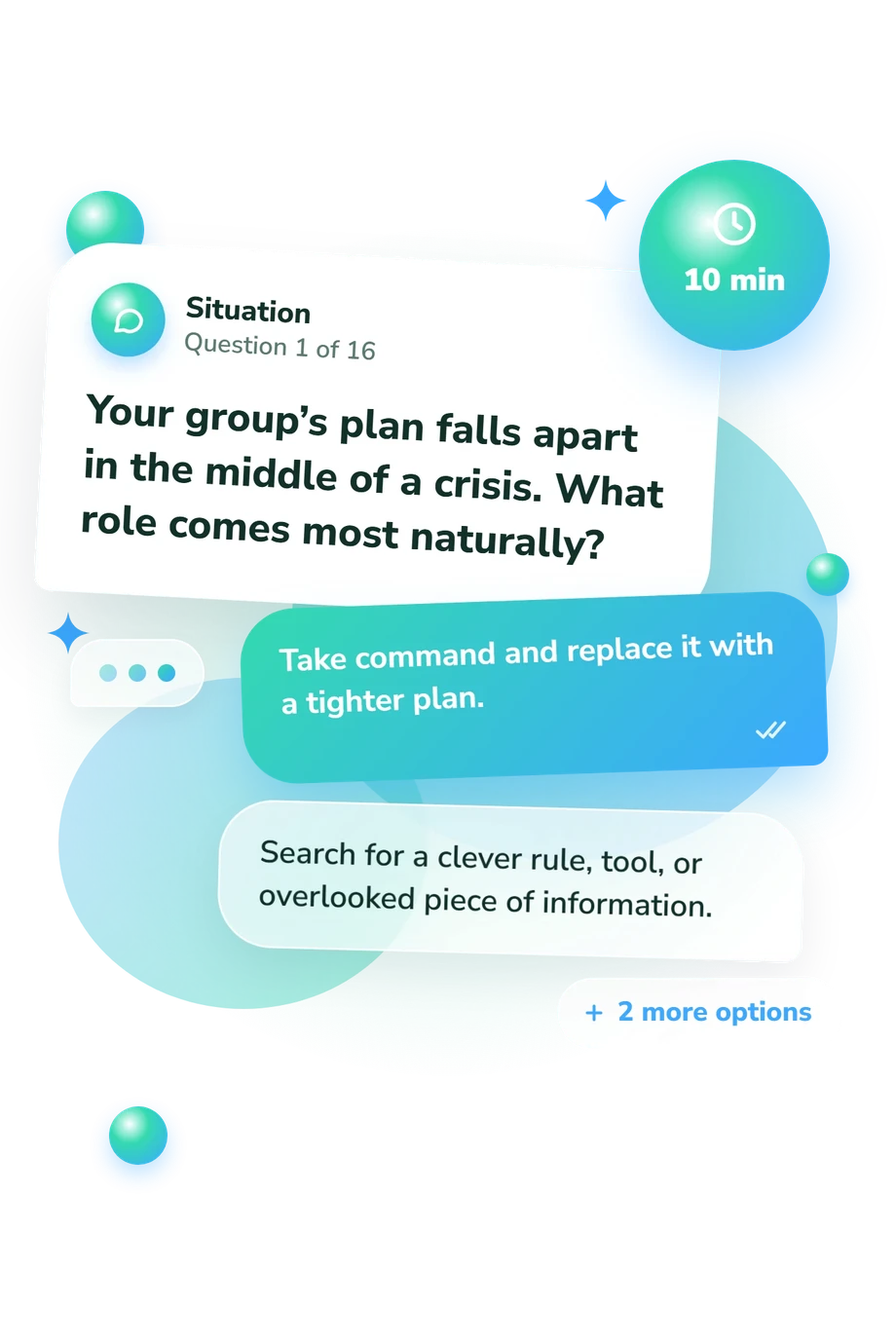
- Take command and replace it with a tighter plan.
- Search for a clever rule, tool, or overlooked piece of information.
- Improvise with what is nearby while making sure nobody gets left behind.
- Try a bold detour that could turn the disaster into an adventure.
- Help map the route and identify useful facts they may have missed.
- Remind them of their responsibilities and insist on strict precautions.
- Offer emotional support while respecting that the choice is theirs.
- Ask to come along, partly to help and partly because it sounds incredible.
- To the people present—I want to know whether they need help.
- To whatever looks most fun to touch or climb.
- To the object that might offer the greatest practical advantage.
- Everywhere at once; I want to decode how the entire room works.
Amphibia Character Quiz - Description and methodology of the test
Fans who enjoy the adventurous world of Amphibia can use the Amphibia Character Quiz to consider how they respond when plans fail, friends face risks, or unfamiliar possibilities appear. The scenarios focus on choices and situations rather than fixed identity. This scenario-based questionnaire suits Amphibia character fans interested in relationships, leadership, curiosity, loyalty, and personal growth.
What This Assessment Explores
The result presents four character-linked approaches to uncertainty, friendship, discovery, and influence, showing which Amphibia character style your choices most closely echo. Scenarios involve failed plans, risky journeys, damaged trust, unfamiliar systems, and chances to lead. The strongest affinity marks the style that best matches your chosen reactions, while close scores can suggest a blended profile.
These are the four dimensions shown in the result:
- Anne Boonchuy Affinity (0-12) reflects adaptable, heart-led responses: Different path 0-4, Shared spark 5-8, Strong Anne affinity 9-12.
- Marcy Wu Affinity (0-12) reflects curiosity, ideas, and imaginative absorption: Different path 0-4, Shared spark 5-8, Strong Marcy affinity 9-12.
- Sasha Waybright Affinity (0-12) reflects confidence, competition, leadership, and control: Different path 0-4, Shared spark 5-8, Strong Sasha affinity 9-12.
- Sprig Plantar Affinity (0-12) reflects spontaneity, playfulness, curiosity, and wholehearted loyalty: Different path 0-4, Shared spark 5-8, Strong Sprig affinity 9-12.
Methodology and Evidence Base
Each item presents a short situation with four response choices, so the format asks you to select the reaction that feels most natural rather than rate isolated adjectives. The choices cover problem-solving, emotional support, curiosity, competition, control, playfulness, and loyalty, creating a thematic character-affinity profile. They test how loyalty and independence interact when relationships change.
The method uses the animated series Amphibia as a narrative frame for forced-choice scenarios. The series supplies recognizable patterns associated with Anne, Marcy, Sasha, and Sprig, while the questionnaire translates them into everyday dilemmas. It is conceptually consistent with Jonathan Cohen’s 2001 account of identification with media characters and with Huang and Fung’s 2024 work on measuring identification with narrative characters, but it is not an adaptation of either published instrument.
Scoring is comparative: the highest of the four displayed scores indicates the strongest affinity, and scores within one point form a blended result. Because answers depend on self-report, current mood, familiarity with the series, and how each situation is imagined, the displayed scores compare the four affinities and do not provide a normative interpretation.
- Amphibia. Created by Matt Braly. Disney Television Animation, 2019-2022.
- Cohen, Jonathan. “Defining Identification: A Theoretical Look at the Identification of Audiences With Media Characters.” Mass Communication & Society, vol. 4, no. 3, 2001, pp. 245-264. 10.1207/S15327825MCS0403_01.
- Huang, Kate Y., and Helene H. Fung. “Measuring Identification with Narrative Characters: The Development and Validation of a New Scale.” Current Psychology, vol. 43, 2024, pp. 24835-24849. 10.1007/s12144-024-06191-2.
Updated: