
Am I an NPC Quiz
How the Scales are Structured
Who Usually Takes This Test?
See How You Compare
Below is a preview of how scores are typically distributed across each scale.
Example Questions From the Test
- I mostly observe while remaining open to being included.
- I join when a topic gives me something natural to add.
- I focus on my own activity until boarding begins.
- I help keep the conversation going or introduce a new topic.
- I make a new plan around something I personally want to do.
- I settle into the most familiar way I usually pass time.
- I wait to see what the people around me start doing.
- I use the first convenient option I notice.
- I ask my companion to pick for both of us.
- I take whichever available seat is quickest to select.
- I compare a couple of comfort trade-offs before choosing.
- I choose according to the exact flight experience I want.
Am I an NPC Quiz - Description and methodology of the test
People who want to examine how they respond to social cues, defaults, and shared decisions may find the Am I an NPC Quiz a useful self-reflection exercise. It suits curious readers seeking a structured look at evaluating perspectives, directing choices, and participating socially, rather than a result that determines whether someone is literally an NPC. The NPC quiz turns familiar travel situations into a profile of influence, choice, and connection.
What This Assessment Explores
The questionnaire treats NPC as a metaphor for how people respond to influence, defaults, preferences, and social opportunities. Travel situations cover recommendations, changed plans, group decisions, practical trade-offs, and brief conversations. This NPC questionnaire uses those travel scenarios for general self-reflection about everyday choices, social cues, and participation.
The three result dimensions are:
- Independent Perspective (0-15) reflects how you weigh opinions and social cues: Consensus-Oriented (0-5) follows shared cues, Contextual Evaluator (6-10) mixes guidance with observation, and Independent Appraiser (11-15) forms a personal conclusion.
- Personal Agency (0-15) measures how strongly you direct choices: Default-Friendly (0-5) accepts convenient routes, Selectively Self-Directed (6-10) asserts preferences selectively, and Active Director (11-15) voices the experience you want.
- Social Presence (0-15) explores active participation: Quiet Presence (0-5) conserves social energy, Responsive Presence (6-10) engages when invited, and Social Catalyst (11-15) initiates or adds energy.
Methodology and Scientific Basis
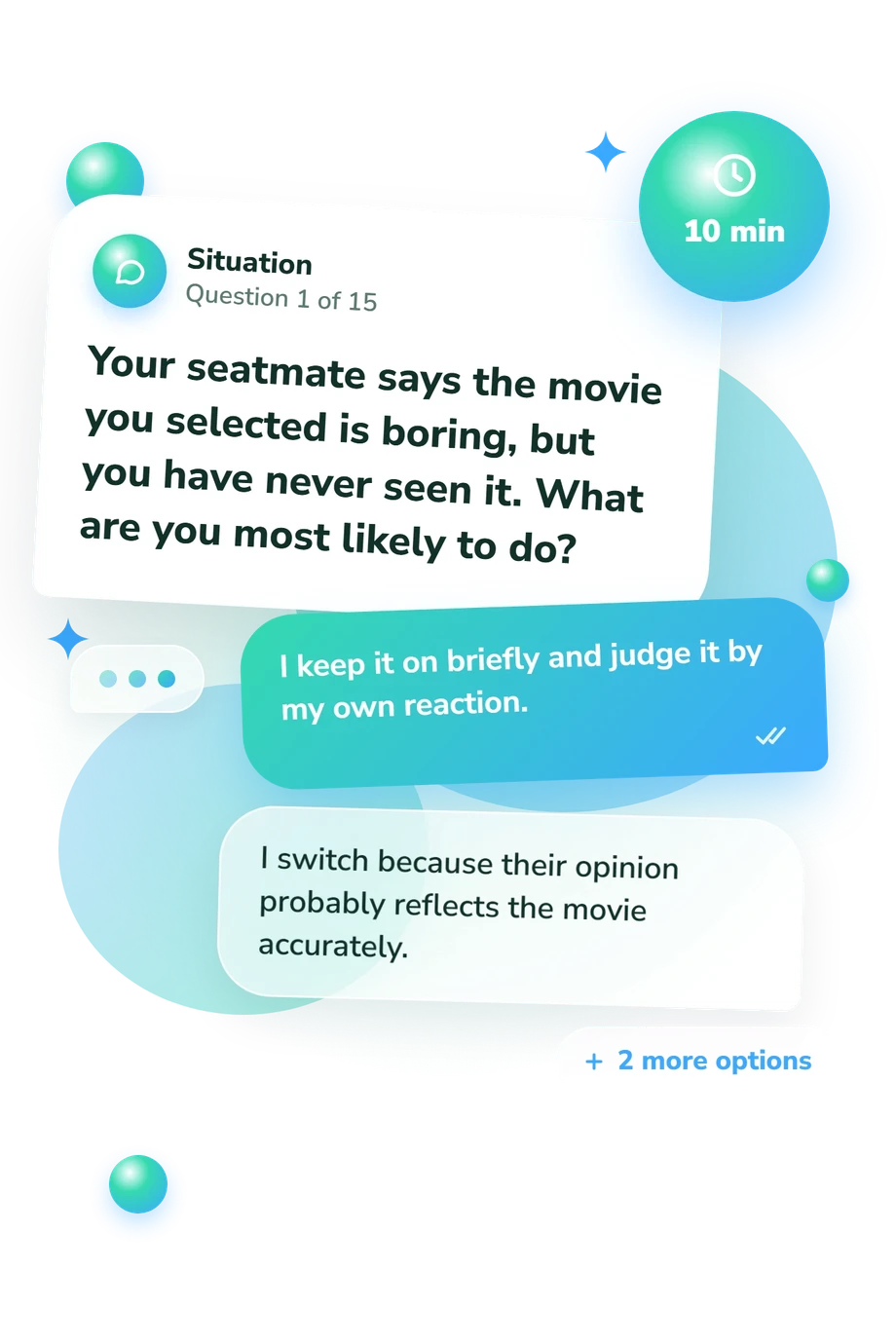
Each item presents a travel situation with four response options. The alternatives cover recommendations, defaults, personal preferences, and social openings; the respondent selects the option that best matches their reaction. This captures stated tendencies, not observed behavior.
The scoring places responses within named bands, but point allocation is not documented. Interpretation is therefore descriptive: the result summarizes how respondents report weighing advice, stating preferences, and joining shared activity in these scenarios, rather than ranking judgment or fixing a social style.
The questionnaire’s use of the NPC metaphor is conceptually consistent with Gallagher and Topinka (2023), whose cultural analysis contrasts scripted conformity with active self-direction. It is also conceptually consistent with Asch (1955) on social pressure, Bandura (2006) on human agency, and Levasseur et al. (2010) on social participation; it is not an adaptation or validation of these works.
Within this NPC test, interpretation is strongest when you consider current context. Mood, recent experiences, social comfort, the wish to appear independent, and limited self-awareness can shape self-report. Treat the profile as a prompt for noticing patterns; quiet participation remains valid.
- Gallagher, Rob, and Robert Topinka. (2023). The politics of the NPC meme: Reactionary subcultural practice and vernacular theory. Big Data & Society, 10(1), 1-16. 10.1177/20539517231172422
- Asch, Solomon E. (1955). Opinions and Social Pressure. Scientific American, 193(5), 31-35. 10.1038/scientificamerican1155-31
- Bandura, Albert. (2006). Toward a Psychology of Human Agency. Perspectives on Psychological Science, 1(2), 164-180. 10.1111/j.1745-6916.2006.00011.x
- Levasseur, Mélanie, Lucie Richard, Lise Gauvin, and Émilie Raymond. (2010). Inventory and analysis of definitions of social participation found in the aging literature: Proposed taxonomy of social activities. Social Science & Medicine, 71(12), 2141-2149. 10.1016/j.socscimed.2010.09.041
Updated: