
AIDS Quiz
How the Scales are Structured
Who Usually Takes This Test?
See How You Compare
Below is a preview of how scores are typically distributed across each scale.
Example Questions From the Test
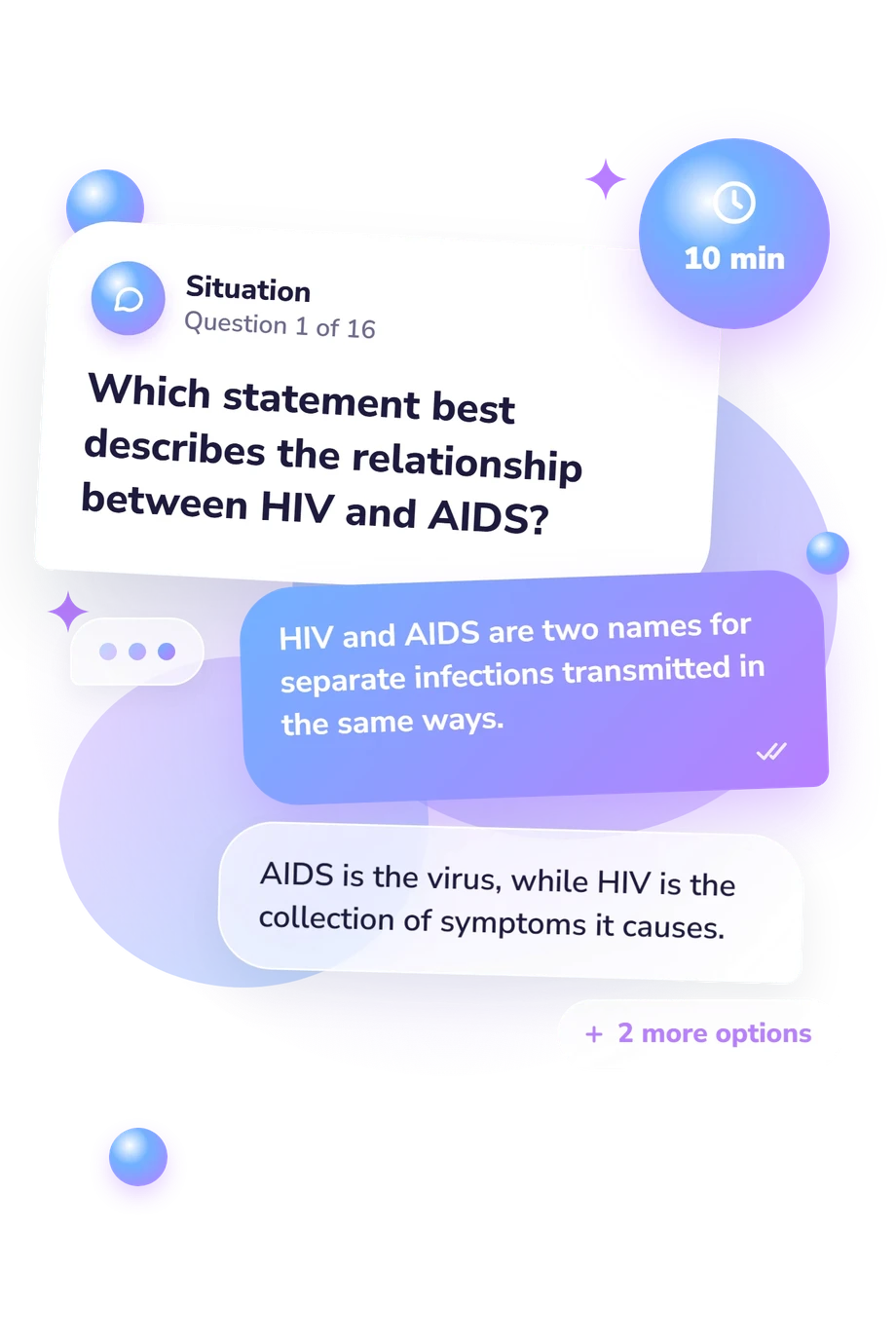
- HIV and AIDS are two names for separate infections transmitted in the same ways.
- AIDS is the virus, while HIV is the collection of symptoms it causes.
- HIV is the virus; AIDS is the most advanced stage of HIV infection when defined clinical criteria are met.
- Every person with HIV immediately has AIDS.
- Sharing a toilet seat with someone who has HIV
- Having sex involving relevant body fluids without an effective prevention method
- Breastfeeding when HIV is not effectively treated
- Sharing injection equipment that contains infected blood
- Saliva, tears, sweat, and urine
- Blood, semen, vaginal or rectal fluids, and breast milk
- Saliva, nasal mucus, vomit, and sweat
- Tears, saliva, breast milk, and perspiration
AIDS Quiz - Description and methodology of the test
People who want to check their understanding of HIV can use the AIDS Quiz to identify stronger areas of knowledge and topics that merit review. The result organizes learning priorities for more informed decisions. As an AIDS awareness quiz, it suits general readers, students, educators, and anyone preparing to make sense of prevention or testing information.
What This Assessment Explores
At its core, the assessment checks whether a reader can distinguish established HIV facts from common misconceptions. Items cover transmission, U=U, PrEP, condoms, sterile equipment, treatment, testing windows, early symptoms, and advanced HIV.
Its practical emphasis makes this quiz about AIDS useful for reviewing prevention, testing after exposure, and urgent-care decisions. The intended audience is any general reader seeking a clearer grasp of these concepts.
The result provides one aggregate score, and the questions cover these thematic areas:
- AIDS Knowledge is the 0-16 score: Foundations to build (0-6), Developing knowledge (7-12), or Strong knowledge (13-16).
- Transmission and prevention are covered through recognition of body fluids, protective methods, U=U, PrEP, and safer injection.
- Testing and disease-course topics cover understanding of windows, follow-up testing, treatment, advanced HIV, and early symptoms.
Methodology and Scientific Basis
Each question presents four answer choices, and the answer-based total reflects knowledge performance rather than symptoms, personal risk estimation, or HIV status. The cited instruments do not establish psychometric properties for this questionnaire.
Conceptually, its closest reference is HIV-KQ-18 (Carey & Schroder, 2002), a brief HIV knowledge measure. The earlier HIV-KQ by Carey, Morrison-Beedy, and Johnson (1997) offers a related framework. This questionnaire is conceptually consistent with those instruments, not a direct adaptation or newly validated version.
Selected content aligns with Eisinger, Dieffenbach, and Fauci (2019) on U=U and CDC recommendations from 2025 on urgent PEP after relevant exposure. Those sources support health information, not psychometric claims about this version.
The result can identify topics for review, but performance can vary with prior education, guessing, attention, and unsupervised conditions. This makes the outcome a guide to topics for review. Readers working through these quiz questions about HIV and AIDS should treat the outcome as educational. It cannot confirm or exclude HIV after exposure; appropriate testing and prompt clinical advice remain necessary next steps.
- Carey, Michael P., and Kerstin E. E. Schroder. “Development and Psychometric Evaluation of the Brief HIV Knowledge Questionnaire.” AIDS Education and Prevention, vol. 14, no. 2, 2002, pp. 172-182. 10.1521/aeap.14.2.172.23902
- Carey, Michael P., Dianne Morrison-Beedy, and Blair T. Johnson. “The HIV-Knowledge Questionnaire: Development and Evaluation of a Reliable, Valid, and Practical Self-Administered Questionnaire.” AIDS and Behavior, vol. 1, no. 1, 1997, pp. 61-74. 10.1023/A:1026218005943
- Eisinger, Robert W., Carl W. Dieffenbach, and Anthony S. Fauci. “HIV Viral Load and Transmissibility of HIV Infection: Undetectable Equals Untransmittable.” JAMA, vol. 321, no. 5, 2019, pp. 451-452. 10.1001/jama.2018.21167
- Centers for Disease Control and Prevention. “Antiretroviral Postexposure Prophylaxis After Sexual, Injection Drug Use, or Other Nonoccupational Exposure to HIV-CDC Recommendations, United States, 2025.” MMWR Recommendations and Reports, vol. 74, no. 1, 2025, pp. 1-56.
Updated: