
Test My Brain
How the Scales are Structured
Who Usually Takes This Test?
See How You Compare
Below is a preview of how scores are typically distributed across each scale.
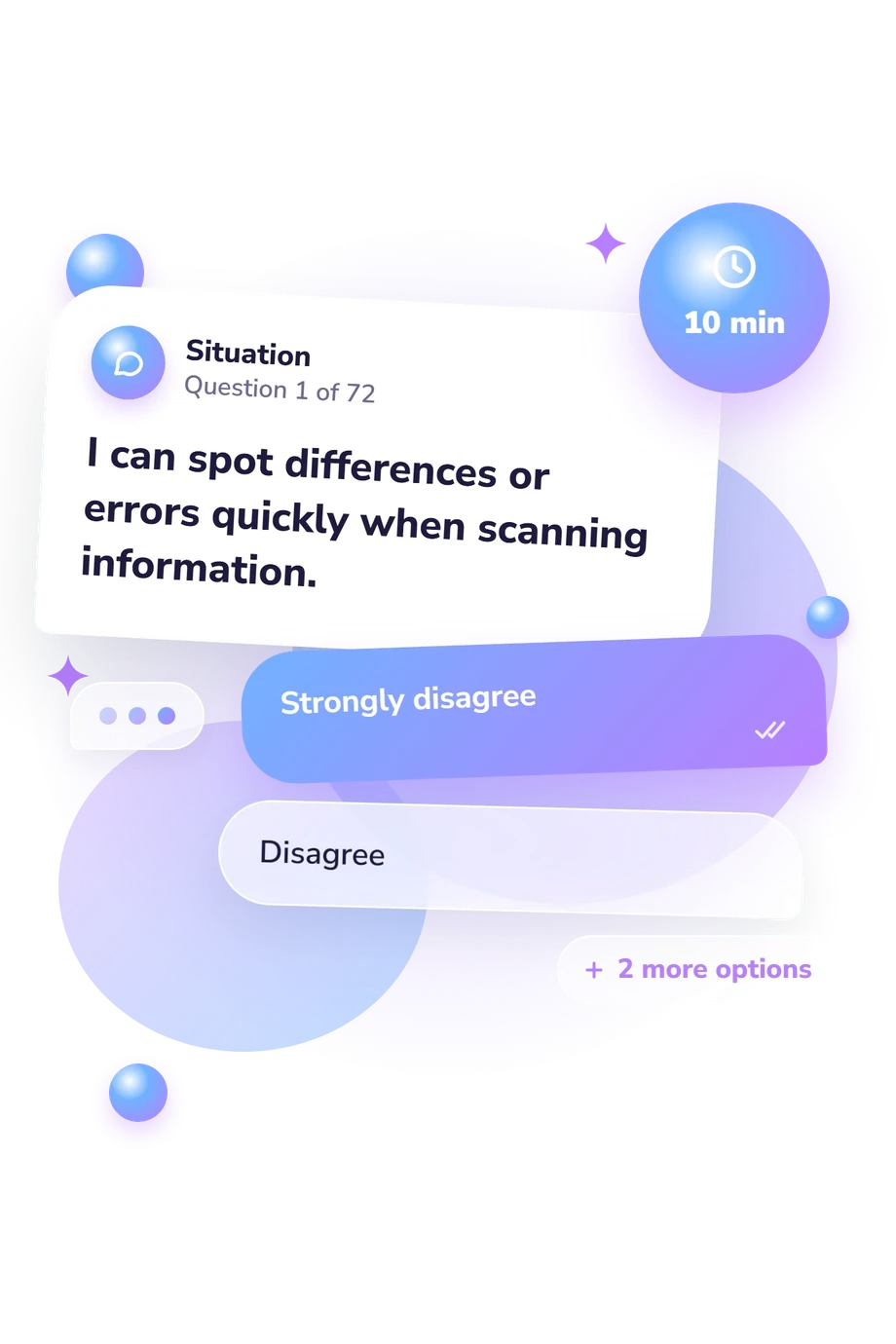
Example Questions From the Test
- Strongly disagree
- Disagree
- Agree
- Strongly agree
- Strongly disagree
- Disagree
- Agree
- Strongly agree
- Strongly disagree
- Disagree
- Agree
- Strongly agree
Test My Brain - Description and methodology of the test
People seeking a structured look at concentration, recall, mental speed, and problem-solving can use this questionnaire to reflect on familiar cognitive demands. Test My Brain is suited to people seeking a practical self-report snapshot rather than a formal examination. It can help you identify areas that feel steady, effortful, or vulnerable to distraction. You rate these abilities in everyday tasks; the result is a cognitive self-assessment rather than direct testing.
What This Assessment Explores
These statements cover sustained attention, working memory, mental speed, and reasoning accuracy. As a self-report cognitive assessment, it asks about distractions, interruptions, sequences, instructions, patterns, rules, and brief verbal information. It suits anyone seeking an everyday picture of perceived cognitive strengths and less consistent areas.
The displayed result separates that profile into three dimensions:
- Attention & Focus (0-20) measures concentration and distraction resistance; Needs Support 0-9, Typical 10-15, and Strong 16-20 are the displayed bands.
- Memory (0-20) measures recall and manipulation after brief delays; Needs practice 0-8, Typical 9-14, and Strong 15-20 are the displayed bands.
- Processing & Reasoning (0-20) measures speed and accuracy in logic and verbal tasks; Developing 0-7, Typical 8-14, and Strong 15-20 are the displayed bands.
Higher scores indicate stronger self-reported ability within the relevant domain.
Methodology and Evidence Base
Sampled prompts are first-person statements about familiar mental tasks. In the sample, two four-option formats appear: some items run from Strongly disagree to Strongly agree, while some memory items use Strongly disagree, Disagree, Not sure, and Agree. Some sampled items use reverse wording, so greater agreement can indicate a less consistent ability. The result displays three scale scores, but the questionnaire does not state the point mapping or reverse-scoring procedure.
As a cognitive abilities test, it uses self-report rather than direct performance tasks. Self-Report Measure of Cognitive Abilities (Jacobs & Roodenburg, 2014) is the closest conceptual comparison: it examined multiple self-rated abilities within a structured cognitive framework, while this questionnaire is not an adaptation of that instrument, so its displayed bands do not carry that instrument's norms.
Herreen and Zajac (2018) reported adequate reliability in older adults but found personality could predict self-rated cognitive ability more strongly than measured performance in several areas. Accordingly, interpret the result as perceived ability shaped by current context, confidence, habits, and self-awareness.
- Jacobs, K. E., & Roodenburg, J. (2014). The development and validation of the Self-Report Measure of Cognitive Abilities: A multitrait-multimethod study. Intelligence, 42, 5-21. DOI 10.1016/j.intell.2013.09.004
- Seidenberg, M., Haltiner, A., Taylor, M. A., Hermann, B. B., & Wyler, A. (1994). Development and validation of a Multiple Ability Self-Report Questionnaire. Journal of Clinical and Experimental Neuropsychology, 16(1), 93-104. DOI 10.1080/01688639408402620
- Herreen, D., & Zajac, I. T. (2017). The reliability and validity of a self-report measure of cognitive abilities in older adults: More personality than cognitive function. Journal of Intelligence, 6(1), Article 1. DOI 10.3390/jintelligence6010001
Updated: