
Minecraft Quiz for Kids
How the Scales are Structured
Who Usually Takes This Test?
See How You Compare
Below is a preview of how scores are typically distributed across each scale.
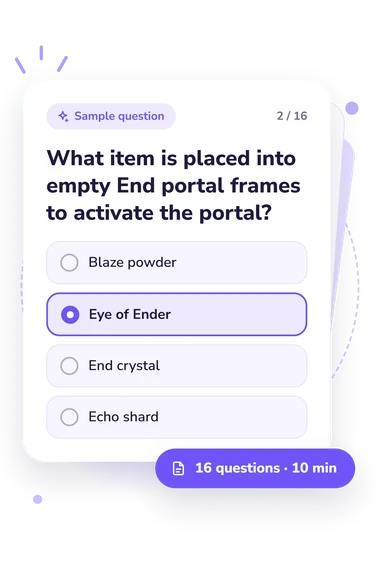
Example Questions From the Test
- A gold-block frame filled with lava
- An obsidian frame ignited with flint and steel
- An iron-block frame struck by lightning
- A stone-brick frame activated with redstone
- Blaze powder
- Eye of Ender
- End crystal
- Echo shard
- Stone pickaxe
- Iron pickaxe
- Golden pickaxe
- Wooden pickaxe
Minecraft Quiz for Kids - Description and methodology of the test
Young players who enjoy Minecraft can use Minecraft Quiz for Kids to turn their current game familiarity into a clear result. A Minecraft knowledge quiz like this gives them a simple way to see where confidence is strongest and where more practice may help. The result can guide what they choose to revisit next, whether they are checking their own progress or sharing it with an adult.
What This Assessment Explores
These questions measure Minecraft knowledge through exploration, building, resources, and survival. They suit young players seeking a focused check of game mechanics rather than a measure of general intelligence or gaming ability.
The main themes are:
- Portal and dimension knowledge shows whether the player can identify how special areas are entered.
- Resource and crafting knowledge indicates how materials, blocks, and tools produce useful outcomes.
- Mob and item knowledge reflects recognition of creatures, drops, equipment, and protection.
- Survival decisions show whether the player chooses sensible actions around hazards or limited supplies.
Minecraft Knowledge measures mechanics, resources, creatures, and dimensions on a 0-16 scale. New Explorer is 0-6, Growing Crafter is 7-12, and Master Builder is 13-16. Because this Minecraft mechanics quiz covers several game systems, its result identifies topics for further practice and helps players decide what to revisit.
Methodology and Scientific Basis
Each item presents a Minecraft situation or identification task with four answer choices. Topics cover portals, farming, mining, taming, hostile mobs, enchanting, navigation, fall protection, crafting, and daylight behavior, while contributing to one knowledge score.
Scoring is explicit: each correct answer contributes one point, and the completed questionnaire produces the total shown against the fixed bands.
The raw correct-answer total from this Minecraft game knowledge check reflects performance on the questionnaire's game content rather than a broader measure of ability.
The content is conceptually consistent with Milton, Davies, and Jones (2017), with related game-mechanics guidance from Milton’s works on the Nether, the End, enchantments, and potions. These books support the subject matter, not validation of this online questionnaire. Lane and Yi (2017) provide a broader learning context for Minecraft, but do not establish norms for this quiz.
Interpret it as a snapshot of performance on selected content: game-version familiarity, attention, guessing, and recent play can affect results, so a lower band points to topics for practice rather than a fixed limit on ability.
- Milton, Stephanie. Minecraft: Guide to Exploration. Written by Stephanie Milton; additional material by Marsh Davies and Owen Jones. New York: Del Rey, 2017. ISBN 978-1-5247-9740-9.
- Milton, Stephanie. Minecraft: Guide to the Nether & the End. Written by Stephanie Milton; additional material by Owen Jones and Marsh Davies. New York: Del Rey, 2017. ISBN 978-1-5247-9723-2.
- Milton, Stephanie. Minecraft: Guide to Enchantments & Potions. Written by Stephanie Milton; additional material by Marsh Davies. New York: Del Rey, 2018. ISBN 978-1-101-96634-1.
- Lane, H. Chad, and Sherry Yi. "Playing With Virtual Blocks: Minecraft as a Learning Environment for Practice and Research." In Cognitive Development in Digital Contexts, edited by Fran C. Blumberg and Patricia J. Brooks, 145-166. Academic Press, 2017. 10.1016/B978-0-12-809481-5.00007-9.