
North America Capitals Quiz
How the Scales are Structured
Who Usually Takes This Test?
See How You Compare
Below is a preview of how scores are typically distributed across each scale.
Example Questions From the Test
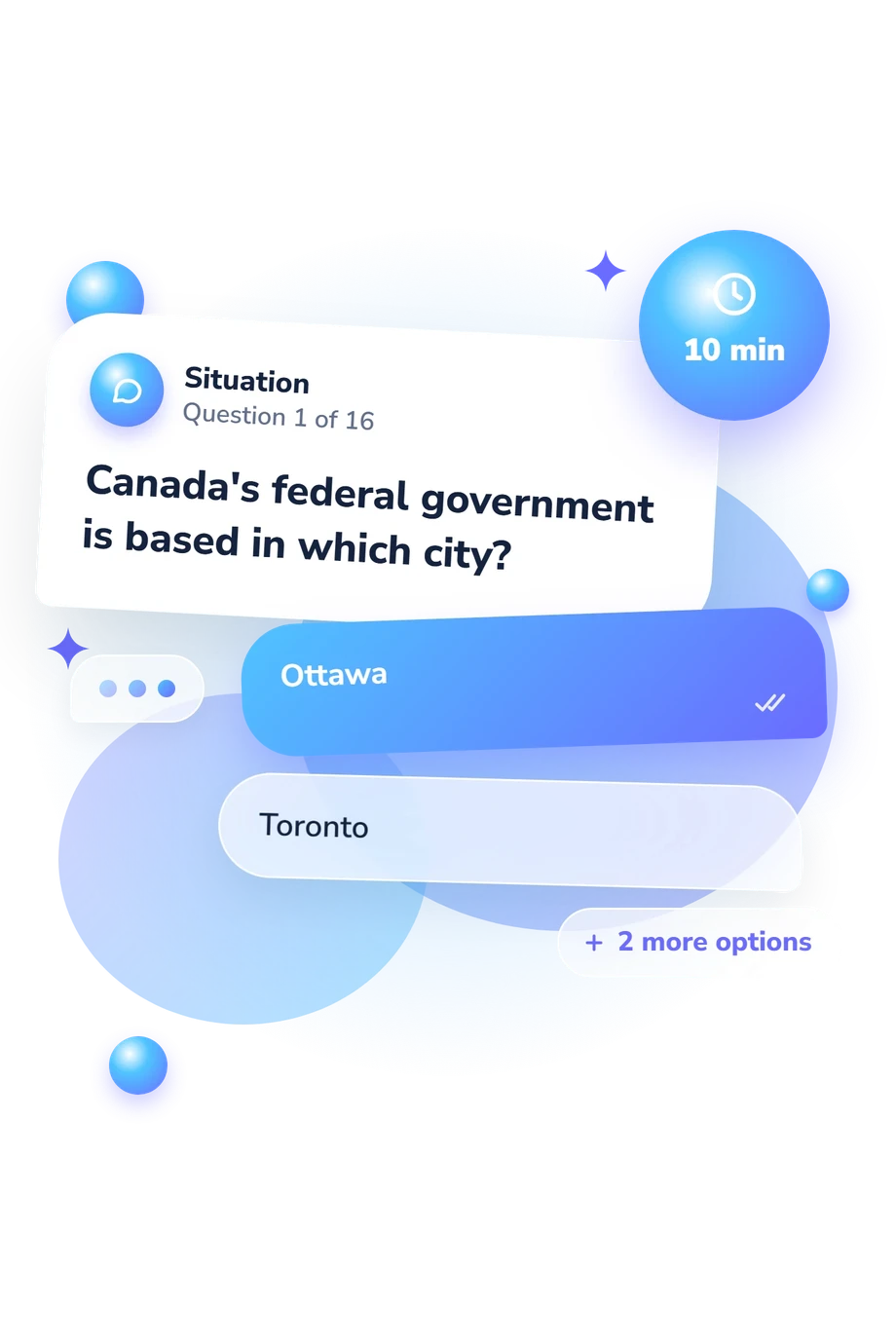
- Ottawa
- Toronto
- Montreal
- Vancouver
- Guadalajara
- Mexico City
- Monterrey
- Puebla
- Tegucigalpa
- San Salvador
- Managua
- San José
North America Capitals Quiz - Description and methodology of the test
People who want to check regional geography out of curiosity can use the North America Capitals Quiz to see how well they connect countries with national capitals. As a quiz on the capitals of North America, this assessment suits anyone checking factual recall across several subregions. The outcome is an overall performance summary for the presented matches, not a breakdown of every regional topic.
What This Assessment Explores
This questionnaire checks factual country-capital recognition across sovereign states in North America, Central America, and the Caribbean. Its items include familiar and less familiar pairings, inland capitals, neighboring places that are easy to confuse, and countries with similar names. In this North American capitals quiz, each item tests whether the respondent can retrieve the matching city or country.
The displayed scale is North America Capitals Knowledge: 0-16, reflecting correct answers about the covered capitals. Its result bands are:
- Foundational (0-6) means some capitals are recognized, but nearby countries or similar names may cause confusion.
- Developing (7-12) means many capitals are known, while less familiar Central American and Caribbean matches remain review targets.
- Strong (13-16) means the respondent demonstrates broad, reliable knowledge across the region.
The result is a snapshot of geographic recall on the presented capital matches.
Methodology and Content Sources
Each item presents four choices and asks for one country-capital match. Prompts involving addresses, itineraries, meetings, and reference lists distinguish nearby or similarly named places. The method emphasizes recognition over open-ended spelling.
The score reflects correct selections and is reported through the displayed total and its bands. The four-choice format used in this North America capitals test measures recognition of the presented country-capital match, not open-ended spelling, map-location skill, political-history knowledge, or recall outside the region.
Cybriwsky (2013) supplies a geographic reference for national capitals. The U.S. Department of State’s 5 FAH-1 H-1020 supports official country designations and capital names. Mason and Blankenship (1988) connect place-name geography with educational practice. These are content and educational references, not evidence validating this questionnaire’s scoring, reliability, or bands; the questionnaire is not presented as an adaptation of a published instrument.
Self-administered recall can be influenced by prior study, attention, guessing, and similar-name confusion. The catalogue’s performance bands describe performance on these questions; broader geographic ability requires other evidence.
- Cybriwsky, Roman Adrian. Capital Cities around the World: An Encyclopedia of Geography, History, and Culture. ABC-CLIO, 2013. ISBN 9781610692472.
- U.S. Department of State. 5 FAH-1 H-1020: Countries, Official Designations, and Capitals. Foreign Affairs Handbook, updated June 18, 2024.
- Mason, Mary T., and Glen Blankenship. “Where in the World? The Status of Place-Name Geography Instruction.” The Journal of Social Studies Research, vol. 12, no. 1, 1988, pp. 1-7. DOI 10.1177/235227981988012001001.
Updated: