
Protein Synthesis Quiz
How the Scales are Structured
Who Usually Takes This Test?
See How You Compare
Below is a preview of how scores are typically distributed across each scale.
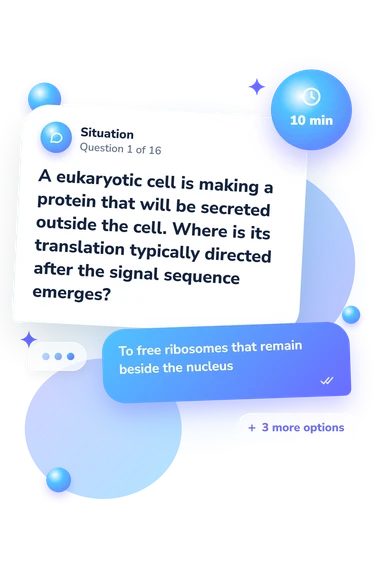
Example Questions From the Test
- In the nucleus
- On ribosomes in the cytoplasm
- Inside the Golgi apparatus
- In transport vesicles leaving the endoplasmic reticulum
- 3′-AUG CCU-5′
- 5′-UAC GGA-3′
- 5′-AUG CCU-3′
- 5′-ATG CCT-3′
- 5′-UAC AAA-3′
- 5′-AUG UUU-3′
- 3′-AUG UUU-5′
- 5′-ATG TTT-3′
Protein Synthesis Quiz - Description and methodology of the test
Students reviewing cell biology can use the protein synthesis quiz to decide whether they are ready to connect transcription, RNA processing, and translation in further study. It suits learners who want a protein synthesis practice quiz before studying or revising. An overall knowledge band indicates whether broad review may be useful.
What This Assessment Explores
This questionnaire connects gene-expression steps in eukaryotic cells. It covers nucleotide direction, RNA processing, codons, ribosomes, mutations, and protein targeting. Students can use it as a molecular biology study quiz for revision or exam readiness.
Protein Synthesis Knowledge is reported in three bands: Foundations to review (0-6), Developing knowledge (7-12), and Strong knowledge (13-16). The bands indicate whether to revisit DNA, RNA, codons, and ribosomes; develop practice with sequences, mutations, RNA processing, and targeting; or connect major mechanisms and apply them to common molecular scenarios. This score is an educational summary, not a measure of laboratory proficiency.
The question themes are:
- Transcription and RNA processing show how DNA becomes messenger RNA.
- Translation shows how codons, anticodons, ribosomes, and termination guide protein production.
- Mutations and targeting show effects on reading frames, signal sequences, and protein destinations.
Methodology and Scientific Basis
Each item presents a molecular-biology scenario and four answer choices, requiring the best explanation. Questions move between recognition and application: identifying transcription or translation events, reading DNA and RNA direction, predicting mutation effects, and tracing protein production or targeting. As a DNA-and-protein-synthesis quiz, it supports revision of connected genetic mechanisms. The displayed result is a single score from 0-16, and the questionnaire does not state how answers are weighted or whether the bands are norm-referenced.
Lodish and colleagues' 2021 textbook provides the framework for gene expression, RNA processing, translation, targeting, and eukaryotic cell organization. The questionnaire is conceptually consistent with that framework, not an adaptation or reproduction of the textbook. The 1961 study by Nirenberg and Matthaei supports the link between nucleotide sequences and amino-acid incorporation, while the 1961 study by Brenner, Jacob, and Meselson supports messenger RNA's connection between genes and ribosomes.
Interpretation should focus on the overall knowledge band and the study topics it points toward. Selected answers can also reflect guessing, attention, prior instruction, and current familiarity with the material.
- Lodish H, Berk A, Kaiser CA, Krieger M, Bretscher A, Ploegh H, Martin KC, Yaffe MB, Amon A. Molecular Cell Biology. 9th ed. New York, NY: W.H. Freeman; 2021.
- Nirenberg MW, Matthaei JH. The dependence of cell-free protein synthesis in E. coli upon naturally occurring or synthetic polyribonucleotides. Proceedings of the National Academy of Sciences of the United States of America. 1961;47(10):1588-1602. DOI 10.1073/pnas.47.10.1588.
- Brenner S, Jacob F, Meselson M. An Unstable Intermediate Carrying Information from Genes to Ribosomes for Protein Synthesis. Nature. 1961;190:576-581. DOI 10.1038/190576a0.
Updated: