
Cortisol Quiz
How the Scales are Structured
Who Usually Takes This Test?
See How You Compare
Below is a preview of how scores are typically distributed across each scale.
Example Questions From the Test
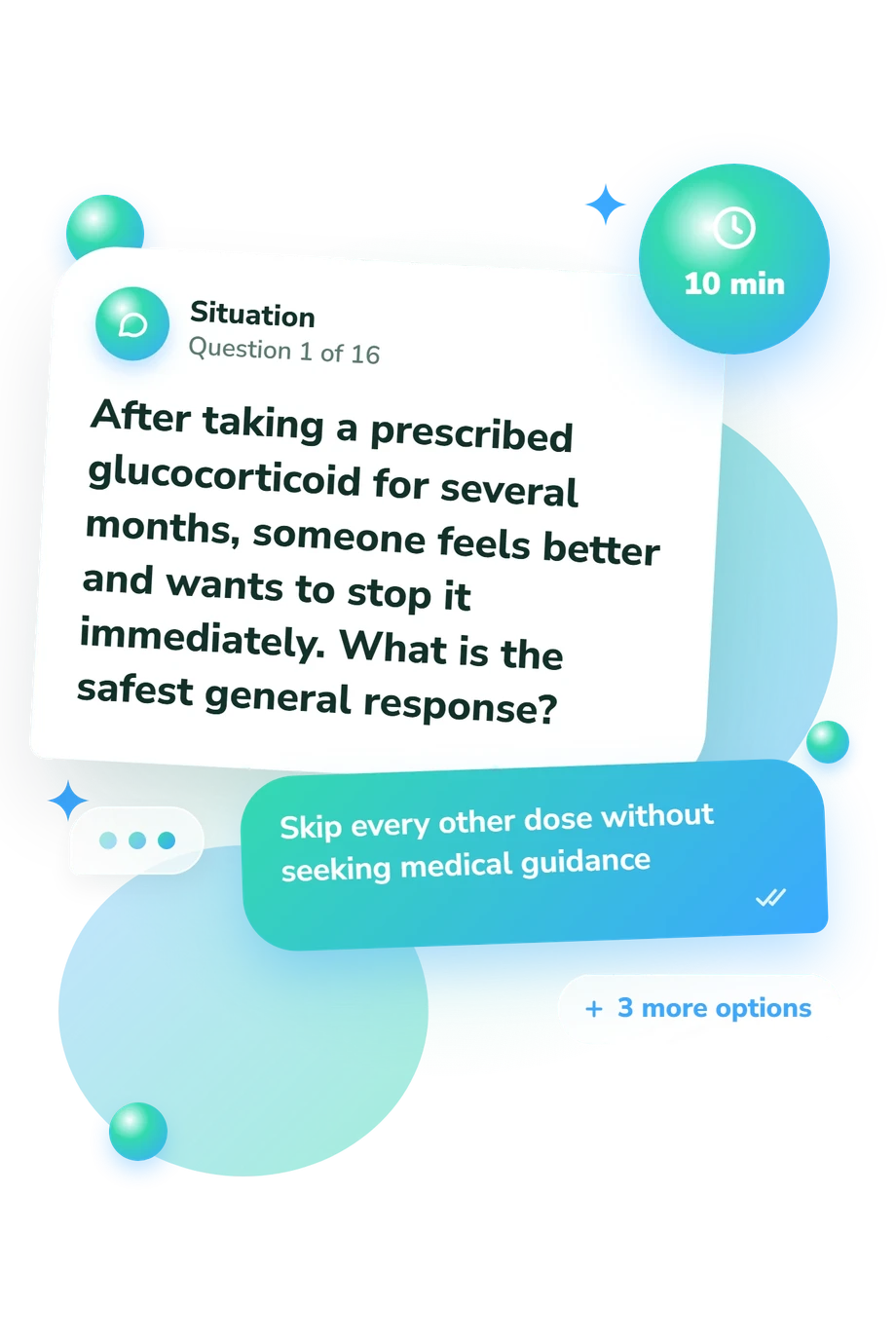
- Skip every other dose without seeking medical guidance
- Move the entire dose to bedtime before stopping the next day
- Contact the prescriber because abrupt withdrawal can be dangerous and a supervised taper may be needed
- Replace the medicine with an over-the-counter cortisol supplement
- A rapid reduction in available blood glucose
- Greater availability of energy, including glucose, to meet demand
- A sharp fall in blood pressure to conserve energy
- Immediate production of antibodies against infection
- In the pancreas, alongside insulin
- In the thyroid gland at the front of the neck
- In the pituitary gland at the base of the brain
- In the adrenal cortex, within glands located above the kidneys
Cortisol Quiz - Description and methodology of the test
For readers who want to understand cortisol without turning a symptom into a conclusion, the cortisol quiz offers a focused knowledge check. It suits someone considering the question of whether I have high cortisol while wanting to understand the physiology behind it. The assessment helps identify which topics deserve closer reading and which assumptions need more context.
What This Assessment Explores
This assessment checks whether readers connect cortisol physiology with health information rather than interpret symptoms in isolation. It covers the rise around waking, nighttime low, patterns of excess or deficiency, and effects of medication, stress, and test timing. That context suits someone considering a quiz about high cortisol but wanting more than symptom matching.
The question themes are:
- Physiology and rhythm show where cortisol is produced and why timing matters.
- Excess and deficiency patterns contrast possible symptoms and hormone relationships without proving a disorder.
- Testing, medication, and safety explain laboratory methods, supervised withdrawal, and urgent warning signs.
Together, these themes produce one scale, Cortisol Knowledge (0-16). Foundations to build (0-6) signals concepts to review; Developing understanding (7-12) reflects many essentials with room to strengthen context; Strong understanding (13-16) reflects a well-rounded grasp of physiology and interpretation. These are educational bands, not clinical cutoffs.
Methodology and Evidence Base
Each item presents a health-related situation with four answer choices, asking the respondent to select the most accurate interpretation. The content tests applied understanding: recognizing daily rhythm, distinguishing possible excess from insufficiency, identifying what common laboratory tests measure, and accounting for medication effects and context.
The questionnaire functions as a cortisol knowledge test, combining responses into a single knowledge score. Its bands organize performance by understanding rather than disease probability. No population norms, diagnostic algorithm, reliability estimate, or standardized clinical status is established for this online questionnaire.
Nieman et al. (2008) is the closest evidence base for possible cortisol excess, including medication history, late-night salivary cortisol, and urinary free cortisol. Bornstein et al. (2016) supports primary adrenal insufficiency, while Beuschlein et al. (2024) supports cautions about glucocorticoid exposure and withdrawal. The questionnaire is conceptually consistent with these guidelines, not an adaptation of any of them.
Because answers depend on attention, prior knowledge, and honest interpretation, the result is a snapshot of educational understanding. Symptoms, medicines, laboratory findings, and urgent signs require clinical context; prescribed glucocorticoids should not be stopped abruptly.
- Nieman LK, Biller MK, Findling JW, Newell-Price J, Savage MO, Stewart PM, Montori VM. The Diagnosis of Cushing's Syndrome: An Endocrine Society Clinical Practice Guideline. The Journal of Clinical Endocrinology & Metabolism. 2008;93(5):1526-1540. 10.1210/jc.2008-0125
- Bornstein SR, Allolio B, Arlt W, Barthel A, Don-Wauchope A, Hammer GD, Husebye ES, Merke DP, Murad MH, Stratakis CA, Torpy DJ. Diagnosis and Treatment of Primary Adrenal Insufficiency: An Endocrine Society Clinical Practice Guideline. The Journal of Clinical Endocrinology & Metabolism. 2016;101(2):364-389. 10.1210/jc.2015-1710
- Beuschlein F, Else T, Bancos I, Hahner S, Hamidi O, van Hulsteijn L, Husebye ES, Karavitaki N, Prete A, Vaidya A, Yedinak C, Dekkers OM. European Society of Endocrinology and Endocrine Society Joint Clinical Guideline: Diagnosis and Therapy of Glucocorticoid-induced Adrenal Insufficiency. The Journal of Clinical Endocrinology & Metabolism. 2024;109(7):1657-1683. 10.1210/clinem/dgae250
Updated: