
Breakup Brad Quiz
How the Scales are Structured
Who Usually Takes This Test?
See How You Compare
Below is a preview of how scores are typically distributed across each scale.
Example Questions From the Test
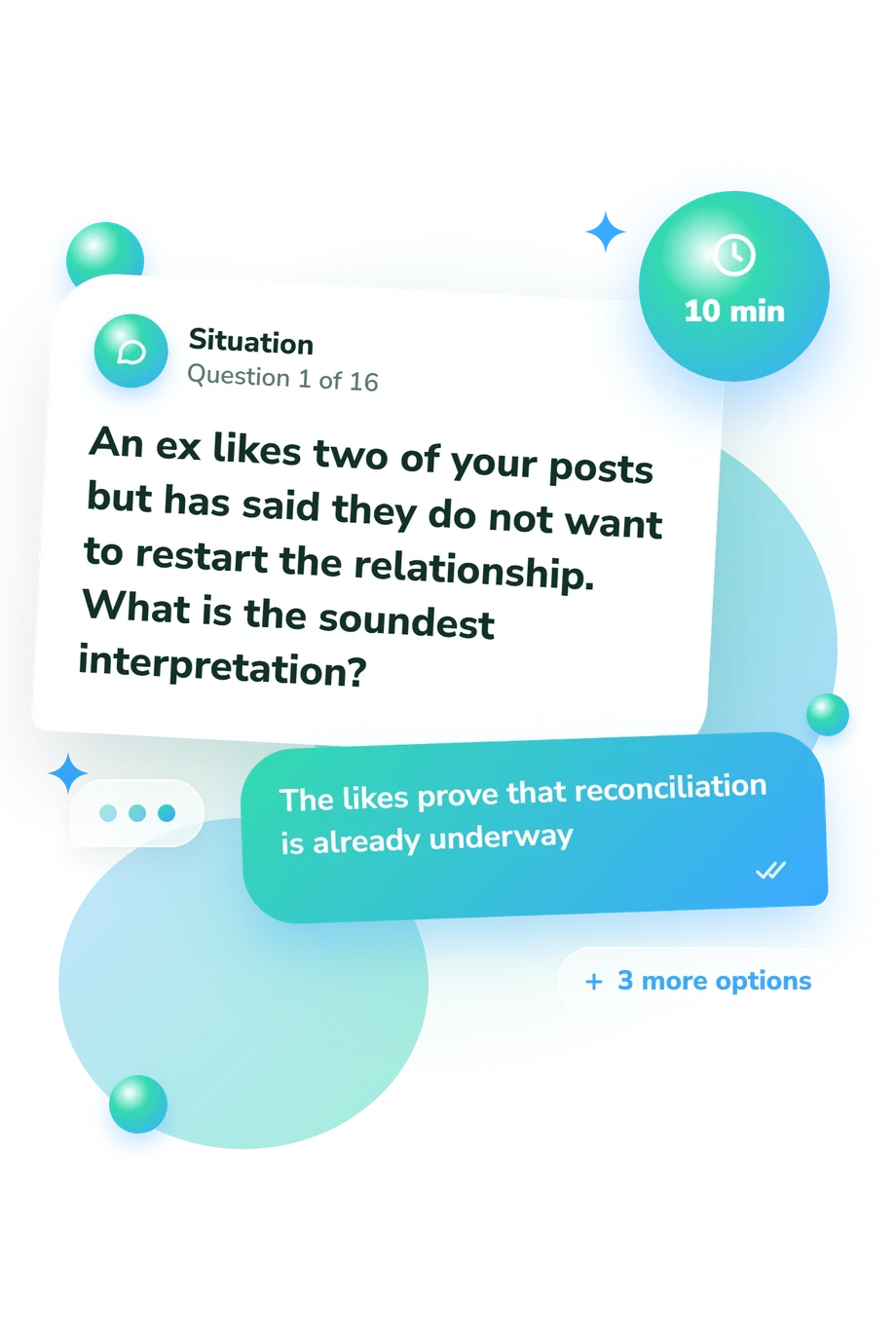
- The likes prove that reconciliation is already underway
- The likes mean you should begin messaging every day
- The likes cancel the earlier request for distance
- Small online signals are ambiguous, so their stated boundary should guide your response
- Wanting daily updates about the other person's mood
- Coordinating shared parenting or resolving a joint lease
- Trying to monitor whom the other person is dating
- Hoping repeated check-ins will create jealousy
- To guarantee that curiosity brings the other person back
- To make the other person worry about losing you
- To regain perspective and reduce reactive contact
- To avoid ever processing what happened
Breakup Brad Quiz - Description and methodology of the test
Readers who want to examine their own choices after a separation can use the BreakupBrad Quiz to test practical understanding rather than predict another person’s behavior. The assessment also works as a breakup communication quiz, focusing on decisions that affect contact, boundaries, emotional recovery, reconciliation, and immediate safety. Its result highlights principles a respondent may recognize confidently or need to review.
What This Assessment Explores
This assessment examines whether a respondent can distinguish respectful breakup conduct from pressure, monitoring, impulsivity, and wishful interpretation. It is intended for people reflecting on contact, distance, recovery, reconciliation, or safety after a relationship ends.
The displayed scale is Breakup Brad Knowledge (0-16): Foundation to build (0-6), Developing understanding (7-12), or Strong understanding (13-16). As a breakup boundaries quiz, it summarizes recognition of constructive principles rather than the likelihood of getting an ex back.
The scenarios cover dimensions:
- Interpreting signals shows whether mixed online behavior is treated cautiously.
- Contact and consent show whether boundaries and willingness guide communication.
- Recovery and closure show whether feelings, reflection, and readiness are understood realistically.
- Safety and repair show whether the result recognizes accountable apologies and proportionate responses to danger.
Methodology and Scientific Basis
Each scenario presents four answer choices and asks for the soundest interpretation, appropriate response, or constructive next step. This situational format tests applied judgment about boundaries, contact, online monitoring, reconciliation, apology, and crisis response.
Scoring compares selected choices with constructive breakup principles and summarizes the pattern as educational knowledge. Read as a Breakup Brad Quiz, it does not estimate reunion likelihood; threats, stalking, coercion, or danger require action regardless of the total.
The content is conceptually consistent with De Smet et al. (2015) on unwanted pursuit after relationship dissolution, Marshall (2012) on Facebook surveillance of former partners and recovery, and Bevan et al. (2003) on compliance-gaining strategies in reconciliation attempts. These studies clarify the themes, but the questionnaire is not presented as an adaptation or standardized administration of any one instrument.
Its score is educational rather than normed against a published reference group, so interpretation should stay close to the scenarios and bands. The assessment can function as a breakup recovery quiz, prompting reflection on habits and choices, while self-report remains sensitive to current emotion, selective memory, and self-presentation. The result is a starting point for review, not a complete assessment of a relationship.
- De Smet, Olivia, Katarzyna Uzieblo, Tom Loeys, Ann Buysse, and Thomas Onraedt. "Unwanted pursuit behavior after breakup: occurrence, risk factors, and gender differences." Journal of Family Violence, 2015, 30(6), 753-767. 10.1007/s10896-015-9687-9
- Marshall, Tara C. "Facebook surveillance of former romantic partners: associations with postbreakup recovery and personal growth." Cyberpsychology, Behavior, and Social Networking, 2012, 15(10), 521-526. 10.1089/cyber.2012.0125
- Bevan, Jennifer L., Kenzie A. Cameron, and Megan R. Dillow. "One more try: Compliance-gaining strategies associated with romantic reconciliation attempts." Southern Communication Journal, 2003, 68(2), 121-135. 10.1080/10417940309373255
Updated: