
Dental Quiz
How the Scales are Structured
Who Usually Takes This Test?
See How You Compare
Below is a preview of how scores are typically distributed across each scale.
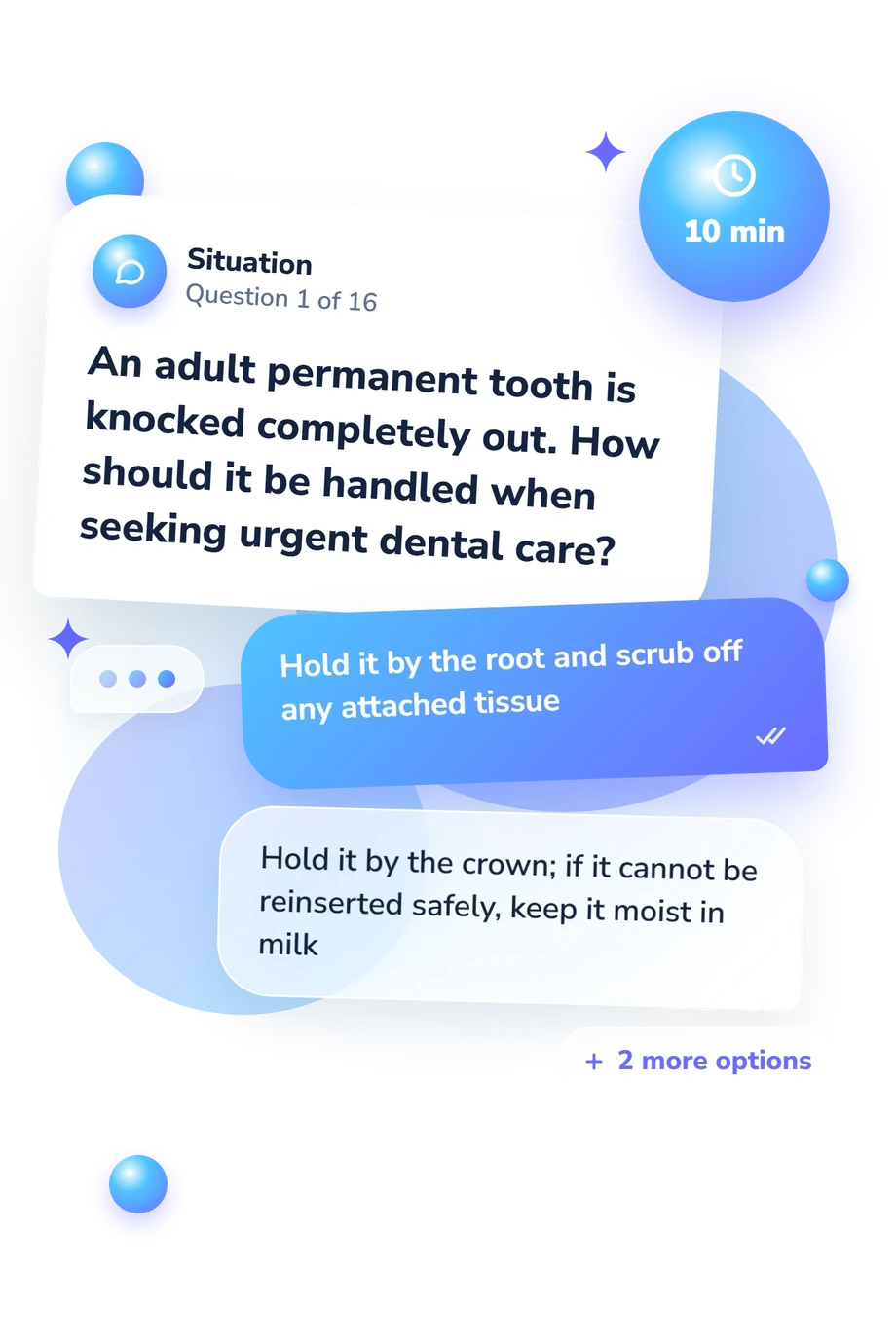
Example Questions From the Test
- Scrubbing the spot firmly with an abrasive paste
- Waiting until a hole forms before changing oral-care habits
- Avoiding all contact between the area and saliva
- Improved plaque control and appropriate fluoride exposure
- Brush immediately with firm pressure
- Hold the drink around the teeth to dilute its acidity
- Rinse with water and wait before brushing
- Brush immediately with baking soda to neutralize the acid
- Enamel
- Dentin
- Cementum
- Pulp
Dental Quiz - Description and methodology of the test
Readers can use this dental quiz to check how confidently they recognize sound oral-health choices. This oral health quiz highlights strengths and topics worth revisiting, offering a focused starting point for learning before a routine visit or further reading on their own. It suits anyone who wants a clearer review of everyday dental principles.
What This Assessment Explores
Rather than testing rare terminology, the questionnaire examines whether a reader can apply oral-health principles to realistic situations. It covers prevention, brushing and flossing, fluoride, plaque, enamel, decay, treatment choices, dental imaging, primary teeth, and urgent warning signs. For readers seeking a dental knowledge assessment, it provides a structured way to review practical knowledge without requiring a clinical history.
The Dental Knowledge score (0-16) is organized as follows:
- Foundation to build (0-6) indicates that important concepts need targeted review.
- Developing knowledge (7-12) shows that many dental basics are understood, while practical details remain to strengthen.
- Strong knowledge (13-16) reflects a well-rounded grasp of everyday dental health.
These bands show whether further learning should focus on fundamentals, practical application, or occasional clarification. The score describes knowledge demonstrated on this questionnaire, not a diagnosis.
Methodology and Scientific Basis
Each item presents a dental question, with some framed as practical situations, followed by four answer choices. Together, these quiz questions and answers about dental health test recognition of sound oral-health principles, including when self-care is appropriate and when professional or urgent care matters. One point is awarded for each correct response, and the total is based on correct answers only.
Its conceptual reference point is CMOHK (Macek et al., 2010), a published measure of oral-health conceptual knowledge. This questionnaire is conceptually consistent with that work, not an adaptation of the instrument. Macek et al. (2017) examined relationships between conceptual knowledge and oral-health outcomes, while OHLP, studied by Spinler et al. (2021), adds context for oral and dental health-system knowledge. The questionnaire should not be assumed to have the same standardization, norms, reliability, or validity as those published instruments.
Guessing, prior education, attention, and current concerns can affect performance. Missed topics can guide further learning, help the reader prepare focused questions for dental care, and show which oral-health principles merit closer review.
- Macek M.D., Haynes D., Wells W., Bauer-Leffler S., Cotten P.A., Parker R.M. Measuring conceptual health knowledge in the context of oral health literacy: preliminary results. Journal of Public Health Dentistry. 2010;70(3):197-204. 10.1111/j.1752-7325.2010.00165.x
- Macek M.D., Atchison K.A., Chen H., Wells W., Haynes D., Parker R.M., et al. Oral health conceptual knowledge and its relationships with oral health outcomes: Findings from a Multi-site Health Literacy Study. Community Dentistry and Oral Epidemiology. 2017;45(4):323-329. 10.1111/cdoe.12294
- Spinler K., Valdez R., Aarabi G., Dingoyan D., Reissmann D.R., Heydecke G., von dem Knesebeck O., Kofahl C. Development of the Oral Health Literacy Profile (OHLP)-Psychometric properties of the oral health and dental health system knowledge scales. Community Dentistry and Oral Epidemiology. 2021;49(6):609-616. 10.1111/cdoe.12688
Updated: