
Pronoun Quiz
How the Scales are Structured
Who Usually Takes This Test?
See How You Compare
Below is a preview of how scores are typically distributed across each scale.
Example Questions From the Test
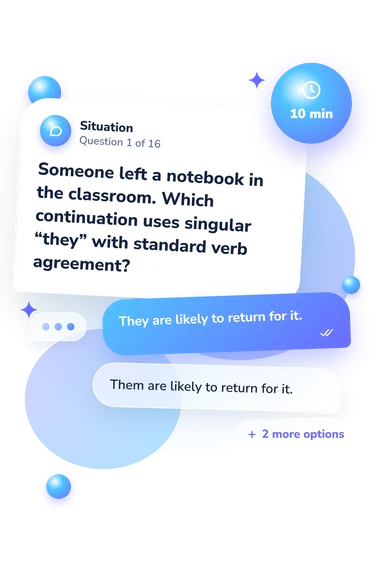
- They are likely to return for it.
- Them are likely to return for it.
- Their is likely to return for it.
- They is likely to return for it.
- It receives the action of the verb.
- It shows that the design belongs to the director.
- It emphasizes that the director personally approved it.
- It introduces a dependent clause about the director.
- I
- me
- myself
- mine
Pronoun Quiz - Description and methodology of the test
People who want to check how accurately they choose and refer to pronouns can use this assessment as a focused language exercise. The pronoun quiz suits anyone reviewing standard English, with a result that identifies rules worth revisiting. As a quiz about pronouns, it asks respondents to apply a choice in context rather than recall an isolated definition.
What This Assessment Explores
People taking this assessment identify and use pronouns in ordinary written-English sentences. The items cover personal, possessive, reflexive, reciprocal, demonstrative, and relative forms, together with subject and object case, pronoun-antecedent agreement, and clear reference.
Several questions ask whether a reader can choose forms such as whom, herself, its, or each other from context. Others address singular they, ambiguous reference, and the difference between a pronoun and another grammatical word. That makes the tool useful as an online pronoun assessment for targeted practice in sentence-level accuracy.
The result is reported as Pronoun Knowledge (0-16), with three catalogue bands:
- Foundational Review (0-6) indicates that some basic patterns are recognized, while case, agreement, antecedents, and pronoun types need review.
- Developing Command (7-12) indicates understanding of many common rules, with possible inconsistency in more demanding structures.
- Strong Command (13-16) indicates accurate, practical knowledge of pronoun choice and reference in standard written English.
Methodology and Evidence Base
Each item presents a sentence with four answer choices. The respondent selects the form or interpretation that fits standard written English, so the task measures applied recognition of grammatical relationships rather than recall of labels. This makes it a practical pronoun grammar quiz for reviewing choices in context.
The result is reported on one displayed scale with a corresponding band; it summarizes performance on these items rather than placing the respondent in a population percentile. The choices sample grammatical form, function, agreement, and reference in context.
The questionnaire's categories are conceptually consistent with distinctions described by Huddleston and Pullum (2002) and Aarts, Chalker, and Weiner (2014), while its attention to antecedent clarity is conceptually consistent with Hobbs (1978). It is not an adaptation of those works.
Use the band to choose what to review, such as case, agreement, reference, or pronoun type. Performance can vary with attention, familiarity with edited English, and item context, so the result is a learning snapshot rather than a complete measure of writing ability.
- Huddleston, Rodney, and Geoffrey K. Pullum. The Cambridge Grammar of the English Language. Cambridge University Press, 2002. 10.1017/9781316423530
- Aarts, Bas, Sylvia Chalker, and Edmund S. C. Weiner. The Oxford Dictionary of English Grammar. 2nd ed. Oxford University Press, 2014. ISBN: 9780199658237
- Hobbs, Jerry R. "Resolving pronoun references." Lingua 44, no. 4 (1978): 311-338. 10.1016/0024-3841(78)90006-2