
Werewolf or Vampire Quiz
How the Scales are Structured
Who Usually Takes This Test?
See How You Compare
Below is a preview of how scores are typically distributed across each scale.
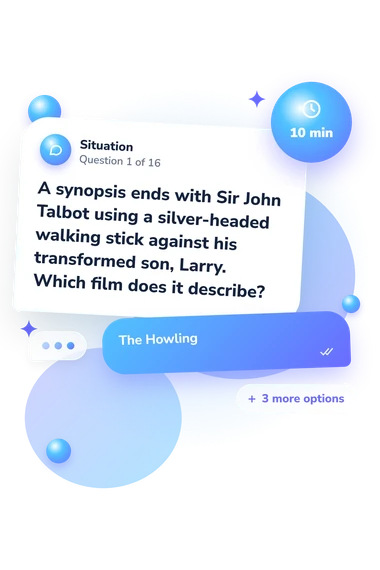
Example Questions From the Test
- John Landis
- George A. Romero
- Joe Dante
- Wes Craven
- Salem's Lot
- I Am Legend
- Interview with the Vampire
- Fevre Dream
- Carmilla appeared roughly twenty-five years earlier
- Dracula appeared about twenty years earlier
- They were published in the same year
- Carmilla appeared about fifty years later
Werewolf or Vampire Quiz - Description and methodology of the test
Readers who enjoy classic horror can use this knowledge check to sort familiar stories, characters, and traditions before deciding whether a deeper review of vampire and werewolf fiction would be useful. The werewolf or vampire quiz suits anyone who wants a focused, low-pressure way to test recall. As a vampire or werewolf personality quiz, it emphasizes cultural knowledge rather than personal identity or supernatural traits.
What This Assessment Explores
This questionnaire measures recognition of influential werewolf and vampire books, films, characters, authors, and tradition-specific rules. It suits readers checking cultural and literary knowledge, not people seeking a personality classification.
Someone approaching an am i a vampire or a werewolf quiz may expect a creature label, but this result instead shows which material you identify accurately.
The main knowledge areas are:
- Werewolf cinema tests whether you connect films with directors, actors, plots, and release context.
- Vampire literature checks recognition of authors, characters, scenes, and publication history.
- Folklore and adaptation knowledge measures whether you apply rules to the specific story or tradition.
The displayed scale, Werewolf and Vampire Knowledge (0-16), summarizes performance. Foundations (0-6) signals basic recognition, Developing Knowledge (7-12) a solid but incomplete grasp, and Monster Scholar (13-16) strong accuracy.
Methodology and Evidence Base
Each item uses four-option multiple choice, with one best answer tied to the work or tradition named. As an are you a vampire or werewolf quiz, it measures recall and interpretation rather than temperament. This is a content-based knowledge assessment, not a standardized psychological trait scale.
Responses are checked against an answer key, and the total becomes a profile of performance across the selected material. A higher result indicates more reliable recognition of the tested references; a lower result identifies topics to revisit, not a universal level of folklore expertise.
Its evidence base is conceptual, not psychometric. Guiley (2011) frames vampire and werewolf lore; Silver and Ursini (2011) and Mann (2020) support the film-history and adaptation context, while Stoker's Dracula supplies a primary literary source. These books inform question content, but they do not validate this online questionnaire.
With no reported norms, reliability estimates, or clinical standardization, the bands are descriptive categories for this question set. Familiarity with particular adaptations, honest recall, and current attention can affect performance. The result works best as a focused knowledge snapshot read alongside the stories and films behind missed answers.
- Rosemary Ellen Guiley. The Encyclopedia of Vampires and Werewolves, Second Edition. New York: Facts On File, 2011. ISBN 978-1-4381-3632-5.
- Alain Silver and James Ursini. The Vampire Film: From Nosferatu to True Blood. 4th ed. Milwaukee: Limelight Editions, 2011. ISBN 978-0-87910-395-8.
- Craig Ian Mann. Phases of the Moon: A Cultural History of the Werewolf Film. Edinburgh: Edinburgh University Press, 2020. 10.3366/edinburgh/9781474441117.001.0001.
- Bram Stoker. Dracula. Westminster: Archibald Constable and Company, 1897.