
Subject Verb Agreement Quiz
How the Scales are Structured
Who Usually Takes This Test?
See How You Compare
Below is a preview of how scores are typically distributed across each scale.
Example Questions From the Test
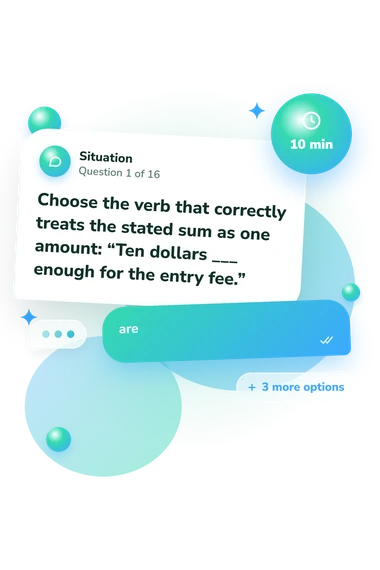
- are
- is
- have been
- were
- The Chronicles of Narnia is on my reading list.
- The Chronicles of Narnia have a place on my reading list.
- The Chronicles of Narnia are on my reading list.
- The Chronicles of Narnia were on my reading list as one title.
- are
- is
- has
- was
Subject Verb Agreement Quiz - Description and methodology of the test
Students, teachers, editors, and writers can use this subject verb agreement quiz when reviewing sentence structure for study, revision, or practical writing. Its multiple-choice format makes this questionnaire a quiz in subject verb agreement: each sentence has a blank and several verb forms, producing an overall indication of agreement knowledge for targeted grammar practice.
What This Assessment Explores
This assessment asks whether you identify the subject and choose a matching verb when nearby nouns or unfamiliar structures distract you. It suits learners, editors, teachers, and writers reviewing agreement.
For learners and reviewers, this agreement quiz samples these constructions; its result indicates an overall performance level rather than a subskill breakdown:
- Subject-Verb Agreement Knowledge (0-16) places performance in Foundations to strengthen (0-6), where basic patterns may be disrupted by nearby nouns or unfamiliar structures; Developing control (7-12), where many everyday sentences are handled but compound subjects, relative clauses, quantities, or inverted structures may need practice; or Strong command (13-16), where agreement is consistent in straightforward and challenging constructions.
- Head-subject recognition shows whether you follow the true subject.
- Special patterns and structural variation cover amounts, titles, each, everyone, number expressions, compound or alternative subjects, clauses, existential there, and irregular plurals.
Methodology and Scientific Basis
Each item presents a sentence with a blank and several verb choices. The respondent selects the form that fits the subject, so the format is selected-response judgment rather than open-ended composition. Items sample singular and plural subjects, intervening nouns, titles and amounts, compound or alternative subjects, clauses, existential there, and irregular plurals.
Scoring does not specify how individual selections contribute to the displayed knowledge result. The questionnaire's mixed item set provides sample quiz practice in subject-verb agreement and an overall performance indication, without explaining why an incorrect response occurred.
The content is conceptually consistent with Bock and Miller's agreement-attraction study, which examines how intervening nouns influence agreement choices, and with Hudson's account and Huddleston and Pullum's account of English agreement. This questionnaire is not a published instrument, adaptation, or validation of those works.
This questionnaire has no established norm group, reported reliability evidence, or diagnostic cutoff, so interpret the result as performance on these sentences; attention, familiarity, and the limited grammar range can affect it.
- Broken agreement. Kathryn Bock and Carol A. Miller. Cognitive Psychology, 23(1), 45-93, 1991. 10.1016/0010-0285(91)90003-7
- The Cambridge Grammar of the English Language. Rodney Huddleston and Geoffrey K. Pullum. Cambridge University Press, 2002. 10.1017/9781316423530
- Subject-verb agreement in English. Richard Hudson. English Language & Linguistics, 3(2), 173-207, 1999. 10.1017/S1360674399000210