
Mascara Quiz
How the Scales are Structured
Who Usually Takes This Test?
See How You Compare
Below is a preview of how scores are typically distributed across each scale.
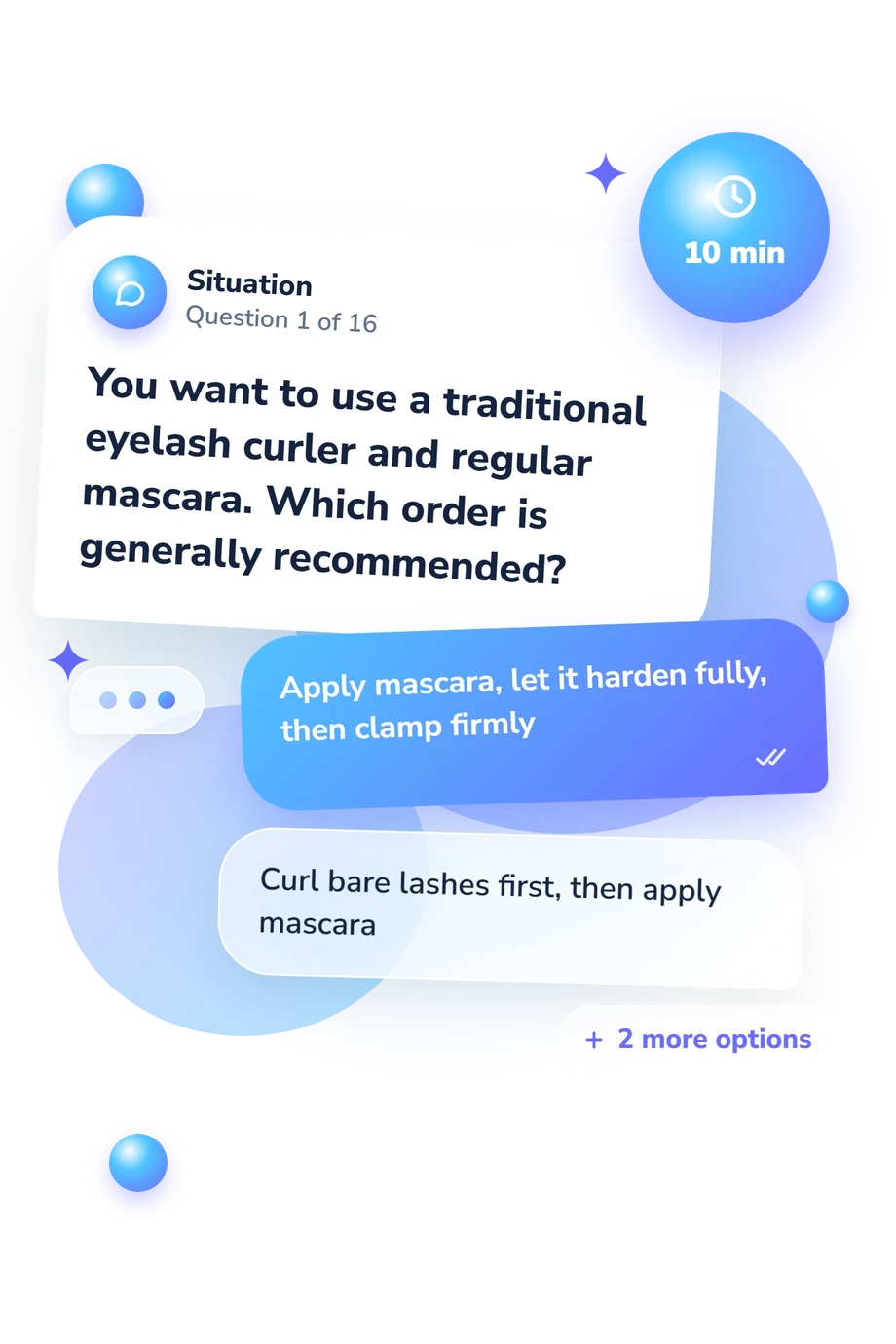
Example Questions From the Test
- Apply mascara, let it harden fully, then clamp firmly
- Curl bare lashes first, then apply mascara
- Apply mascara to the curler before curling
- Curl only after removing the mascara
- Create a base that can enhance the appearance or wear of mascara
- Replace the need for mascara remover
- Dissolve old mascara left on the lashes
- Permanently darken the natural lashes
- To make the formula waterproof
- To separate lashes and remove excess clumps
- To curl the lashes permanently
- To shorten the drying time by absorbing moisture
Mascara Quiz - Description and methodology of the test
Anyone who wants to make everyday lash care more deliberate can use this mascara quiz to check practical knowledge before changing products or routines. It suits people who apply mascara and want a clear baseline for everyday mascara care rather than a brand recommendation. Its result offers a broad indication of knowledge rather than identifying a particular product or routine.
What This Assessment Explores
Practical mascara use-not taste, brand loyalty, or beauty ideals-is the focus. Situations cover preparation, mascara application knowledge, formula behavior, removal, and eye-area care for people reviewing everyday lash routines.
The scenarios focus on four knowledge areas:
- Application technique shows whether curling, priming, coating, and combing are sequenced sensibly.
- Formula knowledge indicates understanding of wear, moisture resistance, and removal behavior.
- Tool knowledge covers how wand shape, excess product, and precise placement affect application.
- Removal and hygiene knowledge covers cleansing, sharing, replacement, and irritation responses.
One displayed scale is Mascara Knowledge (0-16). Its bands are Foundations to build (0-6), Developing knowledge (7-12), and Strong knowledge (13-16). The score summarizes knowledge across these areas. It describes what the respondent currently recognizes, not a personal beauty style.
Methodology and Scientific Basis
Each item presents an everyday situation with four answer choices. The respondent selects the option that best matches mascara practice, so the format tests recognition rather than dexterity, visual acuity, or product fit. The result is a combined educational score, not separate subscores.
This questionnaire is neither a published clinical instrument nor an adaptation. Pack et al. (2008) supports its hygiene content by documenting contamination associated with mascara use. Ng et al. (2016) adds context about eye cosmetics and the ocular surface, while Food and Drug Administration guidance supports precautions around sharing, dried products, removal, and irritation. These sources provide context, not validation.
As an educational snapshot, the result offers a broad summary. The displayed bands are catalogue-defined educational interpretations, not population norms or diagnostic thresholds; answers may reflect product familiarity, memory, routines, or a tendency to choose the safest-sounding option. The result can indicate whether a broad review of mascara knowledge may be useful, but it cannot identify which topic needs attention. It cannot show how consistently someone applies mascara or how their eyes respond to a specific formula.
- Pack, Latricia D., M. Gary Wickham, Rebecca A. Enloe, and Denise N. Hill. "Microbial contamination associated with mascara use." Optometry, vol. 79, no. 10, 2008, pp. 587-593. 10.1016/j.optm.2008.02.011.
- Ng, Alison Yuk San, Katharine S. E. Evans, Rachel V. North, Lyndon Jones, and Christine Purslow. "Impact of Eye Cosmetics on the Eye, Adnexa, and Ocular Surface." Eye & Contact Lens: Science & Clinical Practice, vol. 42, no. 4, 2016, pp. 211-220. 10.1097/ICL.0000000000000181.
- Food and Drug Administration. "Eye Cosmetic Safety." U.S. Food and Drug Administration, updated December 18, 2006.
Updated: