
Genesis Quiz
How the Scales are Structured
Who Usually Takes This Test?
See How You Compare
Below is a preview of how scores are typically distributed across each scale.
Example Questions From the Test
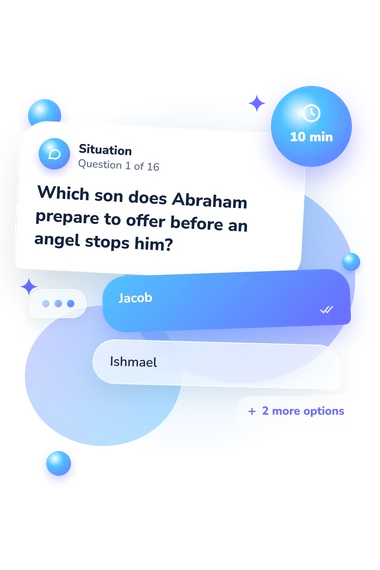
- Jacob
- Ishmael
- Isaac
- Joseph
- He buys it from Esau for a meal of stew
- He disguises himself and presents food while claiming to be Esau
- He defeats Esau in a wrestling contest
- He waits until Esau voluntarily gives it to him
- Escaping a famine affecting the surrounding lands
- Providing protection for Noah’s descendants during another flood
- Creating a temple where Abraham can offer sacrifices
- Making a name for themselves and avoiding dispersion
Genesis Quiz - Description and methodology of the test
Readers preparing for Bible study on Genesis, classroom discussion, or a focused rereading can use this assessment to decide which passages deserve attention first. Its prompts organize review around the book’s narrative, relationships, promises, and turning points. With the Genesis Quiz as a starting point, readers can plan a compact review of the storyline and select passages for closer reading.
What This Assessment Explores
Across the questionnaire, prompts sample the book’s sequence from creation and Eden through Noah, Abraham, Jacob, and Joseph. Several bible quiz questions from the book of Genesis ask about motives, family relationships, covenant signs, dreams, promises, and consequences, sampling factual recognition alongside chronology, relationships, covenant themes, and consequences. Readers can use the result to identify where their mental map is secure and where rereading would clarify chronology or relationships.
The result is organized into three bands:
- Foundation (0-6) indicates recognition of some central people or events, while the book’s sequence and major covenants may need review.
- Developing (7-12) indicates a solid grasp of the main narrative, with details, motives, and consequences still becoming more precise.
- Strong (13-16) indicates detailed, connected knowledge of chronology, family relationships, and recurring promises.
Methodology and Evidence Base
Within the online format, the questionnaire presents questions from Genesis accompanied by four answer choices. Each asks the reader to select the answer that best matches the biblical narrative, covering recognition, sequence, relationships, and cause-and-effect across major episodes and familiar storylines. The questionnaire presents a result on the displayed 0-16 Genesis Knowledge scale, but no item-level formula, weighting system, or norm group is stated for this questionnaire.
Its closest methodological reference is the Standardized Bible Content Test (AABC, 1980), a published Bible-content instrument for assessing knowledge of biblical material. The questionnaire is conceptually consistent with that instrument, not a documented adaptation of it. Gaede’s 1993 analysis provides context for criterion-referenced Bible-content scores; Nelson’s 2004 study distinguishes scriptural knowledge from moral judgment, while Walter Brueggemann’s Genesis commentary in Keck’s edited volume supports attention to literary sequence, covenant themes, and family narratives.
Interpretation should remain focused on performance on these 16 prompts. A higher band reflects stronger recall of the sampled material, not comprehensive biblical literacy, interpretive agreement, or religious commitment. Results may also shift with prior study, attention, and test-taking conditions, so they work best as a guide for selecting passages to review.
- American Association of Bible Colleges. Standardized Bible Content Test: Manual. Fayetteville, AR: Author, 1980.
- Gaede, Charles S. A Criterion-Referenced Analysis of Form F of the Standardized Bible Content Tests of the American Association of Bible Colleges. Doctoral dissertation, University of North Texas, 1993.
- Nelson, Daniel. “Bible Knowledge and Moral Judgment: Knowing Scripture and Using Ethical Reasoning.” Journal of Research on Christian Education 13, no. 1 (2004): 41-57. 10.1080/10656210409484959.
- Keck, Leander E., ed. The New Interpreter’s Bible, Volume 1: General Articles and Introduction, Commentary, and Reflections for Each Book of the Bible, Including the Apocryphal/Deuterocanonical Books. Genesis commentary by Walter Brueggemann. Abingdon Press, 1994.