
Place Value Quiz
How the Scales are Structured
Who Usually Takes This Test?
See How You Compare
Below is a preview of how scores are typically distributed across each scale.
Example Questions From the Test
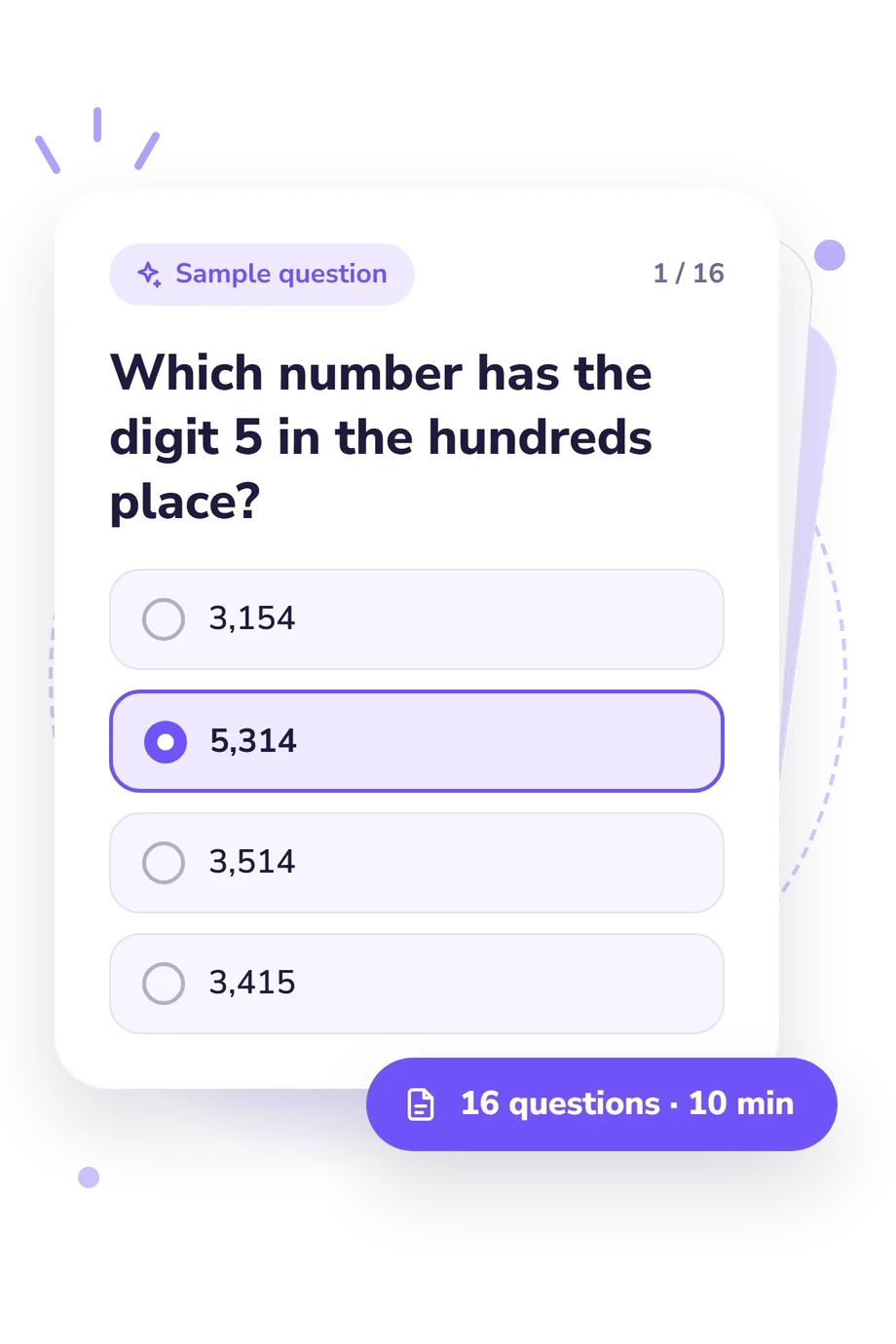
- 3,154
- 5,314
- 3,514
- 3,415
- 9,402
- 9,042
- 9,420
- 90,042
- 205
- 25
- 052
- 025
Place Value Quiz - Description and methodology of the test
Students, parents, and teachers can use this check to see how securely a learner connects a digit’s position with its value. The place value quiz offers an overall indication of current place-value knowledge across questions about whole numbers, decimals, comparison, zeros, expanded form, and changing digits. For independent review or guided classroom follow-up, this place value online quiz offers a concise check of current knowledge.
What This Assessment Explores
The questions examine how a learner locates a digit, names its value, and uses that relationship when reading, writing, comparing, rounding, or transforming numbers. They cover place-value columns in whole-number and decimal notation, including zero’s role and digit changes.
The item groups in this place value chart quiz cover these main topics:
- Whole-number positions show how a learner locates columns and states a digit’s value.
- Decimal notation covers tenths, hundredths, thousandths, and zero’s positional role.
- Forms, comparisons, changes, and rounding show how place value works across representations.
The reported scale, Place Value Knowledge: 0-16, gives an overall level. Foundations to build (0-6) means core positional ideas need review; Developing knowledge (7-12) means many ideas are understood, with practice potentially needed for zeros, decimals, comparison, or changed positions; Strong knowledge (13-16) means place value is consistently identified and applied across whole-number and decimal problems.
Methodology and Evidence Base
Each prompt pairs a numerical situation with four answer choices. Tasks cover number names, place labels, digit values, comparisons, expanded form, decimal notation, digit changes, and rounding. As a place value test, it therefore samples application as well as recognition.
Scoring is summarized by the displayed scale, which reports one aggregate result rather than separate topic scores. The band gives a practical description of current knowledge.
Jensen et al. (2024) treat place value and regrouping as useful constructs for locating conceptual difficulty. Chan, Au, and Tang (2014) link strategic counting with assessment of place-value understanding, while Varelas and Becker (1997) describe developing meaning in positional notation. The questionnaire is conceptually consistent with this work, not a reproduction of those published instruments.
Read the result with the learner’s explanations and classroom context. Multiple-choice performance can miss flexible reasoning and may reflect prior instruction, familiarity with notation, or attention on the day, so the score does not explain why an answer was chosen.
- Jensen, S., Gasteiger, H., & Bruns, J. (2024). Place Value and Regrouping as Helpful Constructs to Diagnose Difficulties in Understanding the Place Value System. Journal für Mathematik-Didaktik, 45, Article 11. 10.1007/s13138-024-00234-8
- Chan, W. W. L., Au, T. K. F., & Tang, J. C. Y. (2014). Strategic counting: A novel assessment of place-value understanding. Learning and Instruction, 29, 78-94. 10.1016/j.learninstruc.2013.09.001
- Varelas, M., & Becker, J. (1997). Children's Developing Understanding of Place Value: Semiotic Aspects. Cognition and Instruction, 15(2), 265-286. 10.1207/s1532690xci1502_4
Updated: