
Seme Uke Quiz
How the Scales are Structured
Who Usually Takes This Test?
See How You Compare
Below is a preview of how scores are typically distributed across each scale.
Example Questions From the Test
- A is the protagonist and B is the antagonist
- A is listed as seme and B as uke
- A is canonically interested in B, regardless of roles
- A is older than B
- Personality alone does not reliably determine seme or uke coding
- Quiet characters are usually seme rather than uke
- Only a character’s height determines the role
- The first character introduced is always uke
- Moe
- Tachi
- Coupling
- Riba, meaning reversible
Seme Uke Quiz - Description and methodology of the test
Readers who want to understand BL conventions without reducing characters to stereotypes can use this assessment to examine terminology, pairing notation, consent, and role coding. This seme or uke quiz about BL conventions tests whether respondents can distinguish role conventions from assumptions about personality, gender, and behavior. The Seme Uke Quiz suits anyone exploring these labels in fictional relationships and fan discussion; its result reflects knowledge, not a fixed identity.
What This Assessment Explores
The questions test whether readers treat seme and uke as contextual BL conventions rather than complete identities. They cover pairing order, fandom terminology, consent, and the difference between role coding and traits such as shyness or forcefulness. Respectful language is also examined when labels are applied to real people.
This semeuke quiz maps knowledge across four areas:
- Pairing notation shows how name order can signal role coding without defining a relationship.
- Context and flexibility recognize pairing-specific roles and reversible dynamics.
- Consent and respect separate freely given agreement from labels and stereotypes.
- Terminology and translation preserve fandom context that one English equivalent may miss.
Results use Seme Uke Knowledge, with a 0-16 range. Foundations (0-6) reflects partial vocabulary and possible stereotype confusion; Developing Knowledge (7-12) shows grasp of common conventions with room to refine context; Strong Knowledge (13-16) indicates nuanced understanding of notation, flexibility, consent, and stereotype-aware interpretation.
Methodology and Evidence Base
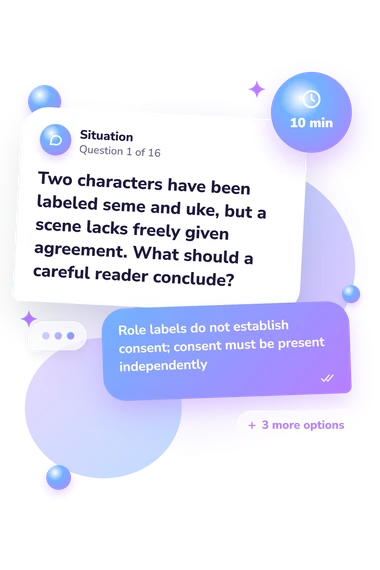
Each item presents a BL situation or terminology question with four answer choices. Selecting the most accurate interpretation tests conceptual knowledge rather than a permanent role identity. In this uke and seme quiz, results are summarized through one knowledge scale, not separate personality dimensions.
Suzuki (2015) offers the closest source for the terminology and classification content, while Fujimoto (2015) provides broader context on gender and BL conventions. McLelland and Welker (2015) place BL within its Japanese cultural and media context. The questionnaire is conceptually consistent with these works, not an adaptation of any cited instrument.
The test's role-focused framing may make the topic approachable, but the result is a snapshot of interpretive knowledge about notation, role flexibility, consent, and stereotype-aware reading. The catalogue presents its score bands as descriptive knowledge levels for this assessment. Familiarity with BL discourse, current attention, and assumptions about real people can affect answers, so the result supports discussion of fictional dynamics without establishing how anyone must behave or identify.
- Fujimoto, Yukari. "The Evolution of BL as 'Playing with Gender': Viewing the Genesis and Development of BL from a Contemporary Perspective." In Boys Love Manga and Beyond: History, Culture, and Community in Japan, edited by Mark McLelland, Kazumi Nagaike, Katsuhiko Suganuma, and James Welker, 76-92. Jackson: University Press of Mississippi, 2015. 10.14325/mississippi/9781628461190.003.0004
- Suzuki, Kazuko. "What Can We Learn from Japanese Professional BL Writers? A Sociological Analysis of Yaoi/BL Terminology and Classifications." In Boys Love Manga and Beyond: History, Culture, and Community in Japan, edited by Mark McLelland, Kazumi Nagaike, Katsuhiko Suganuma, and James Welker, 93-118. Jackson: University Press of Mississippi, 2015. 10.14325/mississippi/9781628461190.003.0005
- McLelland, Mark, and James Welker. "An Introduction to 'Boys Love' in Japan." In Boys Love Manga and Beyond: History, Culture, and Community in Japan, edited by Mark McLelland, Kazumi Nagaike, Katsuhiko Suganuma, and James Welker, 3-20. Jackson: University Press of Mississippi, 2015. 10.14325/mississippi/9781628461190.003.0001