
Preposition Quiz
How the Scales are Structured
Who Usually Takes This Test?
See How You Compare
Below is a preview of how scores are typically distributed across each scale.
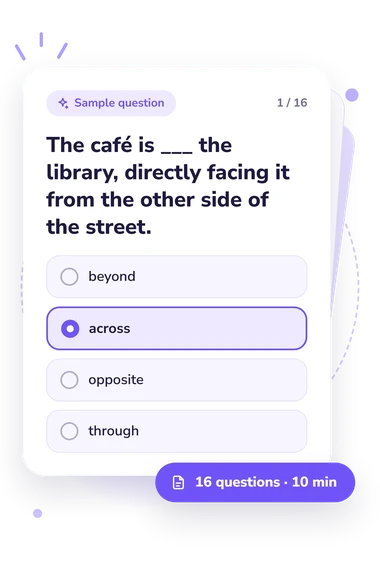
Example Questions From the Test
- beyond
- across
- opposite
- through
- across
- alongside
- beneath
- toward
- of
- on
- to
- for
Preposition Quiz - Description and methodology of the test
People reviewing practical English can use this preposition quiz to examine choices that depend on context, convention, and meaning. It suits learners, writers, and anyone who wants targeted preposition grammar practice rather than a broad estimate of language ability. The result describes current control across familiar constructions and can indicate where review may be useful.
What This Assessment Explores
Across its sentences, this quiz of preposition use asks the respondent to select the form that completes a meaningful context. The items cover spatial relations, time, movement, responsibility, opposition, and conventional verb-preposition pairings. They therefore sample both literal situations and abstract or fixed uses, rather than testing memorized definitions alone.
The following themes explain what different answers bring into the profile:
- Time and duration show how you mark starting points, deadlines, intervals, and limits.
- Place and spatial relation show how you describe position, proximity, facing, and routes.
- Movement and destination show how you distinguish arrival, direction, passage, and endpoints.
- Relationships and collocations show how familiar verbs, adjectives, and nouns combine with required prepositions.
A single Preposition Knowledge scale runs from 0-16. Foundations to strengthen covers 0-6, Developing control covers 7-12, and Strong command covers 13-16. These bands indicate performance across the tested contexts; they do not identify one universal cause of an error.
Methodology and Scientific Basis
Each item presents a sentence with four choices, so the task is contextual selection rather than recall of an isolated rule. Contrasts such as across and between sit beside conventional combinations including responsible for, interested in, object to, and succeed in. The displayed total summarizes performance across the tested items, while the answer options show which alternative was selected.
Its closest conceptual reference is the English preposition test (Ngu & Rethinasamy, 2006). The present questionnaire is conceptually consistent with that work, not a reproduction or validated adaptation. Mueller’s 2011 research distinguishes broad meaning knowledge from knowledge of conventional collocations, which helps explain why a learner may understand a situation yet choose an unexpected pairing. Tyler and Evans’ cognitive-semantic account adds a framework for seeing how spatial meanings extend into time, cause, and social relations.
As a preposition practice quiz, this tool offers a current learning profile rather than a standardized language score: no published norm group, reliability estimate, or diagnostic threshold is supplied for this questionnaire. Results may also reflect exposure, translation habits, attention, and self-awareness on the day, so they are best used to target further practice.
- Bing Hiong Ngu and Soubakeavathi Rethinasamy. Evaluating a CALL software on the learning of English prepositions. Computers & Education, 47(1), 41-55, 2006. 10.1016/j.compedu.2004.08.016
- Charles M. Mueller. English Learners’ Knowledge of Prepositions: Collocational Knowledge or Knowledge Based on Meaning? System, 39(4), 480-490, 2011. 10.1016/j.system.2011.10.012
- Andrea Tyler and Vyvyan Evans. The Semantics of English Prepositions: Spatial Scenes, Embodied Meaning, and Cognition. Cambridge University Press, 2003. 10.1017/CBO9780511486517
Updated: