
What Braces Color Should I Get Quiz
How the Scales are Structured
Who Usually Takes This Test?
See How You Compare
Below is a preview of how scores are typically distributed across each scale.
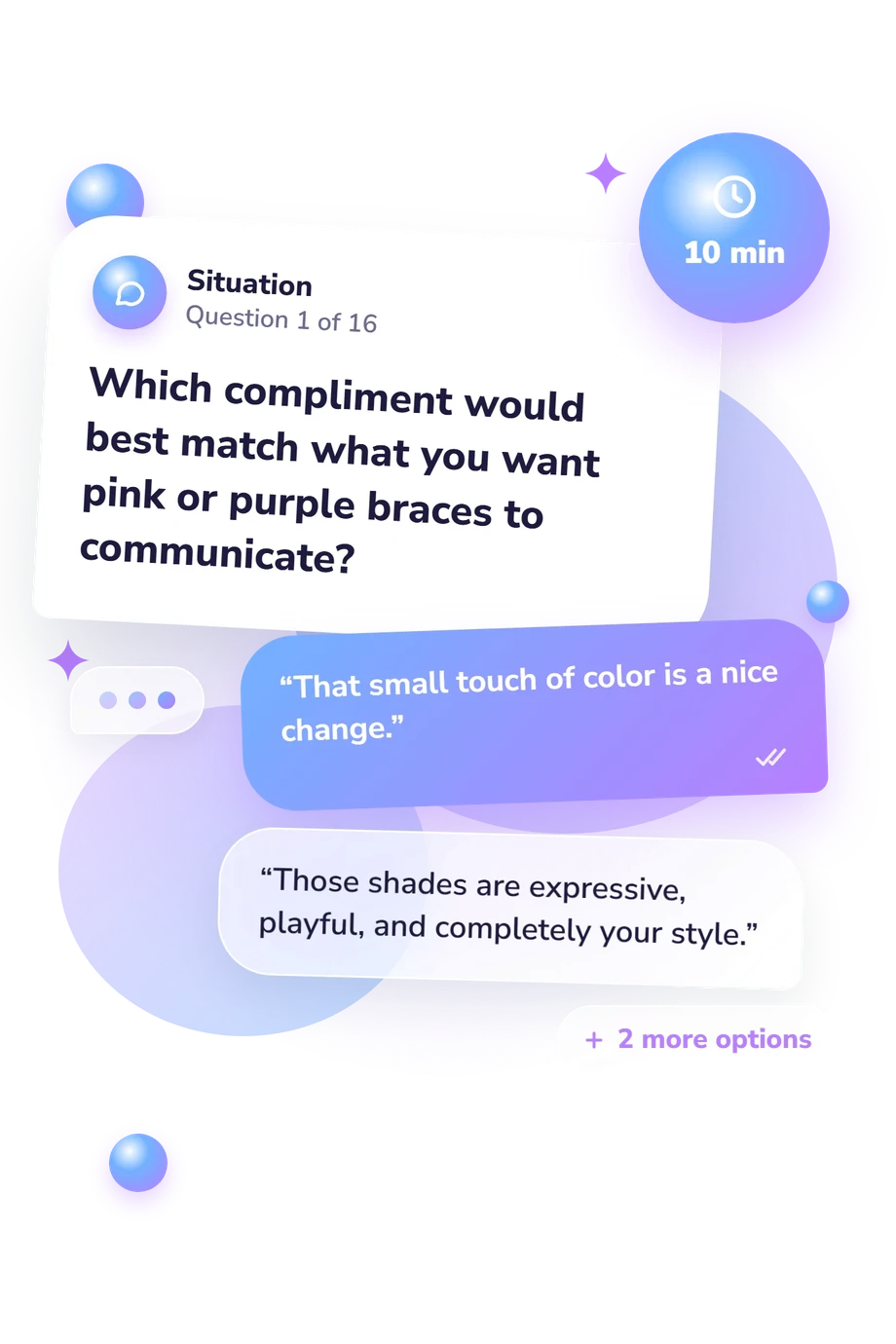
Example Questions From the Test
- Choose silver or charcoal for a streamlined, adaptable look.
- Use a dark neutral but alternate it with one brighter shade.
- Add only a small metallic element to a more colorful combination.
- Let a vivid color be the main feature, even at the formal event.
- Deep teal, violet, or another non-warm seasonal shade.
- A small burnt-orange accent paired with a contrasting color.
- One coordinated shade such as burgundy or rust orange.
- A bold mix of red and orange that clearly captures the season.
- I own almost none because other palettes feel more natural.
- I have one or two warm pieces that come out occasionally.
- I wear red, coral, orange, or burgundy fairly regularly.
- Warm, energetic colors are recurring highlights in my wardrobe.
What Braces Color Should I Get Quiz - Description and methodology of the test
People choosing elastic ligatures often want a shade that feels personal without clashing with everyday clothes, photographs, or special occasions. The What Braces Color Should I Get Quiz is intended for anyone comparing several palettes before an orthodontic appointment. It turns preferences about visibility, coordination, mood, and wardrobe into a profile of likely color directions. This braces color quiz also gives you language for discussing options with your orthodontist.
What This Assessment Explores
Rather than judging attractiveness, it examines which family fits your style, wardrobe, occasions, and preferred visibility, helping answer the practical question posed by the What Color of Braces Should I Get Quiz. The highest score marks the strongest direction; scores within one point can suggest a blend.
These four dimensions show how the profile is read:
- Cool Blues & Teals (0-12) measures affinity for blue-green shades: Other Direction 0-4; Cool-Color Possibility 5-8; Strong Cool Match 9-12.
- Playful Pinks & Purples (0-12) measures affinity for pink-purple shades: Different Expression 0-4; Playful Accent 5-8; Strong Playful Match 9-12.
- Sleek Dark & Metallics (0-12) measures affinity for silver, gray, black, and deep neutrals: More Colorful Direction 0-4; Sleek Alternative 5-8; Strong Sleek Match 9-12.
- Warm Reds & Oranges (0-12) measures affinity for energetic warm shades: Cooler Direction 0-4; Warm-Color Option 5-8; Strong Warm Match 9-12.
Methodology and Scientific Basis
Each item presents a situation with four choices. Together, the choices distinguish rejection, conditional use, balanced combinations, and stronger preference. Used as a braces color selector quiz, it links choices to clothes, accessories, events, photographs, and comfort with visibility.
Deciding what color braces they should get becomes a comparison of style patterns rather than one impulse.
Methodologically, the questionnaire is conceptually consistent with Elekdag-Turk et al. (2010) and Tariq et al. (2017), related orthodontic studies. It is not an adaptation of either instrument.
The result also addresses the practical question that the What Color Braces Should You Get Quiz is designed to explore, without turning preference into a fixed rule.
Palmer and Schloss (2010) supply a lens of learned associations and emotional responses in color preference.
The questionnaire presents color-family outputs, not population norms or clinical cutoffs. It does not state points assigned to responses; interpretation uses displayed totals and bands. Mood, outfits, occasions, and available colors can influence self-report, so use the result to choose and discuss elastics.
- Selma Elekdag-Turk, Nurhat Ozkalayci, Devrim Isci, and Tamer Turk. Color Preferences of Patients Receiving Elastic Ligatures. European Journal of Dentistry, 4(2), 171-174 (2010). 10.1055/s-0039-1697826
- Anum Tariq, Zahida Najam, Usman Ahmed, and Ayesha Aslam. Colour preferences of patients receiving elastic ligatures in fixed orthodontic treatment. Pakistan Orthodontic Journal, 9(2), 83-86 (2017).
- Stephen E. Palmer and Karen B. Schloss. An ecological valence theory of human color preference. Proceedings of the National Academy of Sciences of the United States of America, 107(19), 8877-8882 (2010). 10.1073/pnas.0906172107
Updated: