
8th Grade Math Quiz
How the Scales are Structured
Who Usually Takes This Test?
See How You Compare
Below is a preview of how scores are typically distributed across each scale.
Example Questions From the Test
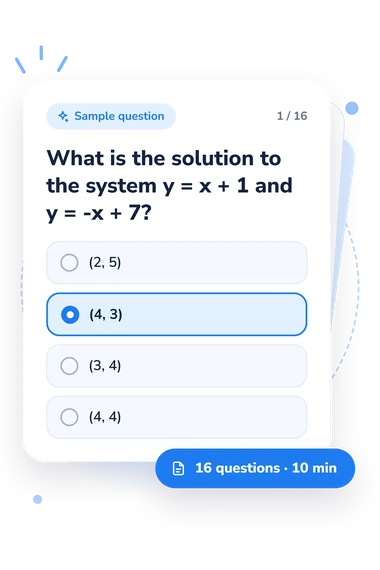
- (2, 5)
- (4, 3)
- (3, 4)
- (4, 4)
- {(1, 2), (1, 3), (2, 4)}
- {(0, 1), (0, 2), (0, 3)}
- {(2, 5), (3, 6), (2, 7)}
- {(-1, 0), (0, 0), (1, 2)}
- Negative thirteen (-13)
- Negative three (-3)
- Positive three (3)
- Positive thirteen (13)
8th Grade Math Quiz - Description and methodology of the test
Students, parents, and educators who want a focused check of middle-school mathematics can use this assessment to examine how securely Grade 8 ideas are understood. The 8th grade math quiz offers a practical snapshot of current performance across several strands. The result from this eighth grade math quiz indicates an overall level of represented knowledge. Reviewing individual answers is needed to locate specific topics; targeted practice can then address them.
What This Assessment Explores
The items sample the kinds of reasoning expected in middle-school algebra, functions, geometry, proportional relationships, statistics, financial contexts, and number operations. They ask the learner to solve equations, interpret rules, apply formulas, compare quantities, and draw a careful conclusion from data. For learners reviewing Grade 8 mathematics, this maths quiz for class 8 brings together a broad foundation across these skills.
The result describes one score, 8th Grade Math Knowledge, reported from 0-16. The bands are:
- Foundations to revisit (0-6) indicates that core procedures need review.
- Developing knowledge (7-12) indicates that many grade-level ideas are understood, with targeted practice still useful.
- Strong knowledge (13-16) indicates solid command of the represented concepts and readiness for more complex applications.
Together, these areas show performance on the sampled skills rather than a complete measure of mathematical ability.
Methodology and Evidence Base
Four-option questions give this grade 8 math quiz online a clear structure for checking represented skills, and one point is awarded for every correct answer.
Content is conceptually consistent with Daro et al. (2015), whose Grade 8 alignment study examined how assessment items corresponded with the Common Core State Standards and the NAEP mathematics framework. The Common Core State Standards organize work across algebra, functions, geometry, statistics, and number concepts, while the 2009 NAEP mathematics framework emphasizes content and reasoning. Dingman et al. (2013) adds comparison of shared U.S. expectations. These sources provide context for the content, not evidence that this online questionnaire is an adaptation of a published assessment.
Broad performance bands describe overall achievement in this maths quiz for grade 8; reviewing individual items is needed to identify particular skills for further practice. No norms, reliability estimates, or independent validation results are established for this online version, so the bands are not national percentiles or course grades. Current concentration, prior instruction, and unfamiliar wording can affect performance; follow-up practice gives the score its most useful meaning.
- Daro, Phil, Gerunda B. Hughes, and Fran Stancavage. Study of the Alignment of the 2015 NAEP Mathematics Items at Grades 4 and 8 to the Common Core State Standards (CCSS) for Mathematics. Washington, DC: American Institutes for Research, 2015.
- National Governors Association Center for Best Practices, Council of Chief State School Officers. Common Core State Standards for Mathematics. Washington, DC: National Governors Association Center for Best Practices, Council of Chief State School Officers, 2010.
- National Assessment Governing Board. Mathematics Framework for the 2009 National Assessment of Educational Progress. Washington, DC: U.S. Department of Education, 2008.
- Dingman, Shannon, Dawn Teuscher, Jill A. Newton, and Lisa Kasmer. Common Mathematics Standards in the United States: A Comparison of K-8 State and Common Core Standards. The Elementary School Journal, 113(4), 541-564, 2013. 10.1086/669939