
What Gun Should I Get Quiz
How the Scales are Structured
Who Usually Takes This Test?
See How You Compare
Below is a preview of how scores are typically distributed across each scale.
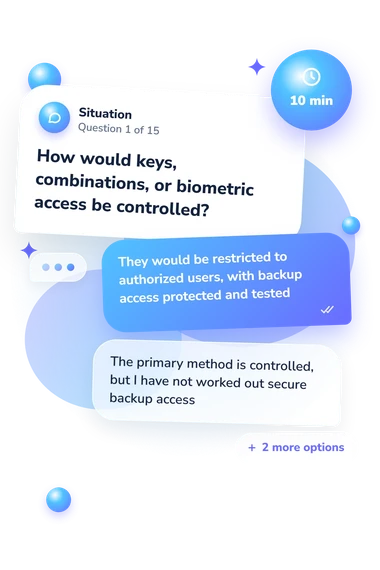
Example Questions From the Test
- They would be restricted to authorized users, with backup access protected and tested
- The primary method is controlled, but I have not worked out secure backup access
- A key or code might be kept where another household member could discover or borrow it
- A person who should not have firearm access already knows the code or can obtain the key
- I know of no access attempt or incident, and access controls are routinely checked
- I have noticed a minor weakness, such as a poorly protected spare key, but no access attempt
- There has been a close call or attempted access that was interrupted before anyone handled a firearm
- An unauthorized person has accessed or handled a firearm, or a firearm has recently gone missing
- I consistently maintain a safe direction and keep my finger outside the trigger guard until an intended shot
- I understand both rules but would want supervised practice before relying on my habits
- I sometimes catch myself losing track of direction or resting my finger near the trigger during handling
- I have had an unintentional discharge, caused an injury, or recently pointed a firearm at someone unintentionally
What Gun Should I Get Quiz - Description and methodology of the test
People considering firearm access or acquisition can use the What Gun Should I Get Quiz to slow a consequential decision and check whether essential safety conditions are in place. It is for readers reviewing purpose, conflict, storage, training, and access-not for matching a person to a make or model. For readers weighing how to choose a handgun, it supplies a readiness review before action.
What This Assessment Explores
The questionnaire tests whether circumstances support firearm access rather than recommending a product. It covers purpose, urgency, conflict, harm-related thoughts, alternatives, storage, unauthorized access, transport, training, malfunctions, and impairment.
The three dimensions shown in the result are:
- Decision Context & Immediate Risk (0-15) reflects urgency, conflict, coercion, harm-related thoughts, and alternatives. Its bands are Baseline review (0), Points to resolve (1-2), and Action required (3-15).
- Secure Storage & Access Control (0-15) reflects storage and unauthorized-access concerns. Its bands are Baseline review (0), Points to resolve (1-2), and Action required (3-15).
- Training & Handling Preparation (0-15) reflects gaps in instruction, handling, malfunction response, and impairment boundaries. Its bands are Baseline review (0), Points to resolve (1-2), and Action required (3-15).
Someone asking what handgun I should get is redirected toward whether access should wait, which risks need resolution, and what safer alternatives or support belong in the plan.
Methodology and Evidence Base
Each item offers four response options, from preparation and controlled access to danger. The respondent chooses the closest situation. Scoring groups answers into three domains and displays totals; no point value should be inferred beyond the output.
Structured self-report gives the questionnaire a means-safety lens. It is conceptually consistent with the Lock to Live decision aid, which emphasizes conversations and reducing access to lethal means, but does not adapt or validate it. Readiness and risk review, not product matching, addresses what kind of gun I should buy.
Butterworth, Daruwala, and Anestis (2020) connect ownership reasons with firearm beliefs, means-safety openness, and storage. Berrigan, Azrael, Hemenway, and Miller (2019) add evidence on training and storage among US gun owners. These studies establish no norms here.
These bands are unvalidated reflective summaries, not legal, clinical, severity, or proficiency cutoffs. Stress, self-awareness, and disclosure can shape self-report results. A concerning response matters independently of total. Someone asking what pistol should I get is prompted to resolve safety conditions before product details; harm-related urges or plans require distance from firearms and urgent support.
- Betz ME, Knoepke CE, Siry B, Clement A, Azrael D, Ernestus S, Matlock DD. 'Lock to Live': development of a firearm storage decision aid to enhance lethal means counselling and prevent suicide. Injury Prevention. 2019;25(Suppl 1):i18-i24. 10.1136/injuryprev-2018-042944
- Butterworth SE, Daruwala SE, Anestis MD. The Role of Reason for Firearm Ownership in Beliefs about Firearms and Suicide, Openness to Means Safety, and Current Firearm Storage. Suicide and Life-Threatening Behavior. 2020;50(3):617-630. 10.1111/sltb.12619
- Berrigan J, Azrael D, Hemenway D, Miller M. Firearms Training and Storage Practices Among US Gun Owners: A Nationally Representative Study. Injury Prevention. 2019;25(Suppl 1):i31-i38. 10.1136/injuryprev-2018-043126