
Classical Music Quiz
How the Scales are Structured
Who Usually Takes This Test?
See How You Compare
Below is a preview of how scores are typically distributed across each scale.
Example Questions From the Test
- Continuo
- A cappella
- Tutti
- Obbligato
- Diminuendo
- Crescendo
- Sforzando
- Pianissimo
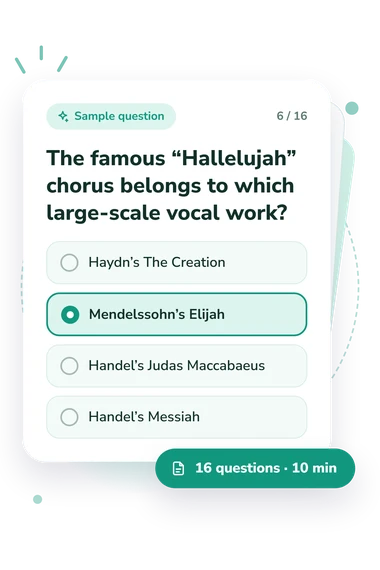
- Haydn’s The Creation
- Mendelssohn’s Elijah
- Handel’s Judas Maccabaeus
- Handel’s Messiah
Classical Music Quiz - Description and methodology of the test
This assessment checks connections among musical terms, composers, works, periods, and performance practices. The classical music quiz presents short recognition questions built around familiar repertoire and musical situations. Its overall result places the respondent in a broad knowledge level and can prompt further exploration of repertoire and terminology. The format is a classical music trivia quiz, with each prompt asking for the best answer among four options.
What This Assessment Measures
This assessment checks familiarity with Western art music rather than a narrow repertoire. Its situations ask the respondent to recognize a term, composer, work, period, genre, or performance instruction. It suits curious listeners, students, and concertgoers seeking a snapshot of musical literacy.
The main areas are:
- Composers and repertoire connect familiar works with their creators.
- Forms and genres distinguish development, concerto, aria, and leitmotif.
- Periods and styles link musical features with Baroque, Classical, or Romantic practice.
- Vocal and choral music covers opera, sacred works, and ensemble terms.
- Performance language and orchestral practice check crescendo, pizzicato, and tuning A.
The Classical Music Knowledge score runs from 0-16 and equals the number of correct answers. Foundations to build is 0-6, Developing knowledge is 7-12, and Strong knowledge is 13-16. The overall score summarizes performance across these classical music questions and places the respondent in a knowledge band.
Methodology and Evidence Base
Each item gives a brief musical situation or recognition prompt with four answer choices. Selecting the best answer tests retrieval and contextual discrimination rather than extended written explanation. The total is the number of correct responses, and its bands indicate the breadth of knowledge represented.
That approach is conceptually consistent with VanWeelden (2014), which examined recognition of Western art music, but this questionnaire is not that study’s instrument. Its coverage also overlaps the content domains in Educational Testing Service’s Music (4JMF), including terminology, repertoire, and performance knowledge. Omar et al. (2010) offer a related cognitive perspective: music knowledge can be organized across different kinds of recognition.
The scoring is right or wrong because this quiz on classical music asks for one best answer to each prompt: the total equals the number of correct answers, and the band summarizes overall performance. Because the questionnaire produces a single aggregate score, it cannot identify particular knowledge gaps or the topic behind an incorrect answer. A missed item may reflect unfamiliarity with a composer, term, work, or period, but the aggregate cannot separate those possibilities.
- Kimberly VanWeelden. Preservice Music Teachers’ Recognition of Western Art Music Found in Popular Culture. Journal of Music Teacher Education. 2014;24(1):65-75. 10.1177/1057083713497588
- Educational Testing Service. Test Content - Music (4JMF). Princeton, NJ: Educational Testing Service; 2013.
- Rohani Omar, Julia C Hailstone, Jane E Warren, Sebastian J Crutch, Jason D Warren. The cognitive organization of music knowledge: a clinical analysis. Brain. 2010;133(4):1200-1213. 10.1093/brain/awp345
Updated: