
How Active Am I Quiz
How the Scales are Structured
Who Usually Takes This Test?
See How You Compare
Below is a preview of how scores are typically distributed across each scale.
Example Questions From the Test
- Rarely or never
- A few times per month
- One or two days per week
- Three or more days per week
- No days
- One day
- Two or three days
- Four or more days
- I do not currently have purposeful cardio sessions
- Less than 15 minutes
- 29 minutes
- 30 minutes or more
How Active Am I Quiz - Description and methodology of the test
People deciding whether to take the How Active Am I Quiz may find it useful when they want to examine whether their current routine leaves room for more movement or more planned exercise. It suits readers comparing ordinary demands with their opportunities to move. The profile keeps attention on practical choices rather than a fixed label. Readers can also use this am i sedentary or lightly active quiz to consider where their routine currently sits.
What This Assessment Explores
The questionnaire separates everyday movement from purposeful activity and examines how routines hold up when plans change. It covers walking, standing, household tasks, sitting breaks, cardio, strengthening, mobility, flexibility, and balance. The result shows current or recurring routines and gives readers a way to approach the do i exercise enough quiz question, while keeping that question separate from the amount of movement built into daily life.
The three displayed dimensions are:
- Everyday Movement (0-15) reflects walking, standing, active transport, household movement, and breaks from sitting: Limited presence (0-5), Regular presence (6-10), or Strong presence (11-15).
- Purposeful Cardio Activity (0-15) reflects the frequency, duration, challenge, and consistency of breath-raising activity: Limited (0-5), Regular (6-10), or Strong (11-15).
- Strength, Mobility, and Balance (0-15) reflects strengthening and mobility or balance practice: Limited presence (0-5), Regular (6-10), or Strong (11-15).
Methodology and Scientific Basis
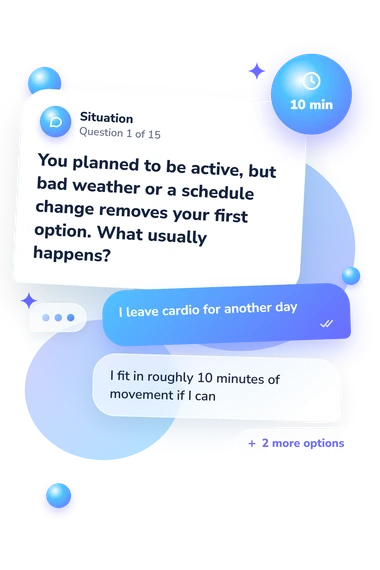
Each item offers four ordered responses, with the dimension changing by prompt: options track frequency, duration, breadth, intensity, continuity, or adaptation to disruption. Prompts cover routine context and planned activity, including responses to weather or a busy schedule. This self-report format creates a movement profile rather than a simple workout tally.
Results appear as three domain scores, but the item-level formula is not stated. The displayed bands are reflective summaries rather than medical or fitness cutoffs, so they describe current habits without setting a clinical threshold.
The questionnaire is conceptually consistent with QMov24h’s broader movement framing and related to the physical-activity domains in the Global Physical Activity Questionnaire (GPAQ). The WHO Guidelines add context for physical activity and sedentary behaviour. These sources do not validate this questionnaire, which is not an adaptation of any of them.
A result from the how active are you quiz can still be shaped by memory, workload, mood, access, pain, disability, and personal interpretations of effort. Comparisons between people should therefore be cautious when circumstances affect opportunities to move.
- Rodrigues, Bruno, Pedro B. Júdice, Adilson Marques, Eliana V. Carraça, Luís Lopes, Eduarda Sousa-Sá, Jorge Encantado, António Videira-Silva, Dylan P. Cliff, Romeu Mendes, and Rute Santos, on behalf of the QMov24h working group. “24-hour Movement Questionnaire (QMov24h) for adults: development process and measurement properties.” International Journal of Behavioral Nutrition and Physical Activity, vol. 21, article 116, 2024. 10.1186/s12966-024-01667-7
- Armstrong, Timothy, and Fiona Bull. “Development of the World Health Organization Global Physical Activity Questionnaire (GPAQ).” Journal of Public Health, vol. 14, no. 2, 2006, pp. 66-70. 10.1007/s10389-006-0024-x
- World Health Organization. WHO Guidelines on Physical Activity and Sedentary Behaviour. Geneva: World Health Organization, 2020. ISBN: 978-92-4-001512-8
Updated: