
Love vs Infatuation Quiz
How the Scales are Structured
Who Usually Takes This Test?
See How You Compare
Below is a preview of how scores are typically distributed across each scale.
Example Questions From the Test
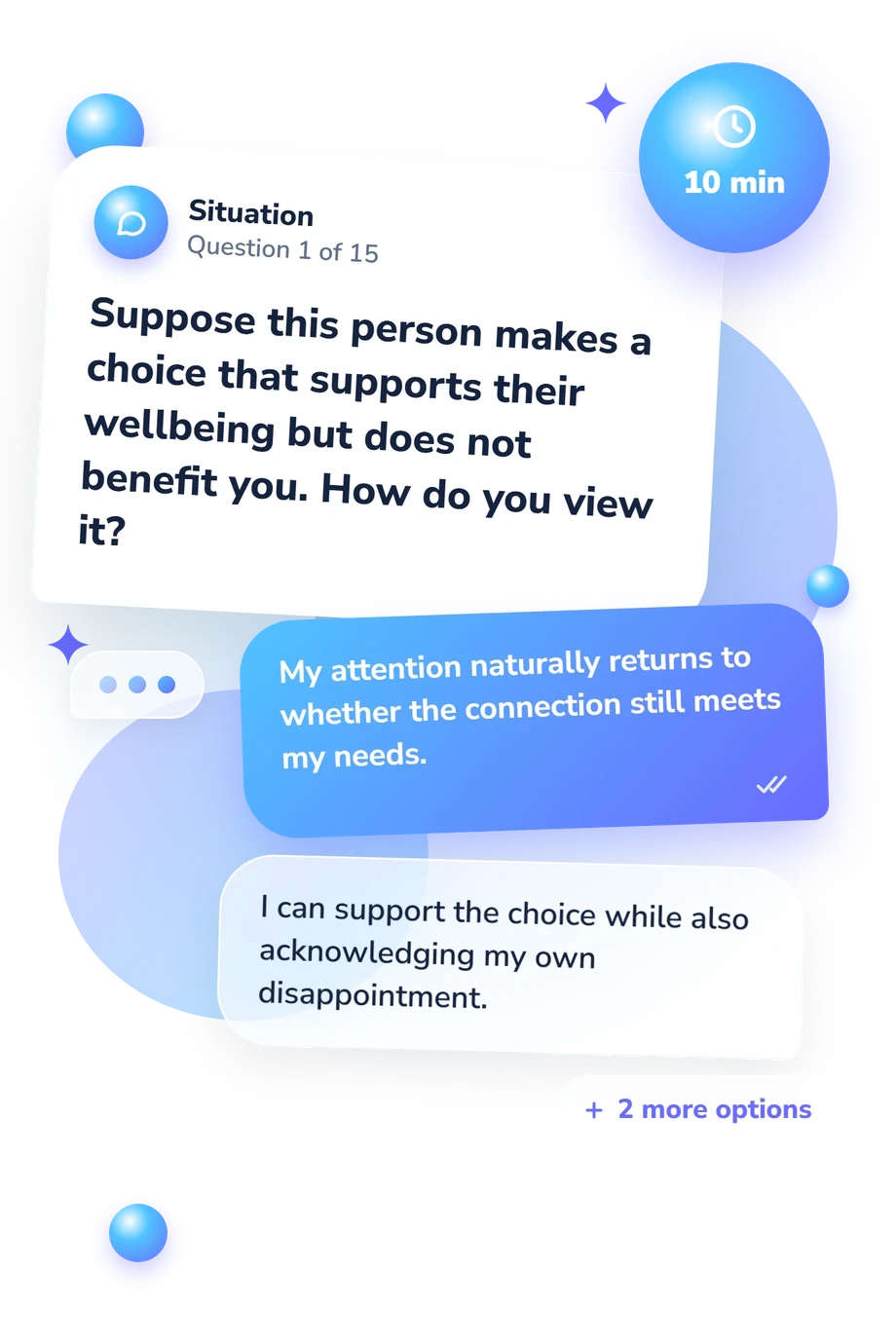
- My attention naturally returns to whether the connection still meets my needs.
- I can support the choice while also acknowledging my own disappointment.
- I want the best for them, although my own hopes strongly shape my reaction.
- My support depends somewhat on whether the choice keeps us close.
- I enjoy imagining possibilities while remembering that they are guesses.
- I feel remarkably certain about who they are despite the missing information.
- I wait for experience to provide evidence before forming a strong conclusion.
- I tend to fill the gaps with favorable assumptions that feel convincing.
- I notice them, but my mood and attention change very little.
- I feel a quick lift and hope there might be a small interaction.
- I am pleased to see them and become a little more alert.
- It is a pleasant detail, but I soon return to what I was doing.
Love vs Infatuation Quiz - Description and methodology of the test
People who feel drawn to someone but cannot distinguish curiosity, attachment, and idealization can use this assessment to organize those impressions. The love vs infatuation quiz is intended for self-reflection when a connection feels significant but its meaning remains uncertain. It focuses on how you respond to uncertainty, disappointment, disagreement, and emotional intensity. This assessment, a love or infatuation quiz, gives those reactions clearer language without forcing a single conclusion.
What This Assessment Explores
The questionnaire distinguishes early possibility, grounded care, and intense preoccupation as affinity patterns, making it an is it love or infatuation quiz for uncertain connections. Scenarios cover uncertainty, delayed replies, disappointment, disagreement, limitations, imagined futures, and closeness. These situations clarify the connection's pattern.
The displayed scales organize the result around three distinct affinity patterns:
- Early Crush (0-15) concerns anticipation, small interactions, and possibility-based attraction: Little Crush Pattern (0-5), Emerging Interest (6-10), and Strong Crush Affinity (11-15).
- Grounded Love (0-15) concerns care, realistic knowledge, compatibility, and repair: Still Forming (0-5), Growing Foundation (6-10), and Grounded Affinity (11-15).
- Infatuation (0-15) concerns idealization, urgency, and emotional highs or lows: Limited Intensity (0-5), Heightened Pull (6-10), and Strong Infatuation Affinity (11-15).
The highest score indicates the strongest affinity; scores within one point indicate a blend.
Methodology and Scientific Basis
Each item presents a relationship situation with four response options that represent different possible reactions, including care, realism, defensiveness, urgency, and preoccupation. Choosing the closest reaction creates a structured self-report. In this infatuation quiz, three scale scores are displayed; the answer-to-score mapping is not documented, so individual contributions should not be reverse-engineered from the ranges.
Conceptually, it is consistent with the Infatuation and Attachment Scales (Langeslag et al., 2013), which distinguish passionate infatuation from attachment. It can also be read alongside Sternberg’s triangular theory of love and Hatfield and Sprecher’s work on passionate love. These are conceptual reference points, not proof this questionnaire is an adaptation or standardized administration of those instruments.
For someone taking this am i in love or infatuated quiz, results compare emotional intensity with realistic knowledge, responsiveness, and tolerance for uncertainty. The highest affinity is the strongest current pattern; near-equal scores suggest overlap.
Because the bands are internal to this questionnaire, they are not population norms. Mood, recent contact, idealization, and self-awareness may shift the result, so read it as a snapshot of the current connection.
- Langeslag, S. J. E., Muris, P., & Franken, I. H. A. (2013). Measuring romantic love: Psychometric properties of the Infatuation and Attachment Scales. The Journal of Sex Research, 50(8), 739-747. 10.1080/00224499.2012.714011
- Sternberg, R. J. (1986). A triangular theory of love. Psychological Review, 93(2), 119-135. 10.1037/0033-295X.93.2.119
- Hatfield, E., & Sprecher, S. (1986). Measuring passionate love in intimate relationships. Journal of Adolescence, 9(4), 383-410. 10.1016/S0140-1971(86)80043-4
Updated: