
General Knowledge Quiz for High School Students
How the Scales are Structured
Who Usually Takes This Test?
See How You Compare
Below is a preview of how scores are typically distributed across each scale.
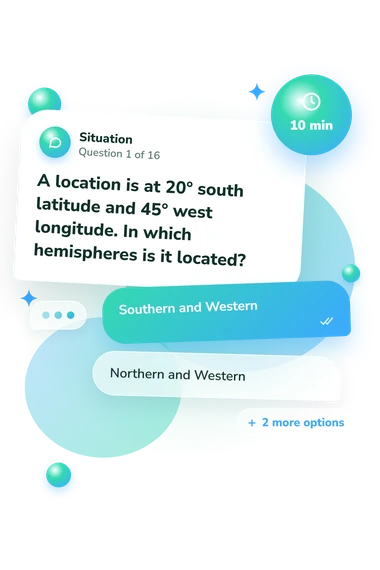
Example Questions From the Test
- Southern and Western
- Northern and Western
- Northern and Eastern
- Southern and Eastern
- 10
- 8
- 12
- 14
- 9
- 7
- 4
- 8
General Knowledge Quiz for High School Students - Description and methodology of the test
Students who want a broad check of classroom knowledge can use this assessment to see how accurately they connect ideas across familiar academic subjects. For learners, parents, and educators, this general knowledge quiz for high school students offers an overall snapshot rather than a subject-specific grade. It is designed for readers who want breadth rather than a specialist score. Students can use the high school quiz to identify strengths and topics for deliberate review.
What This Assessment Explores
The assessment samples broad school knowledge rather than one specialist subject. Its cross-subject format makes this a secondary school general knowledge quiz, offering a broad snapshot instead of a course grade.
Main thematic groups include:
- Geography and civics test location, government, and constitutional principles.
- Literature tests recognition of devices and meaning in brief scenarios.
- Science covers experiments, biology, chemistry, physics, ecology, and Earth science.
- Mathematics tests calculation, data, number systems, ratios, and applied reasoning.
- History and economics examine major transformations and opportunity cost.
The high school general knowledge quiz reports one General Knowledge Knowledge scale from 0-16: Foundation Building (0-6) indicates core concepts to revisit; Developing Knowledge (7-12) reflects a useful but uneven base; Strong Knowledge (13-16) reflects consistently accurate understanding across the sample. These are informal bands, not standardized academic levels.
Methodology and Scientific Basis
Each item is a multiple-choice question with four options and one best answer. The high school quiz questions mix recall with application, asking for facts, calculations, or interpretations of short scenarios and principles.
Scoring is item-based, with one point awarded for each correct answer. The total summarizes accuracy across the sampled domains, but cannot show why an answer was missed or whether knowledge transfers to unfamiliar problems.
Conceptually, the questionnaire is consistent with the General Knowledge Test (Tran et al., 2014), a related general-knowledge study examining broad knowledge alongside school-related factors. It is not presented as an adaptation of that study. Lynn, Irwing, and Cammock likewise treat general knowledge as a broad, multi-domain construct rather than one school subject.
Roediger and Marsh note that multiple-choice testing can produce learning effects, while distractors and guessing may influence performance. Results also depend on topic selection, prior familiarity, exposure to similar questions, attention, and recall at the time of testing, so read the score as a study-planning snapshot across this sample.
- Tran, Ulrich S., Agnes A. Hofer, and Martin Voracek. (2014). Sex Differences in General Knowledge: Meta-Analysis and New Data on the Contribution of School-Related Moderators among High-School Students. PLOS ONE, 9(10), e110391. 10.1371/journal.pone.0110391
- Lynn, Richard, Paul Irwing, and Thomas Cammock. (2002). Sex Differences in General Knowledge. Intelligence, 30(1), 27-39. 10.1016/S0160-2896(01)00064-2
- ACT, Inc. (2024). ACT Technical Manual. Iowa City, IA: ACT, Inc.
- Roediger, Henry L., III, and Elizabeth J. Marsh. (2005). The Positive and Negative Consequences of Multiple-Choice Testing. Journal of Experimental Psychology: Learning, Memory, and Cognition, 31(5), 1155-1159. 10.1037/0278-7393.31.5.1155