
Ancient Rome Quiz
How the Scales are Structured
Who Usually Takes This Test?
See How You Compare
Below is a preview of how scores are typically distributed across each scale.
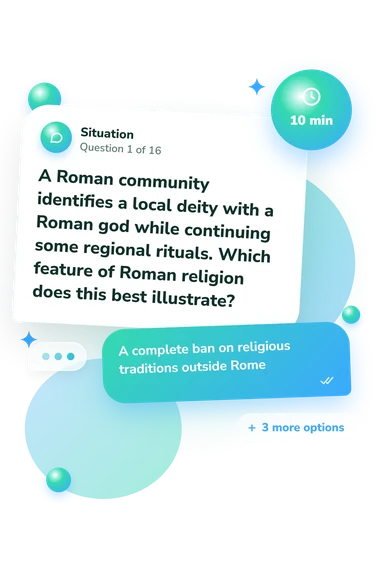
Example Questions From the Test
- The Senate and People of Rome
- The Soldiers and Praetors of the Republic
- The Sacred Province and Queen of Rome
- The Supreme Power of the Roman Quarters
- A direct democracy replaced all elected offices
- Annually elected consuls replaced the king as leading magistrates
- The Roman Empire was immediately established
- Provincial governors took control of the city
- Macedon
- Ptolemaic Egypt
- Parthia
- Carthage
Ancient Rome Quiz - Description and methodology of the test
Readers who want to check their overall understanding of Roman civilization can use this assessment as a focused self-test. The ancient rome quiz suits curious learners, students, and history enthusiasts who want to see how accurately they recognize key developments and interpret selected historical situations. Questions in this roman history quiz give a concise way to gauge general knowledge before further reading or study.
What This Assessment Explores
This questionnaire measures recognition and interpretation of Roman history, rather than personal opinions. It suits learners examining politics, society, religion, economy, technology, and expansion. The Rome quiz result describes overall performance across the questions, offering a general indication of knowledge.
The questions cover three thematic groups:
- Institutions and political change show how you connect laws, magistracies, social conflict, and imperial rule.
- Society, religion, and economy reveal how you interpret adaptation, patronage, citizenship, trade, and agriculture.
- Evidence, engineering, expansion, and chronology test how you relate roads, water, conquest, and turning points.
Questions about Roman institutions and daily life give the roman quiz a broad historical scope. Ancient Rome Knowledge is 0-16: Foundations to Build (0-6), Developing Roman Historian (7-12), and Commanding the Roman World (13-16).
Methodology and Evidence Base
The questionnaire combines direct factual and terminology questions with shorter scenarios and evidence-based prompts; each item offers four answer choices. Some questions call for contextual reasoning, while others test accurate recognition, making this a structured multiple-choice knowledge assessment rather than a standardized psychological self-report instrument.
The questionnaire is conceptually consistent with the historical context presented by Le Glay and colleagues and with the political and administrative perspectives discussed by Flower and Lintott. It is not an adaptation of those publications; they support the subject matter and interpretive frame of this questionnaire. Across the Republic, imperial government, society, infrastructure, and long-term change, the roman empire quiz asks for grounded reasoning.
The questionnaire reports one overall knowledge scale, with bands describing performance on these questions only. Prior education, language, familiarity with conventional historical narratives, attention, and the selected topics can all affect the outcome. Use it as a focused indication of current knowledge and a guide to further study, while recognizing that the result reflects this quiz’s questions and response choices.
- Le Glay, Marcel, Jean-Louis Voisin, Yann Le Bohec, David Cherry, and Donald G. Kyle. A History of Rome. 4th ed. Edited by Eleni Manolaraki. Chichester: Wiley-Blackwell, 2009.
- Flower, Harriet I., ed. The Cambridge Companion to the Roman Republic. 2nd ed. Cambridge: Cambridge University Press, 2014. 10.1017/CCO9781139424783.
- Lintott, Andrew William. Imperium Romanum: Politics and Administration. London: Routledge, 1993.