
Trigonometry Quiz
How the Scales are Structured
Who Usually Takes This Test?
See How You Compare
Below is a preview of how scores are typically distributed across each scale.
Example Questions From the Test
- Two complete π-radian intervals
- Half of a π-radian interval
- One π-radian interval
- Four complete π-radian intervals
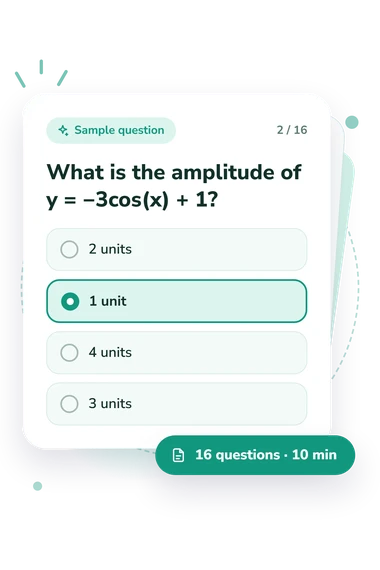
- 2 units
- 1 unit
- 4 units
- 3 units
- 1/2
- √3/2
- √2/2
- 1
Trigonometry Quiz - Description and methodology of the test
People who want a focused check of classroom trigonometry can use this trigonometry quiz to see which core ideas are secure and which need review. It presents conceptual and applied tasks in an online quiz focused on trigonometry, making it suitable for learners revising formulas or preparing for coursework. The overall result checks current understanding and may help show whether further review is useful before more demanding problems.
What This Assessment Measures
The questionnaire samples several ways of thinking with trigonometric relationships rather than one isolated formula. Its reported scale, Trigonometry Knowledge (0-16), reflects conceptual recall, symbolic manipulation, geometric reasoning, and application. Foundation to build (0-6) marks emerging core understanding; Developing knowledge (7-12) reflects competence with standard problems but room to strengthen multi-step links; Strong knowledge (13-16) reflects reliable command across conceptual and applied questions.
The main themes are:
- Functions and graphs show whether you can identify period, amplitude, and transformations.
- Exact values and identities reveal how securely you use standard angle relationships.
- Triangle ratios and laws indicate how well you connect side lengths with angles.
- Applications and coordinate reasoning test whether you can transfer trigonometry to heights, quadrants, reference angles, and unit-circle signs.
This trigonometry practice quiz can indicate which broad themes may merit further review.
Methodology and Evidence Base
Each item presents a problem with several answer choices, and each correct response adds one point. The total represents performance on these questions, with the displayed bands describing different levels of results within the overall score. The test therefore rewards accurate answers rather than written derivations.
This online trigonometry assessment supports independent review, but selected answers cannot show every step of a learner’s reasoning or reveal why an option was chosen.
The assessment has content overlap with Kamber Hamzić et al. (2025) in its coverage of triangle and circle trigonometry, but it is not an adaptation of that study. It also is not an adaptation of work by Susetyawati and Wicaksono (2023) or Tandas (2021); those studies do not validate this online quiz.
Prior instruction, concentration, calculator use, and confidence may influence answers; missed concepts are best treated as revision cues rather than a complete measure of mathematical ability.
- Kamber Hamzić, Dina, Mirsad Trumić, and Ismar Hadžalić. (2025). Construction and analysis of test in triangle and circle trigonometry. International Electronic Journal of Mathematics Education, 20(1), em0805. 10.29333/iejme/15734
- Susetyawati, M. M. Endang, and Bintang Wicaksono. (2023). Item analysis of a mathematics test on trigonometry content. Jurnal Derivat: Journal of Mathematics and Mathematics Education, 10(3), 129-138. 10.31316/jderivat.v10i3.5218
- Tandas, Joseph Balinag. (2021). Development of a valid and reliable summative test in plane trigonometry. Journal of Science and Mathematics Letters, 9(1), 46-59. 10.37134/jsml.vol9.1.5.2021