
4th of July Quiz
How the Scales are Structured
Who Usually Takes This Test?
See How You Compare
Below is a preview of how scores are typically distributed across each scale.
Example Questions From the Test
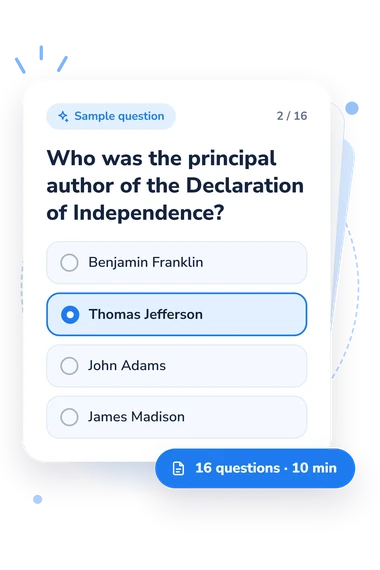
- Benjamin Franklin
- Thomas Jefferson
- John Adams
- James Madison
- The ratification of the United States Constitution
- The inauguration of the first U.S. president
- The American victory at Yorktown
- The adoption of the Declaration of Independence in 1776
- Common Sense
- The Preamble to the U.S. Constitution
- The Gettysburg Address
- The Declaration of Independence
4th of July Quiz - Description and methodology of the test
People deciding whether to test their understanding of American independence can use this 4th of July Quiz as a focused knowledge exercise. It suits a quick self-check before a class discussion, family game, or holiday activity. This July 4th quiz can reveal which facts are secure and which deserve another look.
What This Assessment Explores
The questionnaire tests factual Independence Day knowledge, not personality or opinion. It suits anyone reviewing national documents, chronology, symbols, and civic traditions through factual questions. As a Fourth of July quiz, it corrects familiar misunderstandings.
Key areas:
- Questions about the Declaration cover its purpose, authorship, adoption, and signers.
- Chronology separates the July 2 vote, July 4 adoption, later signatures, and the 1826 anniversary.
- Symbols and traditions connect the flag, fireworks, anthem, and ceremonies with Independence Day.
- Civic observances address nighttime flag display and a Sunday holiday’s federal treatment.
The 4th of July Knowledge scale runs from 0-16. Building Foundations (0-6) shows some recognition but a need to review history, symbols, and customs; Developing Knowledge (7-12) shows a solid grasp with chronology or finer-detail gaps; Strong Knowledge (13-16) shows broad, accurate knowledge of the Declaration, traditions, and July 4 history.
Methodology and Evidence Base
Each item uses selected response: a historical or practical scenario has four choices and one accurate answer. Questions mix recall with applied correction, asking respondents to recognize facts and reject plausible alternatives. The July 4 quiz tests knowledge in context rather than isolated dates.
The result is one knowledge outcome, not separate personality traits. Its bands describe familiarity with the Declaration, traditions, and history surrounding July 4 as interpretive levels.
The quiz’s historical content is consistent with the National Archives record of the founding declaration and Pahl’s 2005 discussion of the July 2 vote and July 4 adoption; neither source is presented as the questionnaire’s source instrument. Flag questions follow Title 4 of the United States Code. The 2019 study by Smith, Breakstone, and Wineburg offers a relevant assessment perspective: answers can show performance on defined historical questions, but not deep historical reasoning by themselves.
Schooling and prior exposure to U.S. history can affect performance, so the result reflects these questions rather than historical understanding in full.
- Pahl, Ronald H. “July 4, 1776: The Actual Day of the Declaration of Independence?” Social Studies, vol. 96, no. 5, 2005, pp. 214-215. 10.3200/TSSS.96.5.214-215
- Continental Congress. Declaration of Independence. July 4, 1776. National Archives, Records of the Continental and Confederation Congresses and the Constitutional Convention, Record Group 360.
- United States Congress. United States Code, Title 4, Chapter 1: The Flag. Office of the Law Revision Counsel, 2025.
- Smith, Mark, Joel Breakstone, and Sam Wineburg. “History Assessments of Thinking: A Validity Study.” Cognition and Instruction, vol. 37, no. 1, 2019, pp. 118-144. 10.1080/07370008.2018.1499646