
German States Quiz
How the Scales are Structured
Who Usually Takes This Test?
See How You Compare
Below is a preview of how scores are typically distributed across each scale.
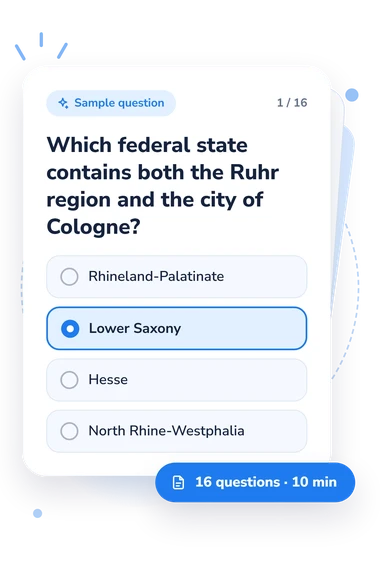
Example Questions From the Test
- Rhineland-Palatinate
- Lower Saxony
- Hesse
- North Rhine-Westphalia
- Berlin, Hamburg, and Munich
- Berlin, Bremen, and Cologne
- Bremen, Hamburg, and Hanover
- Berlin, Bremen, and Hamburg
- Leipzig — Brandenburg
- Nuremberg — Hesse
- Freiburg — Rhineland-Palatinate
- Dresden — Saxony
German States Quiz - Description and methodology of the test
For learners, travelers, and curious readers, this German States Quiz offers a focused way to check how well a mental map connects administrative facts with real places. It suits anyone who wants to use this Germany states quiz to identify gaps before studying regional geography, planning travel, or revisiting familiar knowledge. It helps readers identify which parts of Germany's federal geography need review.
What This Assessment Explores
The questions examine Germany’s 16 federal states through relationships among capitals, cities, coastlines, borders, historic places, and regional features. They show whether separate facts can be connected into a usable mental map.
Several prompts show how this Germany map quiz tests city-and-state pairings, the three city-states, capitals, borders, and clues such as the Black Forest or Baltic coastline. The key dimensions are:
- State and capital pairings show whether administrative centers are linked to the correct federal states.
- City-state recognition shows whether Berlin, Bremen, and Hamburg are identified as federal states rather than ordinary cities.
- Regional clues show whether coastlines, landmarks, and cities are connected with the state where they belong.
The result reports German States Knowledge (0-16): Foundations (0-6), Developing Knowledge (7-12), or Strong Knowledge (13-16). These bands describe quiz accuracy, not comprehensive geographic expertise.
Methodology and Evidence Base
Each item presents a prompt with four answer choices, combining recall with short geographic scenarios. Respondents identify a capital, count the federal states, match a city to its state, or infer an answer from borders and coastlines. This is a direct multiple-choice knowledge assessment.
Scoring yields one total for the 16 responses, and the displayed band translates that result into a concise description of performance. This assessment is a states of Germany quiz with descriptive, non-norm-referenced feedback: it does not compare the reader with a norm group.
Buse (2005) provides the closest content reference for Germany’s regions and political geography. Gunlicks (2003) adds context for the federal states and federalism, while Abendroth and Böhme (2000) provide regional and political detail for Hesse. The questionnaire is conceptually consistent with these works, but it is not an adaptation of them.
Results can shift with memory, place-name familiarity, attention, or guessing, so use them to guide review and self-reflection.
- Buse, Dieter K. The Regions of Germany: A Reference Guide to History and Culture. Greenwood Press, 2005. ISBN 978-0-313-32400-0.
- Abendroth, Elisabeth, and Klaus Böhme. “Hesse.” In Hans-Georg Wehling (ed.), The German States: History, Politics, Economics, 1st ed., pp. 127-141. VS Verlag für Sozialwissenschaften, 2000. DOI 10.1007/978-3-322-93230-3.
- Gunlicks, Arthur. The Länder and German Federalism. Manchester University Press, 2003. DOI 10.7228/manchester/9780719065323.001.0001.