
Do I Have Mono Quiz
How the Scales are Structured
Who Usually Takes This Test?
See How You Compare
Below is a preview of how scores are typically distributed across each scale.
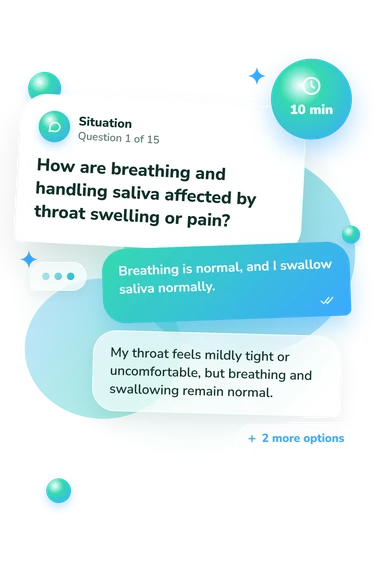
Example Questions From the Test
- Four to seven days.
- More than a week, or it improved and then became worse again.
- I do not currently have a cluster of illness symptoms.
- One to three days.
- One change was slight and short-lived.
- I have not noticed any of these changes.
- One or more changes are clear, persistent, or occurring together.
- One change has happened more than once during this illness.
- They are intense, persistent, or keep me from basic activities.
- They have been mild and occasional.
- They recur or make me stop some normal activities.
- I have not experienced these symptoms.
Do I Have Mono Quiz - Description and methodology of the test
For anyone wondering whether fatigue, fever, throat changes, or swollen lymph nodes fit an illness pattern, the Do I Have Mono Quiz helps organize symptoms before deciding what to do. It is intended for people reflecting on a current illness, not for confirming an infection. Used as a how to know if you have mono quiz, it highlights patterns and warning signs that may deserve clinical attention.
What This Assessment Explores
The questionnaire organizes symptoms that can accompany infectious mononucleosis while flagging experiences that may need prompt or urgent care. It suits a current or recent illness involving fatigue, fever, sore throat, swollen lymph nodes, appetite change, rash, reduced hydration, or reduced daily function. The result shows endorsed domains rather than identifying the cause. This mono quiz also highlights breathing, swallowing, abdominal or left-shoulder discomfort, alertness, and hydration.
The three displayed scales are:
- Systemic Illness Pattern (0-15) reflects whole-body symptoms; its bands are No indicator endorsed (0), Indicator present (1-2), and Action warranted (3-15).
- Throat and Lymph Signs (0-15) reflects throat, lymph-node, and skin changes; its bands are No indicator endorsed (0), Indicator present (1-2), and Action warranted (3-15).
- Urgent Complication Signs (0-15) reflects listed warning experiences; its bands are No indicator endorsed (0), Indicator present (1-2), and Action warranted (3-15).
Methodology and Scientific Basis
Each item is a self-report question with four response options spanning no noticeable change, mild or recurring symptoms, functional impact, and severe or urgent experiences. The prompts distinguish duration, intensity, and effects on eating, drinking, alertness, and daily activity, making this structured symptom reflection rather than a laboratory or clinician-administered assessment.
Responses are grouped into three displayed 0-15 summaries. The bands are reflective, not validated diagnostic, severity, or clinical cutoffs; a concerning answer can matter even when the total is low. As a flu or mono quiz, the assessment organizes overlapping symptoms, but symptoms alone cannot confirm infectious mononucleosis or exclude other illnesses.
Clinical framing is conceptually consistent with Ebell et al. (2016); Hoagland (1960) provides context for common manifestations, while Sylvester et al. (2019) and Wolfe and Rowe (1980) support attention to splenic and upper-airway complications. The questionnaire is an online self-report tool, not a standardized diagnostic instrument. As a do you have mono quiz, it should prompt medical help for breathing difficulty, inability to swallow saliva, confusion, fainting, severe upper-left abdominal or left-shoulder pain, or inability to keep fluids down, regardless of the total.
- Ebell MH, Call M, Shinholser J, Gardner J. Does This Patient Have Infectious Mononucleosis? The Rational Clinical Examination Systematic Review. JAMA. 2016;315(14):1502-1509. 10.1001/jama.2016.2111
- Hoagland RJ. The clinical manifestations of infectious mononucleosis: a report of two hundred cases. The American Journal of the Medical Sciences. 1960;240:55-63. 10.1097/00000441-196007000-00003
- Sylvester JE, Buchanan BK, Paradise SL, Yauger JJ, Beutler AI. Association of Splenic Rupture and Infectious Mononucleosis: A Retrospective Analysis and Review of Return-to-Play Recommendations. Sports Health. 2019;11(6):543-549. 10.1177/1941738119873665
- Wolfe JA, Rowe LD. Upper airway obstruction in infectious mononucleosis. Annals of Otology, Rhinology & Laryngology. 1980;89(5 Pt 1):430-433. 10.1177/000348948008900511