
Addition Quiz
How the Scales are Structured
Who Usually Takes This Test?
See How You Compare
Below is a preview of how scores are typically distributed across each scale.
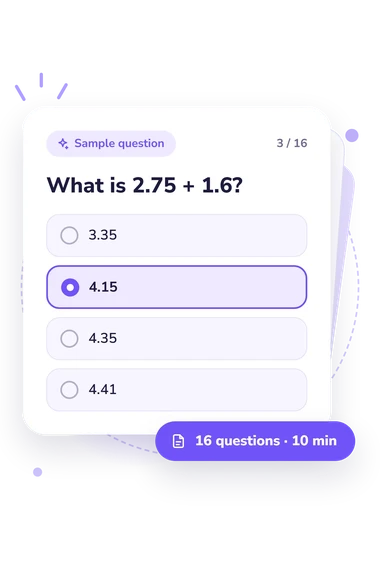
Example Questions From the Test
- 500
- 800
- 700
- 600
- (25 + 16) + 4 = 45
- 25 + 20 = 45
- (25 + 4) + 16 = 45
- 25 + (16 − 4) = 37
- 35
- 15
- 35
- 41
Addition Quiz - Description and methodology of the test
Students, parents, tutors, and adult learners who want to examine calculation skills can use this addition quiz to see how accurately and flexibly learners apply addition across the sampled concepts. It suits someone choosing what to practise next, checking a learner’s understanding, or reviewing concepts before more advanced work. For learners adding quiz practice to their routine, this focused format offers an educational snapshot rather than a broad mathematics profile.
What This Assessment Measures
These items go beyond rapid recall. They ask respondents to use whole numbers, money, decimals, fractions, signed numbers, and everyday contexts while choosing a result or method. The focus suits learners identifying secure skills and useful practice. As an addition practice quiz, it gives tutors and parents concrete topics to discuss.
The main thematic groups are:
- Foundational fluency shows whether basic facts, missing addends, and simple combinations are handled accurately.
- Place-value reasoning shows how the learner manages multidigit addition, regrouping, decomposition, and estimation.
- Flexible application shows whether addition remains meaningful across properties, checking strategies, money, decimals, fractions, signed numbers, and word problems.
Results appear on the Addition Knowledge scale (0-16): Foundations to build (0-6), Developing command (7-12), and Strong command (13-16). This is a snapshot of performance across the sampled concepts and points toward practice needs.
Methodology and Evidence Base
The response format is selected choice: each item offers four alternatives, including distractors that may reflect common calculation or interpretation errors. Only one overall result is displayed, so read it alongside the individual skills sampled-such as estimation, fractions, decimals, signed numbers, and checking strategies-rather than as separate topic scores.
Its design is conceptually consistent with the CPF-MA assessment (Hopkins et al., 2025), which treats addition as flexible reasoning rather than procedure alone. It is not presented as an adaptation of that published assessment. Used as an addition skills quiz, it also fits the broader emphasis on connected mathematical understanding described by Fuson et al. (1997) and the National Research Council (2001), especially accuracy, conceptual meaning, fluency, and strategy choice.
The bands are educational labels for this quiz, and the result should be read as a snapshot of performance on the sampled concepts. Performance can vary with prior teaching, attention, language, and guessing, and a single score cannot capture broader mathematical understanding. Use the outcome to guide review, then check progress through explanations and varied problems.
- Hopkins, Sarah, James Russo, and Ann Downton. “Assessing Children’s Capacity for Procedural Flexibility with Mental Addition.” Mathematics Education Research Journal 37 (2025): 773-795. 10.1007/s13394-024-00513-0
- Fuson, Karen C., Diana Wearne, James C. Hiebert, Hanlie G. Murray, Pieter G. Human, Alwyn I. Olivier, Thomas P. Carpenter, and Elizabeth Fennema. “Children’s Conceptual Structures for Multidigit Numbers and Methods of Multidigit Addition and Subtraction.” Journal for Research in Mathematics Education 28, no. 2 (1997): 130-162. 10.2307/749759
- National Research Council. Adding It Up: Helping Children Learn Mathematics. Washington, DC: The National Academies Press, 2001. 10.17226/9822