
Guess the Game Quiz
How the Scales are Structured
Who Usually Takes This Test?
See How You Compare
Below is a preview of how scores are typically distributed across each scale.
Example Questions From the Test
- Red Dead Redemption 2
- Red Dead Redemption
- Call of Juarez: Gunslinger
- Gun
- Terraria
- Minecraft
- Dragon Quest Builders 2
- Roblox
- The Last of Us
- Days Gone
- Dying Light
- The Walking Dead
Guess the Game Quiz - Description and methodology of the test
For players who enjoy testing memory across blockbuster releases and familiar classics, the Guess the Game Quiz offers a focused way to check how accurately you connect a clue with a title. It suits casual players, longtime fans, and anyone curious about the breadth of their game knowledge. As a name the game quiz, it turns recognition into a clear result you can use for reflection.
What This Test Measures
The questions measure recognition rather than gameplay skill. Each clue identifies a title through characters, story events, settings, mechanics, genre conventions, or signature features. The format suits casual players and regular gamers who want to see how broad their knowledge of popular and familiar games is. It is a video game knowledge test: success depends on retrieving the right title from concrete details, not on completing an in-game task.
Results are reported on one scale, Guess the Game Knowledge (0-16), with these bands:
- Opening Round (0-6) indicates that major gaming ideas may be familiar while less familiar genres or detailed clues remain challenging.
- Clue Chaser (7-12) indicates solid knowledge and an ability to connect many characters, settings, and mechanics with the correct titles.
- Game Spotter (13-16) indicates wide-ranging familiarity and precise recognition when several clues point toward the same game.
Methodology and Evidence Base
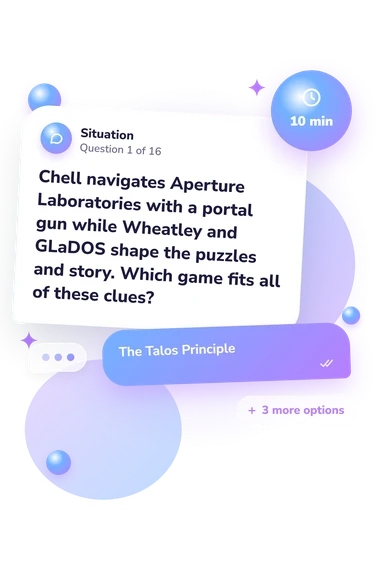
Each item is a multiple-choice recognition task: a clue is followed by four titles, and the respondent chooses the best match. The sample spans action, puzzle, role-playing, simulation, strategy, social deduction, sports, racing, and mobile play, sampling broad familiarity rather than one specialist niche.
The conceptual reference point is the Commercial Video Game Knowledge Metric (Klecka et al., 2021), which assesses recognition of characters, consoles, genres, and popular titles. This questionnaire is conceptually consistent with that work, not an adaptation of its published measure. A game identification quiz of this kind tests title recognition, not technical skill, competitive rank, hours played, or genre-specific expertise.
Latham, Patston, and Tippett (2013) show that genres make different demands and that playing history alone does not establish expertise. Elliott et al. (2020) likewise found that self-ratings did not reliably match expert evaluations of actual play.
The questionnaire reports a descriptive band but has no documented norm-based interpretation, reliability estimate, weighting method, or item-to-score rule; the result describes recognition within this set of clues rather than a population standing. Exposure to particular titles, eras, platforms, memory, and current attention can influence performance, so the result is a snapshot of recognition.
- Klecka, Hanna, Ian Johnston, Nicholas David Bowman, and C. Shawn Green. (2021). Researchers’ commercial video game knowledge associated with differences in beliefs about the impact of gaming on human behavior. Entertainment Computing, 38, Article 100406. 10.1016/j.entcom.2021.100406
- Latham, Andrew J., Lucy L. M. Patston, and Lynette J. Tippett. (2013). Just how expert are “expert” video-game players? Assessing the experience and expertise of video-game players across “action” video-game genres. Frontiers in Psychology, 4, Article 941. 10.3389/fpsyg.2013.00941
- Elliott, Lisa Jo, Tyler Hampton, Jessica McCoy, Kathryn Kriebs, Melissa Rowlison, Autumn Waite, and Abigail Blackwell. (2020). Quantifying video gaming expertise. In Advances in Human Factors in Training, Education, and Learning Sciences - Proceedings of the AHFE 2020 Virtual Conference on Human Factors in Training, Education, and Learning Sciences, 1211, 198-203. Springer. 10.1007/978-3-030-50896-8_30
Updated: