
Creativity Quiz
How the Scales are Structured
Who Usually Takes This Test?
See How You Compare
Below is a preview of how scores are typically distributed across each scale.
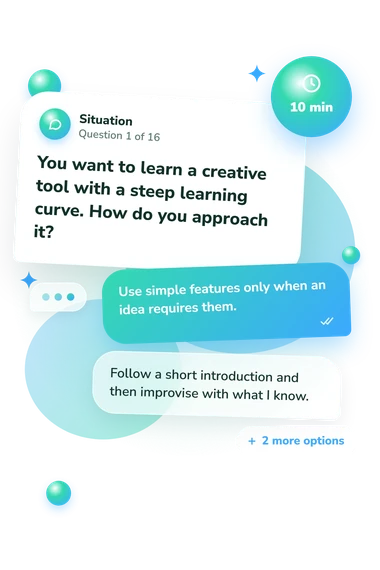
Example Questions From the Test
- Use simple features only when an idea requires them.
- Follow a short introduction and then improvise with what I know.
- Practice a set of core techniques through small projects.
- Study the tool systematically and repeat difficult techniques until they become reliable.
- Choose the direction that best meets the original requirements.
- Compare both options against a practical list of strengths and constraints.
- Look for a workable hybrid that preserves an important element from each.
- Guide a conversation that uncovers the deeper intention behind each option and inspires a shared third direction.
- Putting it in front of people quickly to spark a response.
- Clarifying the central idea so its purpose is easy to recognize.
- Reworking the sections that weaken the whole.
- Adjusting fine details until every element feels deliberate.
Creativity Quiz - Description and methodology of the test
People who want to understand their creative process can use this creativity quiz to examine the choices they make when ideas are forming, changing, and becoming finished work. It is for anyone seeking a profile of creative tendencies rather than a single talent label. This profile addresses the am I creative quiz question by showing which creative approaches feel natural across situations rather than assigning tendencies to project stages.
What This Assessment Explores
The result treats creativity as preferences in collaboration, novelty, refinement, and meaning. This questionnaire answers the how creative am I quiz question by showing which approaches feel natural across situations, not by reducing creativity to one ability.
The four result dimensions are:
- The Catalyst (0-12) reflects shared momentum: Independent Contributor (0-4) favors control, Responsive Collaborator (5-8) integrates input, and Creative Catalyst (9-12) energizes groups.
- The Craftsperson (0-12) reflects refinement: Rapid Shaper (0-4) generates quickly, Practical Maker (5-8) revises selectively, and Dedicated Craftsperson (9-12) pursues finish.
- The Explorer (0-12) reflects discovery: Grounded Selector (0-4) stays focused, Curious Adapter (5-8) tests novelty, and Possibility Explorer (9-12) follows curiosity.
- The Storyteller (0-12) reflects meaning: Direct Communicator (0-4) favors function, Meaning Maker (5-8) uses mood, and Expressive Storyteller (9-12) centers resonance.
Your highest outcome is your strongest affinity; scores within one point indicate a blended creative type.
Methodology and Scientific Basis
Each item presents a concrete creative situation with four possible approaches. The options represent practical clarity, collaboration, experimentation, emotional meaning, and technical refinement. There is no correct choice: selections indicate preferences, and the result is presented through four displayed scales.
Its structure is conceptually consistent with the Creativity Styles Questionnaire-Revised (Kumar et al., 1997), which distinguishes styles of engaging with creative work. It is also compatible with Lack, Kumar, and Arevalo (2003), while Runco and Jaeger (2012) connect creativity with originality and effectiveness. The questionnaire is conceptually consistent with these sources, especially their attention to creative styles, originality, effectiveness, and ways of engaging with creative work.
This questionnaire answers the how creative are you quiz question through relative affinities rather than a fixed talent label. The displayed bands describe categories of affinity rather than clinical cutoffs. Because answers depend on self-perception and current context, the profile’s answer to the question posed by the are you creative quiz is best read as a reflective snapshot of how you may collaborate, explore, refine, or communicate.
- Kumar, V. K., Kemmler, Debra, & Holman, E. Riley. (1997). The Creativity Styles Questionnaire--Revised. Creativity Research Journal, 10(1), 51-58. 10.1207/s15326934crj1001_6
- Lack, Susanna A., Kumar, V. K., & Arevalo, Salvador. (2003). Fantasy Proneness, Creative Capacity, and Styles of Creativity. Perceptual and Motor Skills, 96(1), 19-24. 10.2466/pms.2003.96.1.19
- Runco, Mark A., & Jaeger, Garrett J. (2012). The Standard Definition of Creativity. Creativity Research Journal, 24(1), 92-96. 10.1080/10400419.2012.650092