
Logan Ury Quiz
How the Scales are Structured
Who Usually Takes This Test?
See How You Compare
Below is a preview of how scores are typically distributed across each scale.
Example Questions From the Test
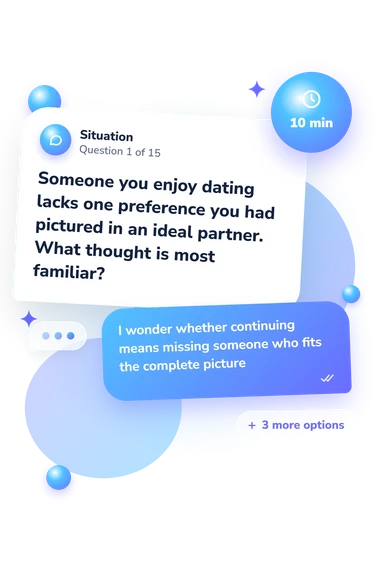
- I wonder whether continuing means missing someone who fits the complete picture
- I compare the missing quality with the person’s strengths before deciding what it means
- I consider whether the preference affects my core needs, then try to stop comparing
- If my central needs are met, I am comfortable letting the original preference go
- Very likely; I tend to notice alternatives and mentally compare what they might offer
- Somewhat likely, especially when I encounter someone who appears strong on a valued trait
- Occasionally, but I usually return my attention to the relationship I chose
- Rarely; once the important criteria are met, I prefer to invest in the choice
- Several parts of my life need to be settled before dating makes sense
- I need at least one major unresolved goal to be completed first
- I prefer some basic stability, but I do not need every concern resolved
- I can date amid ordinary uncertainty if I have enough time and genuine interest
Logan Ury Quiz - Description and methodology of the test
People who feel uncertain about their romantic decisions can use the Logan Ury Quiz to reflect on what may be influencing their choices. This dating tendencies quiz is intended for self-reflection, especially when you want to understand what may be shaping your choices. The result identifies your strongest affinity or a blended profile. The result gives you a concise profile to reflect on.
What This Assessment Explores
Questions examine dating judgments rather than relationship satisfaction after commitment. They cover delayed readiness, comparison among alternatives, and expectations that meaningful connection should feel natural or immediate. The Logan Ury dating quiz suits readers reflecting on how standards and romantic ideals influence action.
The three displayed outcomes describe these dimensions:
- Hesitater (0-15) reflects delaying dating until milestones feel complete: 0-5 Ready-enough mindset, 6-10 Conditional readiness, 11-15 Strong Hesitater affinity.
- Maximizer (0-15) reflects comparing options or revisiting choices: 0-5 Satisficing approach, 6-10 Selective comparison, 11-15 Strong Maximizer affinity.
- Romanticizer (0-15) reflects expecting natural or immediate chemistry: 0-5 Deliberate approach, 6-10 Mixed affinity, 11-15 Strong Romanticizer affinity.
The highest total marks the strongest affinity; every outcome within one point of the highest score belongs to the blended profile. The result describes current tendencies, not fixed readiness, standards, or relationship potential.
Methodology and Evidence Base
Each item presents a dating situation with four response choices. The alternatives express different positions on readiness, comparison, and spontaneous chemistry, turning self-reported preferences into three outcome totals. The exact point contribution of each answer is not specified, so interpret the scores through the displayed ranges rather than infer a scoring formula.
As a self-report questionnaire about dating decisions, it captures stated preferences rather than observed behavior or a clinical interview.
Conceptually, the structure is consistent with Three Dating Tendencies (Ury, 2021). Its comparison theme connects with Schwartz’s maximization framework, while natural and effortful relationship beliefs are consistent with implicit relationship theories discussed by Knee (1998) and Knee and Canevello (2006). These sources clarify the themes; the online questionnaire is not an adaptation or standardized administration of any one of them.
Interpretation is comparative: the highest total is the leading affinity, and every outcome within one point of the highest score belongs to the blended profile. Because responses reflect current self-perception, results may shift with context and response bias; use them to examine patterns, not as a clinical conclusion.
- Ury, Logan. How to Not Die Alone: The Surprising Science That Will Help You Find Love. Simon & Schuster, 2021.
- Knee, C. Raymond. "Implicit Theories of Relationships: Assessment and Prediction of Romantic Relationship Initiation, Coping, and Longevity." Journal of Personality and Social Psychology, 74(2), 360-370, 1998. 10.1037/0022-3514.74.2.360
- Schwartz, Barry. The Paradox of Choice: Why More Is Less: How the Culture of Abundance Robs Us of Satisfaction. Ecco, 2004.
- Knee, C. Raymond, and Amy Canevello. "Implicit Theories of Relationships and Coping in Romantic Relationships." In Self and Relationships: Connecting Intrapersonal and Interpersonal Processes, edited by Kathleen D. Vohs and Eli J. Finkel, 160-176. Guilford Press, 2006.