
College Football Teams Quiz
How the Scales are Structured
Who Usually Takes This Test?
See How You Compare
Below is a preview of how scores are typically distributed across each scale.
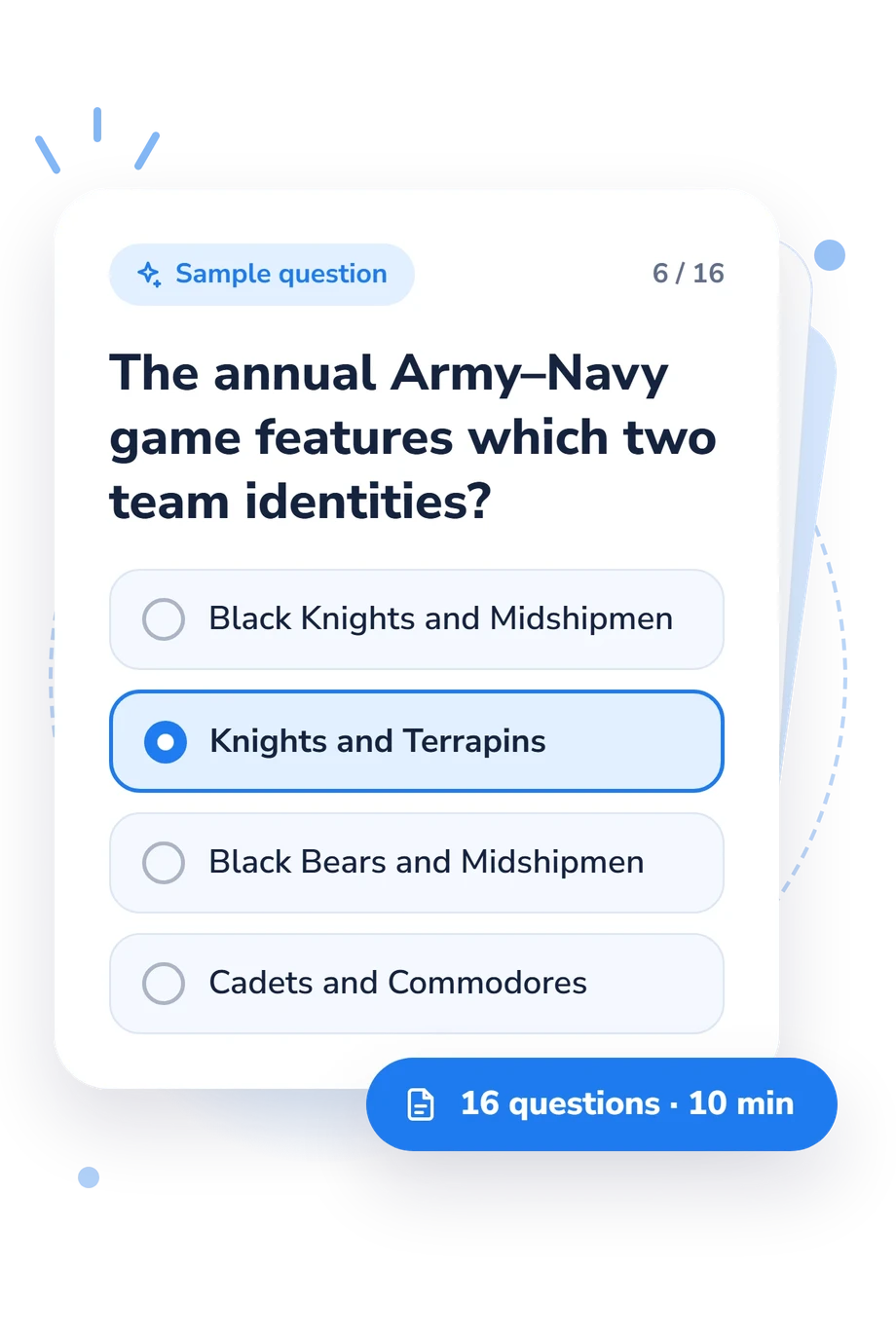
Example Questions From the Test
- Memphis Tigers
- Missouri Tigers
- Clemson Tigers
- LSU Tigers
- Wisconsin Badgers
- Iowa Hawkeyes
- Nebraska Cornhuskers
- Illinois Fighting Illini
- Arkansas
- Georgia
- Auburn
- Alabama
College Football Teams Quiz - Description and methodology of the test
For readers who want a focused way to check their knowledge of major college programs, the college football teams quiz turns familiar names, venues, traditions, and rivalries into a practical fan-oriented challenge. The recognition format makes this an ncaa football teams quiz: fans identify programs from cultural clues rather than calculate statistics. The result places performance on the selected questions within an overall level of college football knowledge.
What This Assessment Measures
The questionnaire measures recognition rather than game statistics. Clues connect schools with stadiums, nicknames, traditions, and rivalry names, showing how readily a respondent identifies a program from a distinctive marker. As an fbs teams quiz, the selected programs test familiarity with college football identities.
These themes organize the questions:
- Team identities show whether you match a school with its football program.
- Venues indicate whether stadium settings lead you to the home team.
- Traditions and nicknames reveal how you connect rituals and team labels with a school.
- Rivalries measure whether established names lead you to the correct pairing.
Together, they feed the College Football Teams Knowledge scale (0-16). Foundation Forming (0-6) signals emerging familiarity; Developing Fan Knowledge (7-12) shows many recognized programs; Standout Team Knowledge (13-16) signals strong command of the covered clues.
Methodology and Evidence Base
Each item presents a short scenario or recognizable clue followed by four answer choices. The respondent selects the program that best fits, and the result reflects performance on the correct-answer set across the questions. This format tests retrieval and association, not coaching knowledge or statistical forecasting.
Quirk (2004) provides a reference point for team identities and major college football coverage. Beck and Wilkinson (2013) support the traditions focus, Stewart (2000) the stadium context, and Quintanar et al. (2015) the importance of rivalry.
Together, these works provide context for the teams, traditions, stadiums, and rivalries represented in the questions. The questionnaire is an informal, catalogue-specific knowledge quiz covering the selected questions, so its result describes performance on this bounded set rather than complete expertise across college football.
Read the result as performance on this selected set of NCAA teams. In an ncaa teams quiz such as this one, regional exposure, fan experience, memory, and guessing can affect recognition, so the result is best read as an informal snapshot of this selected coverage.
- Quirk, James. The Ultimate Guide to College Football: Rankings, Records, and Scores of the Major Teams and Conferences. Urbana: University of Illinois Press, 2004. ISBN 978-0-252-07226-0.
- Beck, Stan, and Jack Wilkinson. College Sports Traditions: Picking Up Butch, Silent Night, and Hundreds of Others. Lanham, MD: Scarecrow Press, 2013. ISBN 978-0-8108-9120-3.
- Stewart, Alva W. College Football Stadiums: An Illustrated Guide to NCAA Division I-A. Jefferson, NC: McFarland, 2000. ISBN 978-0-7864-0902-0.
- Quintanar, Sarah Marx, Cary Deck, Javier A. Reyes, and Sudipta Sarangi. "You Are Close to Your Rival and Everybody Hates a Winner: A Study of Rivalry in College Football." Economic Inquiry 53, no. 4 (2015): 1908-1918. DOI 10.1111/ecin.12215.
Updated: