
Waifu Quiz
How the Scales are Structured
Who Usually Takes This Test?
See How You Compare
Below is a preview of how scores are typically distributed across each scale.
Example Questions From the Test
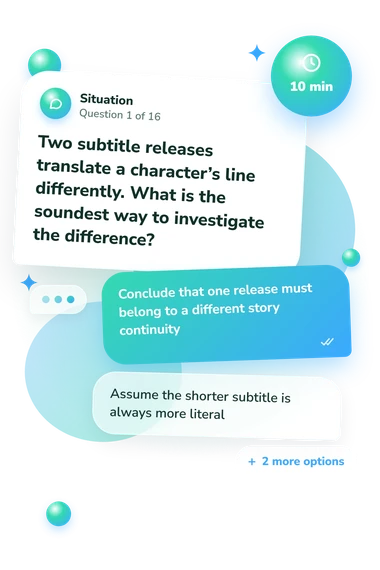
- Conclude that one release must belong to a different story continuity
- Assume the shorter subtitle is always more literal
- Treat the most popular fan wording as the only canonical translation
- Compare the original dialogue and context with reliable translations or localization notes
- Crediting the artist always grants permission to repost
- Fan art may always be reposted because it depicts an existing character
- Credit and permission are different, so you should check the artist’s stated terms or ask
- Changing the crop automatically makes the repost a new original work
- Only the official poll reflects any genuine fan preference
- The official poll determines which character every participant must prefer
- The fan poll becomes official if it receives more votes
- Both measure responses from their own participants, but only one is publisher-organized
Waifu Quiz - Description and methodology of the test
People who enjoy anime and gaming fandoms can use this waifu quiz to examine how confidently they distinguish canon from interpretation, recognize common character archetypes, and evaluate claims about fan culture. It is useful for readers approaching a quiz about anime and waifu culture with curiosity about terminology, source authority, and respectful participation. The result offers a structured snapshot of fandom knowledge rather than a label for personal taste or attachment.
What This Assessment Explores
This assessment examines practical fandom knowledge rather than romantic preference. Items distinguish canon from headcanon, recognize kuudere, yandere, and tsundere, separate characters from voice performers, and clarify official, fan-made, and licensed material. It can interest anyone asking who your waifu is, but its result tests evidence-based understanding.
The content groups into four areas:
- Fandom vocabulary shows whether the respondent uses waifu, shipping, headcanon, and canon accurately.
- Archetypes show whether recurring patterns such as kuudere, yandere, and tsundere are recognized in context.
- Source evaluation tests how the respondent weighs original works, adaptations, official profiles, databases, and products.
- Participation covers permission, spoiler care, and the distinction between meaningful personal attachment and fictional reciprocity.
Waifu Culture Knowledge (0-16) reports Foundation (0-6) for mixed core ideas, Developing (7-12) for familiar terms needing sharper distinctions, and Strong (13-16) for broad, careful knowledge and responsible participation.
Methodology and Scientific Basis
Each item presents a short situation with four answer choices, asking for the most accurate response. Scenarios cover translation differences, reposting art, adaptation changes, canon disputes, polls, licensing, spoilers, archetype labels, and the boundary between personal attachment and fictional reciprocity. The format checks applied understanding rather than self-rated familiarity.
Responses are summarized into the displayed total for one scale; no separate personality profile is claimed. Read the result as current knowledge that can guide review of terminology, source hierarchy, licensing, and fan etiquette. It does not determine who your anime waifu is; it describes how consistently the concepts are handled.
The approach is conceptually consistent with Guo and Zeng (2020), alongside Reysen et al. (2021) on anime-fan psychology and Jenkins (1992) on participatory culture. Copyright items use the attribution-permission distinction described by the U.S. Copyright Office (2021).
The questionnaire is an original online self-reflection tool, not a standardized adaptation or normed diagnostic instrument. Guessing, prior fandom experience, current interests, response bias, and self-awareness can affect scores, while disputed canon may require closer source checking.
- Guo, Chiquan, and Chengyan Zeng. Anime and Manga Fandom in the 21st Century: A Close-Up View. In Handbook of Research on the Impact of Fandom in Society and Consumerism, edited by Cheng Lu Wang, pp. 480-496. IGI Global, 2020. 10.4018/978-1-7998-1048-3.ch023
- Reysen, Stephen, Courtney N. Plante, Daniel Chadborn, Sharon E. Roberts, and Kathleen C. Gerbasi. Transported to Another World: The Psychology of Anime Fans. International Anime Research Project, 2021. ISBN 978-0-9976288-1-4
- Jenkins, Henry. Textual Poachers: Television Fans & Participatory Culture. Routledge, 1992. ISBN 978-0-415-90572-5
- U.S. Copyright Office. Copyright Basics, Circular 1. Revised September 2021.