
Veins and Arteries Quiz
How the Scales are Structured
Who Usually Takes This Test?
See How You Compare
Below is a preview of how scores are typically distributed across each scale.
Example Questions From the Test
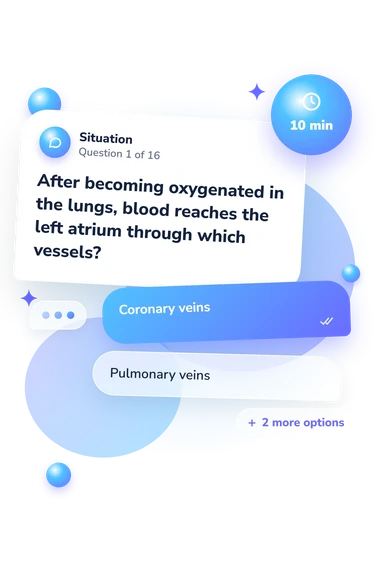
- Coronary veins
- Pulmonary veins
- The superior and inferior venae cavae
- Pulmonary arteries
- Carotid arteries
- Venae cavae
- Jugular veins
- Pulmonary veins
- Pulmonary veins
- The aorta
- The venae cavae
- Pulmonary arteries
Veins and Arteries Quiz - Description and methodology of the test
Learners reviewing human anatomy can use this assessment to connect vessel names with the routes and forces that move blood. The veins and arteries quiz is intended for students and independent learners who want to check whether they understand rather than merely remember circulation facts. The questions make it a veins quiz focused on vessel names, circulation routes, and functions.
What This Assessment Explores
These anatomy quiz questions measure how veins and arteries are named, arranged, and used in pulmonary and systemic circulation. They cover major vessels, oxygenation exceptions, pathway tracing, and links between structure and function. The result therefore reflects connected understanding rather than isolated label recall.
For learners, the text-based questions provide vessel identification and anatomy review in a quiz about veins of the body rather than diagrammatic labeling.
Three content areas shape the result:
- Vessel direction and naming show whether vessels connect to the correct heart chamber, organ, or body region.
- Circulation routes and oxygenation show whether pulmonary and systemic pathways are distinguished accurately.
- Structure and pressure show how wall thickness, compliance, smooth muscle, valves, resistance, and calf-muscle assistance affect flow.
The score can help identify areas for reviewing venous and arterial concepts. It describes performance on these topics, not overall competence.
Methodology and Scientific Basis
Each item offers four options and asks for an anatomy or physiology explanation. Its arteries and veins labeling quiz items cover vessel identification, pathways, resistance, compliance, pulse, obstruction, and venous valves. The result is a knowledge scale, not separate subscores.
The question content is conceptually consistent with the vessel anatomy described by Tucker et al. (2023): arteries carry blood away from the heart, veins return it, pulmonary vessels create oxygenation exceptions, and vessel walls and valves have distinct functions. The questionnaire is not an adaptation of that account. Betts et al. and Drake, Vogl, and Mitchell provide supporting anatomy and physiology context; Guyton et al. (1957) adds context for venous return and right-atrial pressure.
Results appear as Veins and Arteries Knowledge: 0-16, with Foundation to build (0-6), Developing knowledge (7-12), and Strong knowledge (13-16). The catalogue presents these as score classifications; no population comparison is provided. The result can guide review of vessel names and routes throughout the body, but guessing, recent study, and wording familiarity can affect the score. It does not assess hands-on identification or clinical decision-making.
- Tucker, William D., Yingyot Arora, and Kunal Mahajan. “Anatomy, Blood Vessels.” In StatPearls [Internet]. Treasure Island, FL: StatPearls Publishing; updated August 8, 2023. PMID: 29262226.
- Betts, J. Gordon, Kelly A. Young, James A. Wise, Eddie Johnson, Brandon Poe, Dean H. Kruse, Oksana Korol, Jody E. Johnson, Mark Womble, and Peter DeSaix. Anatomy and Physiology 2e. Houston, TX: OpenStax, 2022.
- Guyton, Arthur C., Arthur W. Lindsey, Berry Abernathy, and Travis Richardson. “Venous Return at Various Right Atrial Pressures and the Normal Venous Return Curve.” American Journal of Physiology 189, no. 3 (1957): 609-615. 10.1152/ajplegacy.1957.189.3.609
- Drake, Richard L., A. Wayne Vogl, and Adam W. M. Mitchell. Gray’s Anatomy for Students. 4th ed. Philadelphia, PA: Elsevier, 2019.
Updated: