
1st Grade Quiz Questions
How the Scales are Structured
Who Usually Takes This Test?
See How You Compare
Below is a preview of how scores are typically distributed across each scale.
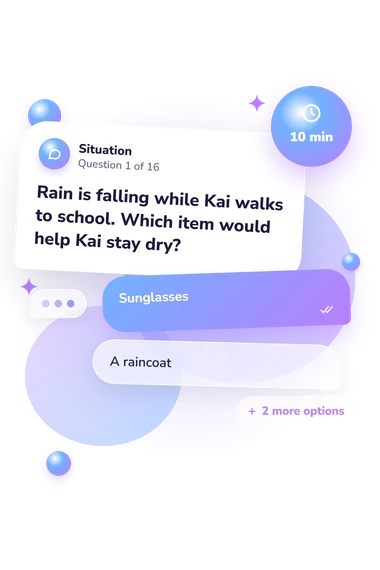
Example Questions From the Test
- Sunglasses
- A raincoat
- A beach towel
- A sun hat
- 1 ten and 1 one
- 4 tens and 1 one
- 1 ten and 4 ones
- 14 tens
- Triangle
- Square
- Rectangle
- Circle
1st Grade Quiz Questions - Description and methodology of the test
For families and teachers deciding whether to use it, this set of 1st grade quiz questions and answers offers a quick view of overall knowledge shown by the selected answers. The quiz for 1st graders covers language, numbers, science, and everyday safety, helping adults decide whether this broad snapshot fits a learner’s current needs. Results describe performance on the sampled material.
What This Assessment Explores
Across these items, the assessment samples practical knowledge from early schoolwork and ordinary routines. The first grade quiz questions include number sense, simple operations, place value, shapes, calendar order, sounds and rhymes, punctuation, weather, plants, living things, and safety decisions. Together, the selected answers show overall knowledge across several domains rather than separate mastery of one subject.
The questionnaire reports one combined result for the 1st grade quiz questions on the 1st Grade Knowledge scale (0-16), rather than separate subject scores. The result is interpreted through these bands:
- Building Foundations (0-6) shows that some key ideas are familiar and extra practice with first-grade concepts may help.
- Developing Knowledge (7-12) indicates that many foundational questions were answered correctly, while a few concepts may need strengthening.
- Strong Knowledge (13-16) reflects a strong grasp of the sampled first-grade material rather than separate mastery in every school subject.
Methodology and Evidence Base
Each prompt presents an everyday question or situation with four answer choices. In this quiz for first graders, the respondent selects the option that best fits the fact, rule, or judgment being tested. The result is combined, not reported as separate scores for mathematics, language, science, or everyday safety. That format makes the questionnaire easy to follow, although attention, wording, reading support, and current context can affect performance.
The method is a brief, curriculum-linked achievement check. Its content is conceptually consistent with the WJ IV Achievement Battery and broadly corresponds to topics in Common Core mathematics and English language arts expectations, as well as the NGSS. This questionnaire is not the WJ IV, a standards test, or an adaptation of those publications.
Scoring gives a descriptive snapshot of the sampled knowledge; the bands describe performance on this questionnaire’s sampled material. The questionnaire is an educational self-check rather than a diagnostic assessment, so its result is best considered with classroom work, observation, and discussion of ideas that may need practice.
- Mather, Nancy, and Barbara J. Wendling. Woodcock-Johnson IV Tests of Achievement Examiner's Manual: Standard & Extended Batteries. Rolling Meadows, IL: Riverside Publishing, 2014.
- National Governors Association Center for Best Practices, Council of Chief State School Officers. Common Core State Standards for Mathematics. Washington, DC: National Governors Association Center for Best Practices, Council of Chief State School Officers, 2010.
- National Governors Association Center for Best Practices, Council of Chief State School Officers. Common Core State Standards for English Language Arts & Literacy in History/Social Studies, Science, and Technical Subjects. Washington, DC: National Governors Association Center for Best Practices, Council of Chief State School Officers, 2010.
- National Research Council. Next Generation Science Standards: For States, By States. Washington, DC: The National Academies Press, 2013. 10.17226/18290.